Kirjojen hintavertailu – 12 903 724 kirjaa ja 27 kauppaa
Kirjailija
Ssu-Yu Teng
Kirjat ja teokset yhdessä paikassa: 5 kirjaa, julkaisuja vuosilta 1954–2011, suosituimpiin kuuluu The Political History of China, 1840-1928. Vertaile teosten hintoja ja tarkista saatavuus suomalaisista kirjakaupoista.
Nimi esiintyy myös muodoissa: Ssu-Yü Teng, Ssu-yü Têng
The Political History Of China, 1840-1928 is a comprehensive book written by Chien-Nung, Li that delves into the political history of China during the period of 1840 to 1928. The book covers the tumultuous period of China's history that saw the country face significant challenges and changes, including the Opium Wars, the Taiping Rebellion, the Boxer Rebellion, and the fall of the Qing dynasty. The book begins by providing an overview of the political landscape of China before the 19th century and then goes on to explore the various factors that led to the country's decline and eventual collapse. It examines the impact of foreign powers, such as Britain and Japan, on China's political and economic systems and the resulting conflicts that arose. The author also delves into the various political movements that emerged during this period, including the reformist movement, the nationalist movement, and the communist movement. The book provides a detailed analysis of the various political ideologies that emerged during this period and the impact they had on China's political landscape. The book concludes by examining the events that led to the fall of the Qing dynasty and the subsequent establishment of the Republic of China in 1912. It also explores the challenges faced by the new government and the political developments that occurred in the years leading up to the establishment of the People's Republic of China in 1949. Overall, The Political History Of China, 1840-1928 is an insightful and detailed account of China's political history during a period of significant change and upheaval. It provides a valuable resource for anyone interested in understanding the political and social dynamics that shaped modern China. This scarce antiquarian book is a facsimile reprint of the old original and may contain some imperfections such as library marks and notations. Because we believe this work is culturally important, we have made it available as part of our commitment for protecting, preserving, and promoting the world's literature in affordable, high quality, modern editions, that are true to their original work.
An examination of the Nien rebellion in China, including a survey of the background and analysis of the causes of the Nien movement, as well as the history of their guerrilla tactics.
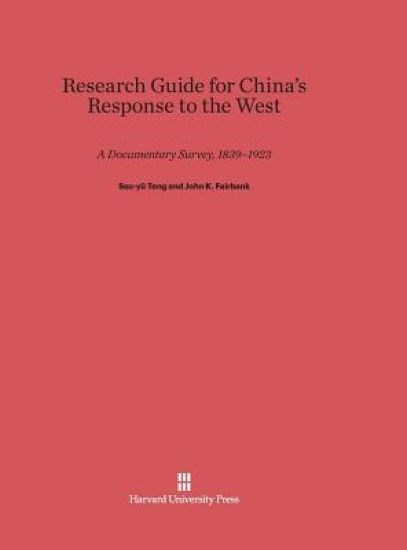
The present confrontation of Communist China and the United States, on which the future of peace in Asia hinges, is merely the latest phase in a continuing historical process--the remaking of China's ancient society under the stimulus of Western contact. How does it happen that a century of foreign trade and missionary evangelism, of modern education and the training of Chinese students in Western ways, has now resulted in a seeming rejection of the West? What has been the real nature of "China's response to the West" during the past century of our contact? This volume gives the first inside account, on so broad a scale, of how China's leaders reacted to the invasion of Western arms and goods, persons and ideas, during the three generations from the Opium War to the rise of the Kuomintang. In 28 chapters, with translations of 65 key documents, the authors trace the stages by which the scholar-officials of the Middle Kingdom were brought to recognize successively the need for Western arms to defend their country, Western technology for making arms, modern science to support technology, its application in modern industry to strengthen the nation, and all the attendant new ideas which led them eventually into great movements for institutional reform, political revolution, and ideological reconstruction. From the famous Commissioner un's first study of Western geography during his anti-opium crusade, through the efforts of Li Hungchang and others at "self-strengthening" by industrialization, down to the critical thought of Dr. Hu Shih and the eclecticism of Sun Yat-sen in the early 20th century, the writings of China's leaders ring the changes on a central theme how to remake their heritage and create a modern nation capable of meeting the West on equal terms. The provincial viceroys, the Reformers of 1898, the Boxers in 1900, the old Empress Dowager, and the eager students studying abroad, each in their own way, all grapple with this absorbing problem. The varied Chinese responses to the West in the formative century here analyzed give us a new insight into the springs of social action among one-fifth of mankind. The companion volume, for the research specialist, provides Notes and Sources, Bibliography, and a Glossary of Chinese names and terms, essential bases for further exploration of this new field.