Kirjojen hintavertailu – 12 903 725 kirjaa ja 27 kauppaa

Kirjailija

Stan Hurn

Kirjat ja teokset yhdessä paikassa: 3 kirjaa, julkaisuja vuosilta 2012–2021, suosituimpiin kuuluu Environmental Econometrics Using Stata. Vertaile teosten hintoja ja tarkista saatavuus suomalaisista kirjakaupoista.

3 kirjaa

Kirjojen julkaisuvuodet: 2012–2021.

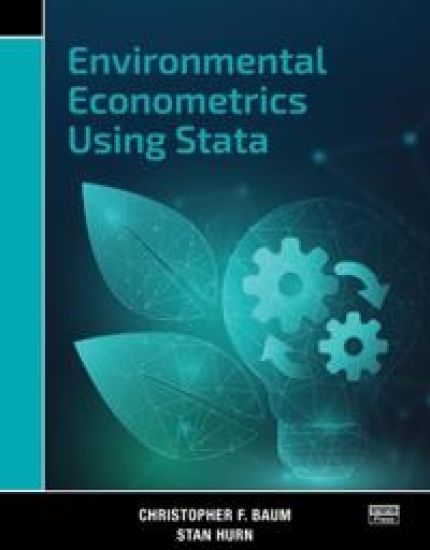
Environmental Econometrics Using Stata

Environmental Econometrics Using Stata

Christopher F. Baum; Stan Hurn

Stata Press
2021
nidottu
Aspects of environmental change are some of the greatest challenges faced by policymakers today. The key issues addressed by environmental science are often empirical, and in many instances very detailed, sizable datasets are available. Researchers in this field should have a solid understanding of the econometric tools best suited for analysis of these data. While complex and expensive physical models of the environment exist, it is becoming increasingly clear that reduced-form econometric models have an important role to play in modeling environmental phenomena. In short, successful environmental modeling does not necessarily require a structural model, but the econometric methods underlying a reduced-form approach must be competently executed. Environmental Econometrics Using Stata provides an important starting point for this journey by presenting a broad range of applied econometric techniques for environmental econometrics and illustrating how they can be applied in Stata. The emphasis is not only on how to formulate and fit models in Stata but also on the need to use a wide range of diagnostic tests in order to validate the results of estimation and subsequent policy conclusions. This focus on careful, reproducible research should be appreciated by academic and non-academic researchers who are seeking to produce credible, defensible conclusions about key issues in environmental science.
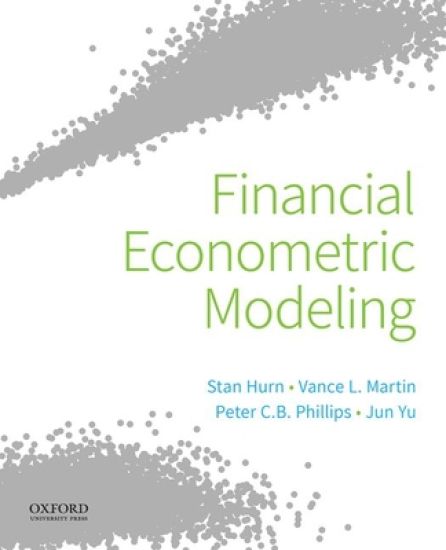
Financial Econometric Modeling

Financial Econometric Modeling

Stan Hurn; Vance L. Martin; Jun Yu; Peter C.B. Phillips

Oxford University Press Inc
2020
nidottu

Halvin toimitettuna 101,60 €

Financial econometrics brings financial theory and econometric methods together with the power of data to advance understanding of the global financial universe upon which all modern economies depend. Financial Econometric Modeling is an introductory text that meets the learning challenge of integrating theory, measurement, data, and software to understand the modern world of finance. Empirical applications with financial data play a central position in this book's exposition. Each chapter is a how-to guide that takes readers from ideas and theories through to the practical realities of modeling, interpreting, and forecasting financial data. The book reaches out to a wide audience of students, applied researchers, and industry practitioners, guiding readers of diverse backgrounds on the models, methods, and empirical practice of modern financial econometrics. Financial Econometric Modeling delivers a self-contained first course in financial econometrics, providing foundational ideas from financial theory and relevant econometric technique. From this foundation, the book covers a vast arena of modern financial econometrics that opens up empirical applications with data of the many different types that are now generated in financial markets. Every chapter follows the same principle ensuring that all results reported in the book may be reproduced using standard econometric software packages such as Stata or EViews, with a full set of data and programs provided to ensure easy implementation.
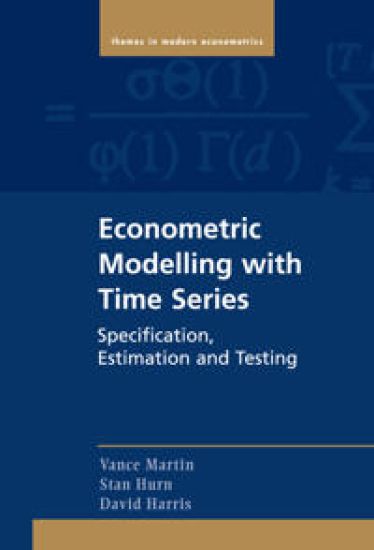
Econometric Modelling with Time Series

Econometric Modelling with Time Series

Vance Martin; Stan Hurn; David Harris

Cambridge University Press
2012
sidottu
This book provides a general framework for specifying, estimating and testing time series econometric models. Special emphasis is given to estimation by maximum likelihood, but other methods are also discussed, including quasi-maximum likelihood estimation, generalised method of moments estimation, nonparametric estimation and estimation by simulation. An important advantage of adopting the principle of maximum likelihood as the unifying framework for the book is that many of the estimators and test statistics proposed in econometrics can be derived within a likelihood framework, thereby providing a coherent vehicle for understanding their properties and interrelationships. In contrast to many existing econometric textbooks, which deal mainly with the theoretical properties of estimators and test statistics through a theorem-proof presentation, this book squarely addresses implementation to provide direct conduits between the theory and applied work.