Kirjojen hintavertailu – 12 859 828 kirjaa ja 27 kauppaa

Kirjailija

Stanley Presser

Kirjat ja teokset yhdessä paikassa: 5 kirjaa, julkaisuja vuosilta 1986–2014, suosituimpiin kuuluu Valuing Oil Spill Prevention. Vertaile teosten hintoja ja tarkista saatavuus suomalaisista kirjakaupoista.

5 kirjaa

Kirjojen julkaisuvuodet: 1986–2014.

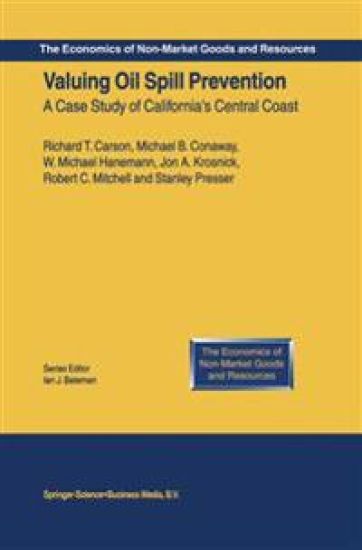
Valuing Oil Spill Prevention

Valuing Oil Spill Prevention

Richard T. Carson; Michael B. Conaway; W. Michael Hanemann; Jon A. Krosnick; Robert C. Mitchell; Stanley Presser

Springer
2014
nidottu
On April 22-23, 1988, approximately 432,000 gallons of San Joaquin Valley crude oil spilled from an aboveground storage tank at a Shell Oil Company refinery into the surrounding environment, including the northern reaches of San Francisco Bay (the Martinez spill). Pursuant to the settlement of the resulting litigation (United States/California v. Shell Oil Co., No. C89-4220, (N. D. Cal1990)), Shell Oil Company provided funding for, among other things, studies to improve future response strategies to oil spills and ensure better restoration of resources and services affected by such spills. The California Oil Spill Contingent Valuation Study was one of the studies funded by the settlement. The purpose of the California Oil Spill (COS) Contingent Valuation (CV) Study was "to execute and document a contingent valuation study of natural resource damages associated with offshore, coastal, or estuarine oil spills in California" (State of California, Department of Justice, Contract Number 89-2126). The COS CV study developed an estimate of per household ex ante economic value for a program to prevent a specified set of natural resource injuries to those species of birds and intertidal life that are consistently affected by oil spills along California's Central Coast. The principal investigators on the COS study team were Richard T. Carson of the University of California, San Diego, and W. Michael Hanemann of the University of California, Berkeley. The study's project manager was Kerry M.
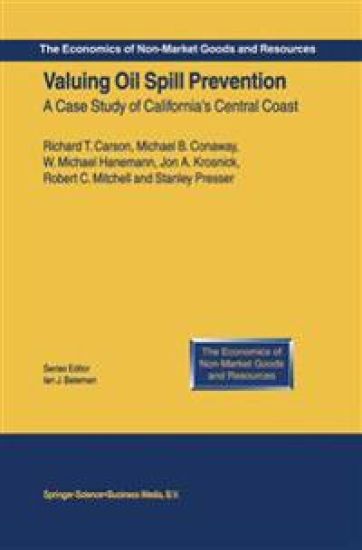
Valuing Oil Spill Prevention

Valuing Oil Spill Prevention

Richard T. Carson; Michael B. Conaway; W. Michael Hanemann; Jon A. Krosnick; Robert C. Mitchell; Stanley Presser

Springer
2004
sidottu
On April 22-23, 1988, approximately 432,000 gallons of San Joaquin Valley crude oil spilled from an aboveground storage tank at a Shell Oil Company refinery into the surrounding environment, including the northern reaches of San Francisco Bay (the Martinez spill). Pursuant to the settlement of the resulting litigation (United States/California v. Shell Oil Co., No. C89-4220, (N. D. Cal1990)), Shell Oil Company provided funding for, among other things, studies to improve future response strategies to oil spills and ensure better restoration of resources and services affected by such spills. The California Oil Spill Contingent Valuation Study was one of the studies funded by the settlement. The purpose of the California Oil Spill (COS) Contingent Valuation (CV) Study was "to execute and document a contingent valuation study of natural resource damages associated with offshore, coastal, or estuarine oil spills in California" (State of California, Department of Justice, Contract Number 89-2126). The COS CV study developed an estimate of per household ex ante economic value for a program to prevent a specified set of natural resource injuries to those species of birds and intertidal life that are consistently affected by oil spills along California's Central Coast. The principal investigators on the COS study team were Richard T. Carson of the University of California, San Diego, and W. Michael Hanemann of the University of California, Berkeley. The study's project manager was Kerry M.
Methods for Testing and Evaluating Survey Questionnaires

Methods for Testing and Evaluating Survey Questionnaires

Stanley Presser; Jennifer M. Rothgeb; Mick P. Couper; Judith T. Lessler; Elizabeth Martin; Jean Martin; Eleanor Singer

John Wiley Sons Inc
2004
nidottu
Written and painstakingly edited by leading experts, this volume offers a state-of-the-art overview of and solid foundation in up-to-date survey questionnaire issues, concerns, and responses. Like several other books in the Wiley Series in Survey Methodology, this work has been prepared in conjunction with an international conference on the topic (in November 2002) by the Survey Research Methods Section of the American Statistical Association, the American Association for Public Opinion Research, the International Association of Survey Statisticians, the Council of American Survey Research Organizations, and the Council of Marketing and Opinion Research. The book covers cognitive interviewing, interaction analysis, response latency, respondent debriefings, vignette analysis, split-sample comparisons, statistical modeling, mode of administration, and special populations. It also considers these topics in light of emerging techniques and technologies. The book’s authors include more than two-dozen eminent professionals in a variety of fields related to survey methodology and questionnaire development, including names such as Gordon Willis of the National Cancer Insitute; Paul Beatty of the National Center for Health Statistics; Paul Biemerof the Research Triangle Institute; Don Dillman of the University of Washington; and Natacha Borgers, Edith de Leuuw, and Astrid Smits of Statistics Netherlands. Copious tables, figures, and references, as well as an extensive glossary, supplement the high quality discussion throughout the text.
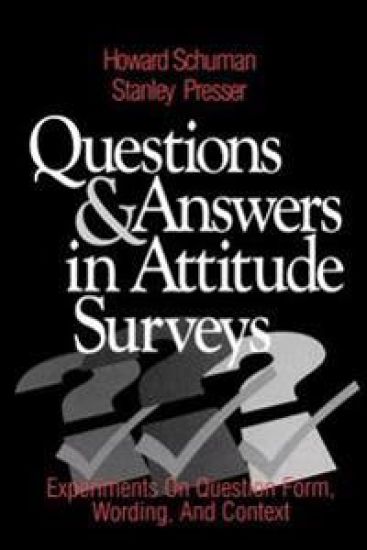
Questions and Answers in Attitude Surveys

Questions and Answers in Attitude Surveys

Howard W. Schuman; Stanley Presser

SAGE Publications Inc
1996
nidottu
Awarded the 2005 Philip Converse Award by the American Political Science AssociationRecipient of the 1996 Paul Lazarsfeld award by the American Sociological Association Methodology Section "Questions and Answers in Attitude Surveys makes an enormous contribution to the field of survey methodology and ranks with such classics as Hyman's Interviewing and Kish's Survey Sampling. To the extent that survey research is only as reliable as its methodology, this book becomes a long-missing foundation stone for the social sciences in general." --Tom Smith in American Journal of Sociology "This volume reports on the sort of program of research we all constantly advocate. . . . It is large-scale, systematic, and cumulative. . . . The book is chock-full of . . . careful generalizations, leaving a reader informed and dazzled." --Judith Tanur in Public Opinion "The book is virtually a treasure chest for the survey methodologist and the survey practitioner." --Lars Bergman in Journal of Official Statistics "This is a classic. . . . Howard Schuman and Stanley Presser have produced a work whose insights and vision have an enduring quality. . . . No one undertaking public opinion analysis in years to come can be taken seriously without becoming intimately familiar with this pioneering research." --John Robinson in Social Forces "In a fundamental way, Howard Schuman and Stanley Presser have pioneered a new state of the art for conducting research on the form, wording, and context of questions asked in attitude surveys." --Robert A. Ellis in Contemporary Psychology "The prodigious work of Howard Schuman and Stanley Presser . . . demonstrates that question wording cannot be isolated from theory or the context of specific issues." --Angell Beza in Contemporary Sociology Comprehensive in its coverage, Questions and Answers in Attitude Surveys covers such issues as question order and response order effects; the lack of overlap between respondent-generated categories for open-ended questions and the closed categories generated by research, even with extensive pretesting with open questions; the effects of explicitly offering respondents a "don't know" or a middle opinion alternative; attitude strength and its relation to reliability; and issues of wording tone.
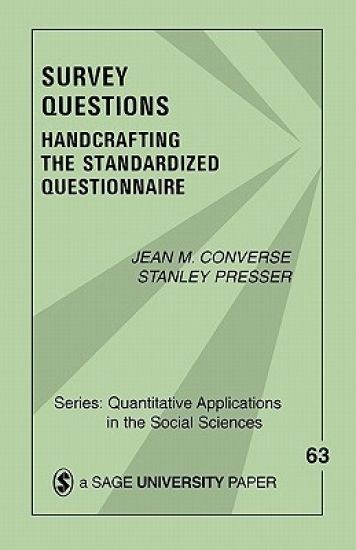
Survey Questions

Survey Questions

Jean M. Converse; Stanley Presser

SAGE Publications Inc
1986
nidottu
"An extremely useful handbook for students and any newcomers to survey research."--NetworkRecent research has yielded many new clues about how survey questions "behave," and some of these findings have offered practical guidance for question writing. Volume 63 reviews this experimental literature and provides both general guiding principles and specific advice on how to develop a survey questionnaire, emphasizing the practical implications of the experience and research of questionnaire designers. The authors also suggest a number of ways in which to make pilot and pretest work more fruitful. The material is easily accessible, yet professionally sophisticated. This volume should be useful to social scientists and others who design survey questionnaires.