

Kirjailija
Stefan Boes
Kirjat ja teokset yhdessä paikassa: 5 kirjaa, julkaisuja vuosilta 2009–2026, suosituimpiin kuuluu Die zeitintelligente Organisation. Vertaile teosten hintoja ja tarkista saatavuus suomalaisista kirjakaupoista.
5 kirjaa
Kirjojen julkaisuvuodet: 2009–2026.

Lieblingsplätze Tölzer Land - Tegernsee - Schliersee
Heike Hoffmann; Stefan Boes
Gmeiner Verlag
2025
nidottu

Lieblingsplätze in Oberbayern
Alexandra Achenbach; Stefan Boes; Klaus Bovers
Gmeiner Verlag
2024
pokkari
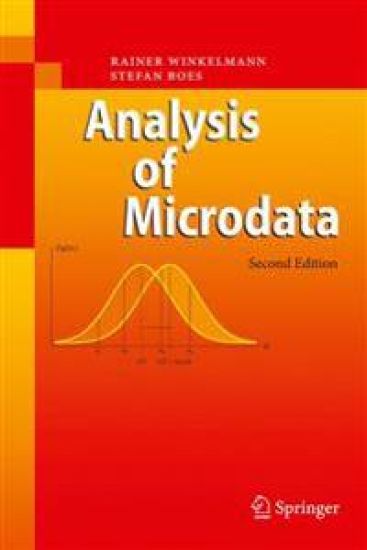
Analysis of Microdata
Rainer Winkelmann; Stefan Boes
Springer-Verlag Berlin and Heidelberg GmbH Co. K
2010
nidottu
The availability of microdata has increased rapidly over the last decades, and standard statistical and econometric software packages for data analysis include ever more sophisticated modeling options. The goal of this book, now initssecondedition,istofamiliarizethereaderwithawiderangeofcommonly used models, and thereby to enable her/him to become a critical consumer of current empirical research, and to properly conduct own empirical analyses. The book can be used as a textbook for an advanced undergraduate, a Master’s or a ?rst-year Ph. D. course on the topic of microdata analysis. In economicsandrelateddisciplines,suchacourseistypicallyo?eredaftera?rst course on the linear regression model. Alternatively, the book can also serve as a supplementary text to applied ?eld courses, such as those dealing with empirical analyses in labor, health or education. Finally, it might provide a useful reference for graduate students, researchers and practitioners who encounter microdata in their work. The focus of the book is on regression-type models in the context of large cross-section samples where the dependent variable is qualitative or discrete, or where the sample is not randomly drawn from the population of interest, due to censoring or truncation of the dependent variable. While our ba- groundisineconomics,andweoccasionallyrefertoproblemsandapplications fromempiricaleconomics,themodelsdiscussedinthisbookshouldbeequally relevant wherever microdata are used, inside the social sciences, including for example quantitative political science and sociology, as well as outside.
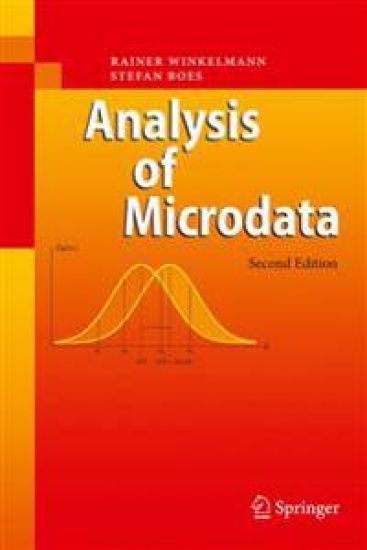
Analysis of Microdata
Rainer Winkelmann; Stefan Boes
Springer-Verlag Berlin and Heidelberg GmbH Co. K
2009
sidottu
The availability of microdata has increased rapidly over the last decades, and standard statistical and econometric software packages for data analysis include ever more sophisticated modeling options. The goal of this book, now initssecondedition,istofamiliarizethereaderwithawiderangeofcommonly used models, and thereby to enable her/him to become a critical consumer of current empirical research, and to properly conduct own empirical analyses. The book can be used as a textbook for an advanced undergraduate, a Master’s or a ?rst-year Ph. D. course on the topic of microdata analysis. In economicsandrelateddisciplines,suchacourseistypicallyo?eredaftera?rst course on the linear regression model. Alternatively, the book can also serve as a supplementary text to applied ?eld courses, such as those dealing with empirical analyses in labor, health or education. Finally, it might provide a useful reference for graduate students, researchers and practitioners who encounter microdata in their work. The focus of the book is on regression-type models in the context of large cross-section samples where the dependent variable is qualitative or discrete, or where the sample is not randomly drawn from the population of interest, due to censoring or truncation of the dependent variable. While our ba- groundisineconomics,andweoccasionallyrefertoproblemsandapplications fromempiricaleconomics,themodelsdiscussedinthisbookshouldbeequally relevant wherever microdata are used, inside the social sciences, including for example quantitative political science and sociology, as well as outside.