Kirjojen hintavertailu – 12 859 818 kirjaa ja 27 kauppaa

Kirjailija

Stefan Hedlund

Kirjat ja teokset yhdessä paikassa: 19 kirjaa, julkaisuja vuosilta 1999–2026, suosituimpiin kuuluu Russia Reverts to Muscovy. Vertaile teosten hintoja ja tarkista saatavuus suomalaisista kirjakaupoista.

19 kirjaa

Kirjojen julkaisuvuodet: 1999–2026.

Russia Reverts to Muscovy

Russia Reverts to Muscovy

Stefan Hedlund

Taylor & Francis
2026
Nidottu
Russia Reverts to Muscovy explores the implications of removing the notion of “Russia” from political and scholarly discourse. The book posits the following questions: Should the state ruled from Moscow be termed “Russia”? Might not “Muscovy” be more appropriate? It reflects on how academia has conceptualized developments among the Eastern Slavs over the centuries from the early days of Muscovy up until the present-day Russian Federation with the result that by consistently viewing events through a Moscow lens the West has been instrumental in supporting Muscovite claims to hegemony and thus in allowing Moscow to play an outsized role not only in the region but also in global geopolitics. This book highlights the more recent developments of the Muscovite state, and the increasingly hollow nature of the claims of the Russian Federation to represent all of Russia. Exploring how the Eastern Slav world could be conceptualized differently and how this world might develop in reality, this book will be of interest to researchers in International Relations, Ethnic Studies, Political Science, and Central Asian, Russian and Soviet Politics.
Russia Reverts to Muscovy

Russia Reverts to Muscovy

Stefan Hedlund

TAYLOR FRANCIS LTD
2025
sidottu

Halvin toimitettuna 240,40 €

Russia Reverts to Muscovy explores the implications of removing the notion of “Russia” from political and scholarly discourse. The book posits the following questions: Should the state ruled from Moscow be termed “Russia”? Might not “Muscovy” be more appropriate? It reflects on how academia has conceptualized developments among the Eastern Slavs over the centuries from the early days of Muscovy up until the present-day Russian Federation with the result that by consistently viewing events through a Moscow lens the West has been instrumental in supporting Muscovite claims to hegemony and thus in allowing Moscow to play an outsized role not only in the region but also in global geopolitics. This book highlights the more recent developments of the Muscovite state, and the increasingly hollow nature of the claims of the Russian Federation to represent all of Russia. Exploring how the Eastern Slav world could be conceptualized differently and how this world might develop in reality, this book will be of interest to researchers in International Relations, Ethnic Studies, Political Science, and Central Asian, Russian and Soviet Politics.
Ideology and Rationality in the Soviet Model

Ideology and Rationality in the Soviet Model

Kristian Gerner; Stefan Hedlund

TAYLOR FRANCIS LTD
2024
nidottu
First published in 1989, Ideology and Rationality in the Soviet Model assumes that since the October Revolution the development of the Soviet Union has essentially been a process of trial and error. Economic rationality has been sacrificed to political expedients, and the cultural sphere has been put to use as a legitimating and rationalizing device. This book analyses the internal logic of this process from the 1917 Bolshevik Revolution to Gorbachev’s ‘revolution from above’, including coverage of the Stalin, Khrushchev and Brezhnev eras. The book focuses on the structural determinants of the Soviet Model, thus seeking to reveal the specific rationalities that characterizes ‘Soviet man’. Its conclusion casts serious doubt on the likelihood of new policies defeating seven decades of Bolshevik rule and social indoctrination. It will be of interest to students of economics, political science and history.
Ukraine, Russia and the West

Ukraine, Russia and the West

Stefan Hedlund

TAYLOR FRANCIS LTD
2023
sidottu
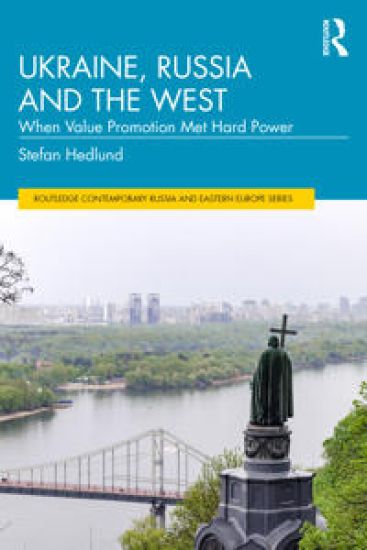
Why did Russia’s all-out war against Ukraine come as such a surprise to the West? This is a key question considered by this reflective and wide-ranging book. The book argues that Russia and the West were playing different games: while Russia under Putin had become obsessed with using hard power to restore the Cold War security architecture in Europe, the major Western powers had become equally obsessed with value promotion that would ensure a global triumph for the values of the West, touted as “universal values.” The Russian play for spheres of interest was clearly defined and demarcated, the Western play for values was, by definition, without limits. Hence there could be no common ground, no constructive communication, and no common understanding. While Russia convinced itself that it would be successful in forcing the West to accept its claims for a new security order, based on hard power, Western governments deluded themselves into believing that value promotion would transform Russia into a liberal democracy and a rules-based market economy. Examining the full situation, exploring political, military, economic and business spheres, the book provides a deep analysis of how the present confrontation has come about.
Ukraine, Russia and the West

Ukraine, Russia and the West

Stefan Hedlund

TAYLOR FRANCIS LTD
2023
nidottu
Why did Russia’s all-out war against Ukraine come as such a surprise to the West? This is a key question considered by this reflective and wide-ranging book. The book argues that Russia and the West were playing different games: while Russia under Putin had become obsessed with using hard power to restore the Cold War security architecture in Europe, the major Western powers had become equally obsessed with value promotion that would ensure a global triumph for the values of the West, touted as “universal values.” The Russian play for spheres of interest was clearly defined and demarcated, the Western play for values was, by definition, without limits. Hence there could be no common ground, no constructive communication, and no common understanding. While Russia convinced itself that it would be successful in forcing the West to accept its claims for a new security order, based on hard power, Western governments deluded themselves into believing that value promotion would transform Russia into a liberal democracy and a rules-based market economy. Examining the full situation, exploring political, military, economic and business spheres, the book provides a deep analysis of how the present confrontation has come about.
Ideology and Rationality in the Soviet Model

Ideology and Rationality in the Soviet Model

Kristian Gerner; Stefan Hedlund

TAYLOR FRANCIS LTD
2022
sidottu
First published in 1989, Ideology and Rationality in the Soviet Model assumes that since the October Revolution the development of the Soviet Union has essentially been a process of trial and error. Economic rationality has been sacrificed to political expedients, and the cultural sphere has been put to use as a legitimating and rationalizing device. This book analyses the internal logic of this process from the 1917 Bolshevik Revolution to Gorbachev’s ‘revolution from above’, including coverage of the Stalin, Khrushchev and Brezhnev eras. The book focuses on the structural determinants of the Soviet Model, thus seeking to reveal the specific rationalities that characterizes ‘Soviet man’. Its conclusion casts serious doubt on the likelihood of new policies defeating seven decades of Bolshevik rule and social indoctrination. It will be of interest to students of economics, political science and history.
Crisis in Soviet Agriculture

Crisis in Soviet Agriculture

Stefan Hedlund

Routledge
2021
nidottu
This book, first published in 1984, analyses the institutions and decision-making processes that determined agricultural production in the Soviet Union. It addresses the crisis in Soviet agriculture of the early 1980s, examining the problems of low productivity, adverse natural conditions and an underdeveloped infrastructure. The book’s analysis of the ‘crisis’ focuses on the growing gap between demand and supply of agricultural produce, and the pressures on the government to alleviate the food shortages.
Private Agriculture in the Soviet Union
First published in 1989. Perestroika, it was widely believed, must succeed in agriculture before permanent change could be affected elsewhere in the Soviet economy. But Soviet agriculture had so far remained stubbornly inefficient and resistant to change. In this book Stefan Hedlund investigates the reasons for this state of affairs. The author gives an account of the emergence, development and performance of private agriculture in the Soviet Union. In particular he describes the essentials of the peculiarly Soviet hybrid of private and socialized agriculture. He places the private sector within the broader framework of Soviet agriculture. He saw Soviet agriculture as a ‘Black Hole’, ready to absorb any resources that came near, be they private plots, urban gardens, factory workshops or military units. Hedlund also examines the impact on the peasants as producers of decades of negative ideological pronouncements in Party propaganda, and of discrimination and at times outright harassment by local officials. He points out that this background makes the prospect of any positive response from the peasants to Gorbachev’s call for perestroika in agriculture extremely unlikely.
The Baltic States and the End of the Soviet Empire

The Baltic States and the End of the Soviet Empire

Kristian Gerner; Stefan Hedlund

Routledge
2019
nidottu
First published in 1993. How is it possible for the three tiny Baltic republics to gain their freedom from the Soviet Union, without a single shot being fired or a single stone thrown at the oppressor? The topic of this book is the implosion of the Soviet empire. It tells the parallel stories of how the three Baltic republics of Estonia, Latvia and Lithuania struggled successfully to gain their freedom, and how the policies pursued by Mikhail Gorbachev served to mobilize and politicize Baltic demands. Particular emphasis is placed on unintended consequences that resulted from repeated interventions by Moscow. The authors develop a loose theoretic framework for the examination of this critical struggle. The study starts by developing the analytical tools and then proceeds to outline, as background, the most salient features of Gorbachev's reform programme and of the history of the Baltic States. The core of the analysis is then presented in three chapters, devoted to three consecutive stages in the game. The first shows how strategies on both sides were initially formulated in consensus. In the second it is shown how consensus transformed into pure conflict, and in the third all actors are seeking to escape general collapse. The main conclusion points at the absence of ‘politics’ in the Soviet System as a main cause of its self-destruction.
Crisis in Soviet Agriculture

Crisis in Soviet Agriculture

Stefan Hedlund

Routledge
2019
sidottu
This book, first published in 1984, analyses the institutions and decision-making processes that determined agricultural production in the Soviet Union. It addresses the crisis in Soviet agriculture of the early 1980s, examining the problems of low productivity, adverse natural conditions and an underdeveloped infrastructure. The book’s analysis of the ‘crisis’ focuses on the growing gap between demand and supply of agricultural produce, and the pressures on the government to alleviate the food shortages.
Private Agriculture in the Soviet Union
First published in 1989. Perestroika, it was widely believed, must succeed in agriculture before permanent change could be affected elsewhere in the Soviet economy. But Soviet agriculture had so far remained stubbornly inefficient and resistant to change. In this book Stefan Hedlund investigates the reasons for this state of affairs. The author gives an account of the emergence, development and performance of private agriculture in the Soviet Union. In particular he describes the essentials of the peculiarly Soviet hybrid of private and socialized agriculture. He places the private sector within the broader framework of Soviet agriculture. He saw Soviet agriculture as a ‘Black Hole’, ready to absorb any resources that came near, be they private plots, urban gardens, factory workshops or military units. Hedlund also examines the impact on the peasants as producers of decades of negative ideological pronouncements in Party propaganda, and of discrimination and at times outright harassment by local officials. He points out that this background makes the prospect of any positive response from the peasants to Gorbachev’s call for perestroika in agriculture extremely unlikely.
The Baltic States and the End of the Soviet Empire

The Baltic States and the End of the Soviet Empire

Kristian Gerner; Stefan Hedlund

Routledge
2018
sidottu
First published in 1993. How is it possible for the three tiny Baltic republics to gain their freedom from the Soviet Union, without a single shot being fired or a single stone thrown at the oppressor? The topic of this book is the implosion of the Soviet empire. It tells the parallel stories of how the three Baltic republics of Estonia, Latvia and Lithuania struggled successfully to gain their freedom, and how the policies pursued by Mikhail Gorbachev served to mobilize and politicize Baltic demands. Particular emphasis is placed on unintended consequences that resulted from repeated interventions by Moscow. The authors develop a loose theoretic framework for the examination of this critical struggle. The study starts by developing the analytical tools and then proceeds to outline, as background, the most salient features of Gorbachev's reform programme and of the history of the Baltic States. The core of the analysis is then presented in three chapters, devoted to three consecutive stages in the game. The first shows how strategies on both sides were initially formulated in consensus. In the second it is shown how consensus transformed into pure conflict, and in the third all actors are seeking to escape general collapse. The main conclusion points at the absence of ‘politics’ in the Soviet System as a main cause of its self-destruction.
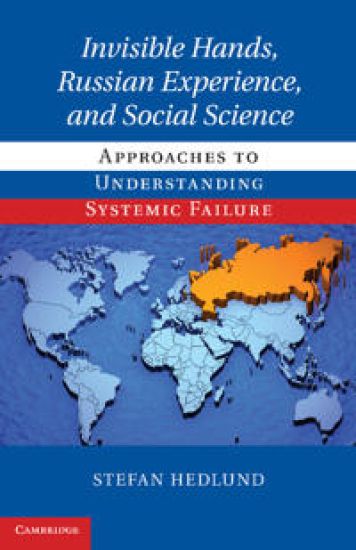
Invisible Hands, Russian Experience, and Social Science

Invisible Hands, Russian Experience, and Social Science

Stefan Hedlund

Cambridge University Press
2013
pokkari
This book investigates cases in which national and international activities have gone massively wrong, entailing seriously negative consequences, and in which the sophisticated analytical models of social science have ceased to be helpful. Illustrations range from the global financial crisis to the failure to achieve speedy systemic change in the former Soviet Union and the failure to achieve development in the Third World. The analysis uses as a backdrop long-term Russian history and short-term Russian encounters with unrestrained capitalism to develop a framework that is based in the so-called new institutionalism. Understanding the causes of systemic failure is shown to require an approach that spans across the increasingly specialized subdisciplines of modern social science. Demonstrating that increasing theoretical sophistication has been bought at the price of a loss of perspective and the need for sensitivity to the role of cultural and historical specificity, the book pleads the case for a new departure in seeking to model the motives for human action.
Russian Path Dependence

Russian Path Dependence

Stefan Hedlund

Routledge
2012
nidottu
Russia's transition to a market economy has been tortuous to say the least. However, this book argues that the arguments and counter-arguments that pitch shock therapy against gradualism are wide of the mark and quite pointless. Indeed, the reasons for the warped outcomes can actually be traced back through the long sweep of Russian history. Decisions made in the distant past can fully influence policy- making in the present. Hedlund's thesis can, like this, be seen as influenced by the 'path dependency' theories of Paul David among others.
Invisible Hands, Russian Experience, and Social Science

Invisible Hands, Russian Experience, and Social Science

Stefan Hedlund

Cambridge University Press
2011
sidottu
This book investigates cases in which national and international activities have gone massively wrong, entailing seriously negative consequences, and in which the sophisticated analytical models of social science have ceased to be helpful. Illustrations range from the global financial crisis to the failure to achieve speedy systemic change in the former Soviet Union and the failure to achieve development in the Third World. The analysis uses as a backdrop long-term Russian history and short-term Russian encounters with unrestrained capitalism to develop a framework that is based in the so-called new institutionalism. Understanding the causes of systemic failure is shown to require an approach that spans across the increasingly specialized subdisciplines of modern social science. Demonstrating that increasing theoretical sophistication has been bought at the price of a loss of perspective and the need for sensitivity to the role of cultural and historical specificity, the book pleads the case for a new departure in seeking to model the motives for human action.
Russia Since 1980

Russia Since 1980

Rosefielde Steven; Stefan Hedlund

Cambridge University Press
2008
sidottu
Russia Since 1980 recounts the epochal political, economic, and social changes that destroyed the Soviet Union, ushering in a perplexing new order. Two decades after Mikhail Gorbachev initiated regime-wrecking radical reforms, Russia has reemerged as a superpower. It has survived a hyperdepression, modernized, restored private property and business, adopted a liberal democratic persona, and asserted claims to global leadership. Many in the West perceive these developments as proof of a better globalized tomorrow, while others foresee a new cold war. Globalizers contend that Russia is speedily democratizing, marketizing, and humanizing, creating a regime based on the rule of law and respect for civil rights. Opponents counterclaim that Russia before and during the Soviet period was similarly misportrayed and insist that Medvedev's Russia is just another variation of an authoritarian 'Muscovite' model that has prevailed for over five centuries. The cases for both positions are explored while chronicling events since 1980.
Russia Since 1980

Russia Since 1980

Rosefielde Steven; Stefan Hedlund

Cambridge University Press
2008
pokkari
Russia Since 1980 recounts the epochal political, economic, and social changes that destroyed the Soviet Union, ushering in a perplexing new order. Two decades after Mikhail Gorbachev initiated regime-wrecking radical reforms, Russia has reemerged as a superpower. It has survived a hyperdepression, modernized, restored private property and business, adopted a liberal democratic persona, and asserted claims to global leadership. Many in the West perceive these developments as proof of a better globalized tomorrow, while others foresee a new cold war. Globalizers contend that Russia is speedily democratizing, marketizing, and humanizing, creating a regime based on the rule of law and respect for civil rights. Opponents counterclaim that Russia before and during the Soviet period was similarly misportrayed and insist that Medvedev's Russia is just another variation of an authoritarian 'Muscovite' model that has prevailed for over five centuries. The cases for both positions are explored while chronicling events since 1980.
Russian Path Dependence

Russian Path Dependence

Stefan Hedlund

Routledge
2005
sidottu
Russia's transition to a market economy has been tortuous to say the least. However, this book argues that the arguments and counter-arguments that pitch shock therapy against gradualism are wide of the mark and quite pointless. Indeed, the reasons for the warped outcomes can actually be traced back through the long sweep of Russian history. Decisions made in the distant past can fully influence policy- making in the present. Hedlund's thesis can, like this, be seen as influenced by the 'path dependency' theories of Paul David among others.
Russia's Market Economy

Russia's Market Economy

Stefan Hedlund

Routledge
1999
nidottu
Russia's Market Economy is a seminal account of Russia's transition to the market, its tortuous development as a fledgling market economy through the 1990s, right through to its spectacular collapse in August 1998. Rather than beginning with the economic collapse, the book traces the historical mismanagement of Russian wealth through to the Soviet command economy, and on to Gorbachev. Stefan Hedlund finally discusses what lessons should be learned from the damage inflicted on the Russian economy, as well as its social, legal and political infrastructure, by the race of reform.