
Kirjailija
Stefan Ihrig
Kirjat ja teokset yhdessä paikassa: 6 kirjaa, julkaisuja vuosilta 2005–2026, suosituimpiin kuuluu Blackness in Interwar Germany. Vertaile teosten hintoja ja tarkista saatavuus suomalaisista kirjakaupoista.
6 kirjaa
Kirjojen julkaisuvuodet: 2005–2026.
German-Turkish relations form an integral backdrop to many of today’s most pressing political concerns, including the absorption of refugees from the Middle East in Europe, debates about coexistence with Muslims in Western societies, and European geopolitics in Western Asia. Yet the story of this relationship, its 800-year history and often fateful consequences, has never been fully told. In this book, Stefan Ihrig presents the first history of the relationship of these two peoples, from the Middle Ages until today. It is a relationship that has had many twists and turns, from adversaries in the early modern conflict between the Ottoman Empire and Christian Central Europe to allies at the end of the nineteenth century and during WWI. In a way it is a story that shows that this is one of the longest-lasting relationships between peoples in Europe. It is also one that contradicts many of the basic tenets of Edward Said’s Orientalism. And, as Ihrig shows, it’s a relationship that surprises and confounds simplistic narratives. Far from one sided, the encounter between German and Turkish-speaking people over the centuries reveals a mutual fascination that stands in contrast to British, French or American interactions with the Middle East and North Africa. The coda to this story is the now up to four million people of Turkish descent living in Germany. With modern Turkey taking an increasingly prominent role on the global stage and the German state the most powerful in the European Union, understanding the history of this complicated and dynamic relationship is more important than ever.
The Armenian Genocide and the Nazi Holocaust are often thought to be separated by a large distance in time and space. But Stefan Ihrig shows that they were much more connected than previously thought. Bismarck and then Wilhelm II staked their foreign policy on close relations with a stable Ottoman Empire. To the extent that the Armenians were restless under Ottoman rule, they were a problem for Germany too. From the 1890s onward Germany became accustomed to excusing violence against Armenians, even accepting it as a foreign policy necessity. For many Germans, the Armenians represented an explicitly racial problem and despite the Armenians’ Christianity, Germans portrayed them as the “Jews of the Orient.” As Stefan Ihrig reveals in this first comprehensive study of the subject, many Germans before World War I sympathized with the Ottomans’ longstanding repression of the Armenians and would go on to defend vigorously the Turks’ wartime program of extermination. After the war, in what Ihrig terms the “great genocide debate,” German nationalists first denied and then justified genocide in sweeping terms. The Nazis too came to see genocide as justifiable: in their version of history, the Armenian Genocide had made possible the astonishing rise of the New Turkey. Ihrig is careful to note that this connection does not imply the Armenian Genocide somehow caused the Holocaust, nor does it make Germans any less culpable. But no history of the twentieth century should ignore the deep, direct, and disturbing connections between these two crimes.
Early in his career, Adolf Hitler took inspiration from Benito Mussolini, his senior colleague in fascism—this fact is widely known. But an equally important role model for Hitler and the Nazis has been almost entirely neglected: Mustafa Kemal Atatürk, the founder of modern Turkey. Stefan Ihrig’s compelling presentation of this untold story promises to rewrite our understanding of the roots of Nazi ideology and strategy. Hitler was deeply interested in Turkish affairs after 1919. He not only admired but also sought to imitate Atatürk’s radical construction of a new nation from the ashes of defeat in World War I. Hitler and the Nazis watched closely as Atatürk defied the Western powers to seize government, and they modeled the Munich Putsch to a large degree on Atatürk’s rebellion in Ankara. Hitler later remarked that in the political aftermath of the Great War, Atatürk was his master, he and Mussolini his students. This was no fading fascination. As the Nazis struggled through the 1920s, Atatürk remained Hitler’s “star in the darkness,” his inspiration for remaking Germany along nationalist, secular, totalitarian, and ethnically exclusive lines. Nor did it escape Hitler’s notice how ruthlessly Turkish governments had dealt with Armenian and Greek minorities, whom influential Nazis directly compared with German Jews. The New Turkey, or at least those aspects of it that the Nazis chose to see, became a model for Hitler’s plans and dreams in the years leading up to the invasion of Poland.
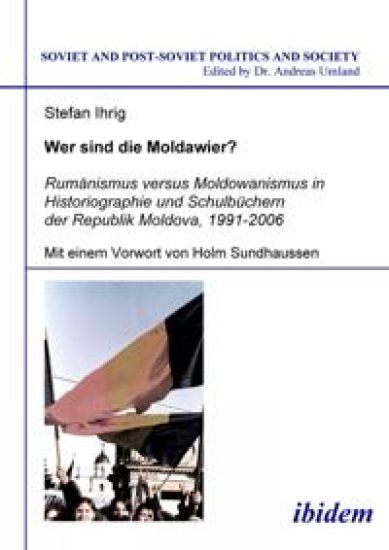
Wer sind die Moldawier?. Rum?nismus versus Moldowanismus in Historiographie und Schulb?chern der Republik Moldova, 1991-2006
Stefan Ihrig; Holm Sundhaussen
Ibidem Press
2008
pokkari
In der kleinen Republik Moldova offenbarte sich die postsowjetische Transformation vor allem als ein Kampf um Identit t. Nicht nur, dass es Str mungen an der Peripherie, in Transnistrien und Gagausien, gab, die den gemeinsamen Staat in Frage stellten. Auch die Mehrheitsbev lkerung scheint sich unsicher zu sein, wer sie eigentlich ist. Sind sie Rum nien und somit Teil der rum nischen Nation oder eine eigenst ndige Nation - die Moldawier? Diese Frage zieht sich wie ein roter Faden durch die letzten f nfzehn Jahre seit der Unabh ngigkeit. In der Geschichte suchte man Antworten und mit Geschichtsschreibung versuchte man die eigenen Positionen zu propagieren. Dabei wurden Historiographie und der schulische Geschichtsunterricht zu Streitarenen: Lehrer und Sch ler demonstrierten, Schulb cher wurden verbrannt und Regierungen bangten um ihr Fortbestehen. Es geht hier somit nicht nur um eine akademische Frage sondern um nicht weniger als die Zukunft des jungen moldawischen Staates: Vereinigung mit Rum nien oder staatliche Eigenst ndigkeit? Dieses Buch zeichnet die historiographischen Entw rfe der Nation in der Debatte zwischen Moldowanismus und Rum nismus in Moldova nach. Es analysiert und kontextualisiert ihre Annahmen und Forderungen. Die Bewertung beider Str mungen und des Verh ltnisses zwischen Geschichtsschreibung und Gesellschaft k nnte dabei kaum negativer ausfallen.
Europa Am Bosporus (Er-)Finden?
Roberta Carnevale; Stefan Ihrig; Christian Weiß
Peter Lang AG
2005
nidottu
Die Debatte um den Beitritt der Turkei geht nicht nur um die Turkei selbst, sondern vor allem um den Charakter der EU. Wie man auf die Turkei antwortet, gibt klare Auskunft daruber, was Europa ist oder sein soll. Diese Analyse typologisiert und dokumentiert die verschiedenen Argumentationslinien der Diskussionsteilnehmer in Westeuropa. Der Begriffskampf um Europa, der sich im Thema Turkei zuspitzt, wird anhand von Tageszeitungen aus Deutschland, Frankreich, Grossbritannien und Italien untersucht. Dabei wird offensichtlich, wie stark die nationale Perspektive bei der Diskussion europaischer Themen immer noch vorherrscht. So ist die kulturell-historische Begrundung Europas eine deutsch-franzoesische Besonderheit. Dies zeigt, wie unterschiedlich die Vorstellungen von (EU-)Europa sind.