

Kirjojen hintavertailu – 12 878 360 kirjaa ja 26 kauppaa

Kirjailija

Stefan Napel

Kirjat ja teokset yhdessä paikassa: 2 kirjaa, julkaisuja vuosilta 2002–2019, suosituimpiin kuuluu Bilateral Bargaining. Vertaile teosten hintoja ja tarkista saatavuus suomalaisista kirjakaupoista.

2 kirjaa

Kirjojen julkaisuvuodet: 2002–2019.

Einführung in die Spieltheorie

Einführung in die Spieltheorie

Manfred J. Holler; Gerhard Illing; Stefan Napel

Springer-Verlag Berlin and Heidelberg GmbH Co. K
2019
nidottu
Was hat Hamlet falsch gemacht? In diesem Buch lernen Sie Instrumente kennen, mit denen Sie dieser Frage systematisch nachgehen können – die Ihnen helfen, Entscheidungssituationen zu durchdenken, die sich durch Konflikte und Koordinationsprobleme auszeichnen. Mit Hilfe spieltheoretischer Konzepte und Ansätze werden Sie Ihre Antwort darauf finden, was Hamlet falsch gemacht hat, warum der Kalte Krieg „kalt" blieb und warum Michelin seinen Eintritt in den US-Markt besser vermieden hätte. Die Spieltheorie ist aus der heutigen Ökonomik nicht mehr wegzudenken. Auch in der Politikwissenschaft, Soziologie und Philosophie findet sich inzwischen ein breites Band sehr unterschiedlicher Anwendungen. Diese Einführung in die Spieltheorie liefert die theoretischen Grundlagen und schult beim Leser die spieltheoretische Argumentationsweise. Für die vorliegende 8. Auflage wurden große Teile der Kapitel 1 bis 4 gründlich überarbeitet und ergänzt. Das neue Kapitel 9 bietet unterhaltsame Einblicke in die spannende (Vor-)Geschichte der Spieltheorie. Eine gut lesbare Einführung!
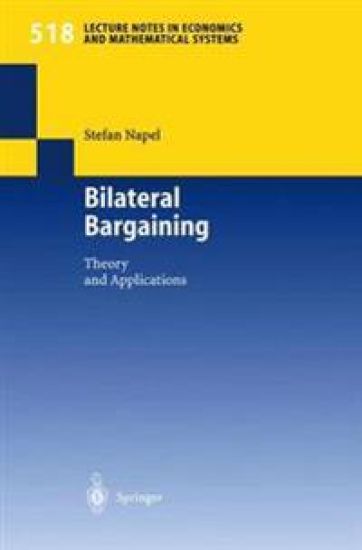
Bilateral Bargaining

Bilateral Bargaining

Stefan Napel

Springer-Verlag Berlin and Heidelberg GmbH Co. K
2002
nidottu
This book investigates bargaining between two agents. Its objective is to present, to extend, and to apply the present state of theoretical knowledge. A wide range of questions will be considered: First of all, will two parties reach efficient agreements? Traditional economic theory gives a generally affirma­ tive answer for perfectly rational agents, who can carry out complex calcu­ lations instantaneously and without cost. The book uses innovative methods to analyse the implications of less demanding assumptions. A practical ques­ tion related to bargaining is: How much power does the design of institutions such as the U. N. Security Council give to each of its members? Formally, non­ permanent members' votes are necessary to pass resolutions, but theoretical investigation of pre-voting negotiation attributes all power to the five perma­ nent members. Or one may ask whether a society should rather finance the education in higher mathematics for a talented person than remedial training for a retarded person? Different concepts of justice yield different answers. Which particular concept is implemented in a given society is also a matter of bargaining, and it is of special philosophical interest to investigate which bargain will be struck in an ideal society in which individual talents and resources are not yet known. Very generally, a bilateral bargaining situation is characterized by two agents - individuals, firms, governments, etc.