Kirjojen hintavertailu – 12 903 725 kirjaa ja 27 kauppaa

Kirjailija

Stefania Centrone

Kirjat ja teokset yhdessä paikassa: 5 kirjaa, julkaisuja vuosilta 2009–2023, suosituimpiin kuuluu Oskar Becker, On the Logic of Modalities (1930): Translation, Commentary and Analysis. Vertaile teosten hintoja ja tarkista saatavuus suomalaisista kirjakaupoista.

5 kirjaa

Kirjojen julkaisuvuodet: 2009–2023.

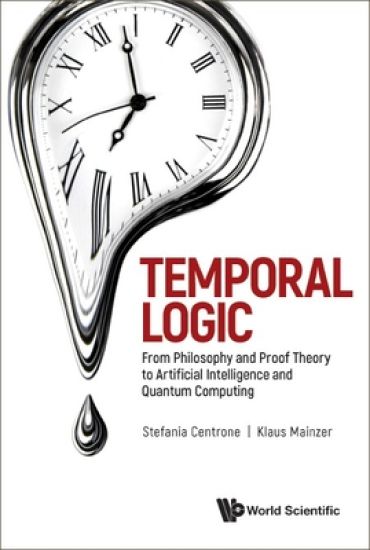
Temporal Logic: From Philosophy And Proof Theory To Artificial Intelligence And Quantum Computing

Temporal Logic: From Philosophy And Proof Theory To Artificial Intelligence And Quantum Computing

Klaus Mainzer; Stefania Centrone

WORLD SCIENTIFIC PUBLISHING CO PTE LTD
2023
sidottu
Calculi of temporal logic are widely used in modern computer science. The temporal organization of information flows in the different architectures of laptops, the Internet, or supercomputers would not be possible without appropriate temporal calculi. In the age of digitalization and High-Tech applications, people are often not aware that temporal logic is deeply rooted in the philosophy of modalities. A deep understanding of these roots opens avenues to the modern calculi of temporal logic which have emerged by extension of modal logic with temporal operators. Computationally, temporal operators can be introduced in different formalisms with increasing complexity such as Basic Modal Logic (BML), Linear-Time Temporal Logic (LTL), Computation Tree Logic (CTL), and Full Computation Tree Logic (CTL*). Proof-theoretically, these formalisms of temporal logic can be interpreted by the sequent calculus of Gentzen, the tableau-based calculus, automata-based calculus, game-based calculus, and dialogue-based calculus with different advantages for different purposes, especially in computer science. The book culminates in an outlook on trendsetting applications of temporal logics in future technologies such as artificial intelligence and quantum technology. However, it will not be sufficient, as in traditional temporal logic, to start from the everyday understanding of time. Since the 20th century, physics has fundamentally changed the modern understanding of time, which now also determines technology. In temporal logic, we are only just beginning to grasp these differences in proof theory which needs interdisciplinary cooperation of proof theory, computer science, physics, technology, and philosophy.
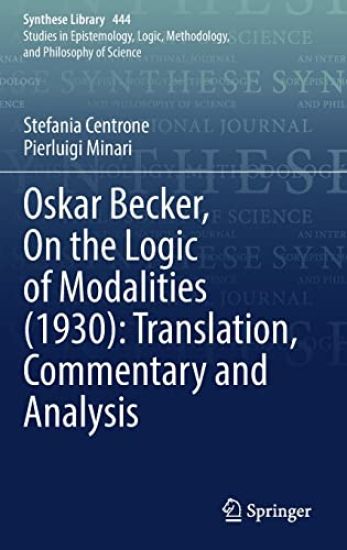
Oskar Becker, On the Logic of Modalities (1930): Translation, Commentary and Analysis

Oskar Becker, On the Logic of Modalities (1930): Translation, Commentary and Analysis

Stefania Centrone; Pierluigi Minari

Springer Nature Switzerland AG
2023
nidottu
This book offers the first-ever English translation of Oskar Becker’s Zur Logik der Modalitäten. This essay, published in 1930, is a pioneering yet often neglected contribution in the context of prewar modal logic research in Europe. Becker’s text is complemented by an extended commentary that explains, analyzes and highlights Becker’s accomplishments and the philosophical background of his investigations. The commentary provides an in-depth analysis of all of Becker's important contributions, both from a philosophical and logical perspective, making it a very useful book for scholars in both philosophy and logic.
Oskar Becker, On the Logic of Modalities (1930): Translation, Commentary and Analysis

Oskar Becker, On the Logic of Modalities (1930): Translation, Commentary and Analysis

Stefania Centrone; Pierluigi Minari

Springer Nature Switzerland AG
2022
sidottu
This book offers the first-ever English translation of Oskar Becker’s Zur Logik der Modalitäten. This essay, published in 1930, is a pioneering yet often neglected contribution in the context of prewar modal logic research in Europe. Becker’s text is complemented by an extended commentary that explains, analyzes and highlights Becker’s accomplishments and the philosophical background of his investigations. The commentary provides an in-depth analysis of all of Becker's important contributions, both from a philosophical and logical perspective, making it a very useful book for scholars in both philosophy and logic.
Logic and Philosophy of Mathematics in the Early Husserl
Logic and Philosophy of Mathematics in the Early Husserl focuses on the first ten years of Edmund Husserl’s work, from the publication of his Philosophy of Arithmetic (1891) to that of his Logical Investigations (1900/01), and aims to precisely locate his early work in the fields of logic, philosophy of logic and philosophy of mathematics. Unlike most phenomenologists, the author refrains from reading Husserl’s early work as a more or less immature sketch of claims consolidated only in his later phenomenology, and unlike the majority of historians of logic she emphasizes the systematic strength and the originality of Husserl’s logico-mathematical work. The book attempts to reconstruct the discussion between Husserl and those philosophers and mathematicians who contributed to new developments in logic, such as Leibniz, Bolzano, the logical algebraists (especially Boole and Schröder), Frege, and Hilbert and his school. It presents both a comprehensive critical examination of some of the major works produced by Husserl and his antagonists in the last decade of the 19th century and a formal reconstruction of many texts from Husserl’s Nachlaß that have not yet been the object of systematical scrutiny. This volume will be of particular interest to researchers working in the history, and in the philosophy, of logic and mathematics, and more generally, to analytical philosophers and phenomenologists with a background in standard logic.
Logic and Philosophy of Mathematics in the Early Husserl
Logic and Philosophy of Mathematics in the Early Husserl focuses on the first ten years of Edmund Husserl’s work, from the publication of his Philosophy of Arithmetic (1891) to that of his Logical Investigations (1900/01), and aims to precisely locate his early work in the fields of logic, philosophy of logic and philosophy of mathematics. Unlike most phenomenologists, the author refrains from reading Husserl’s early work as a more or less immature sketch of claims consolidated only in his later phenomenology, and unlike the majority of historians of logic she emphasizes the systematic strength and the originality of Husserl’s logico-mathematical work. The book attempts to reconstruct the discussion between Husserl and those philosophers and mathematicians who contributed to new developments in logic, such as Leibniz, Bolzano, the logical algebraists (especially Boole and Schröder), Frege, and Hilbert and his school. It presents both a comprehensive critical examination of some of the major works produced by Husserl and his antagonists in the last decade of the 19th century and a formal reconstruction of many texts from Husserl’s Nachlaß that have not yet been the object of systematical scrutiny. This volume will be of particular interest to researchers working in the history, and in the philosophy, of logic and mathematics, and more generally, to analytical philosophers and phenomenologists with a background in standard logic.