Kirjojen hintavertailu – 12 859 819 kirjaa ja 27 kauppaa

Kirjailija

Steffen L. Lauritzen

Kirjat ja teokset yhdessä paikassa: 5 kirjaa, julkaisuja vuosilta 1988–2026, suosituimpiin kuuluu Graphical Models. Vertaile teosten hintoja ja tarkista saatavuus suomalaisista kirjakaupoista.

5 kirjaa

Kirjojen julkaisuvuodet: 1988–2026.

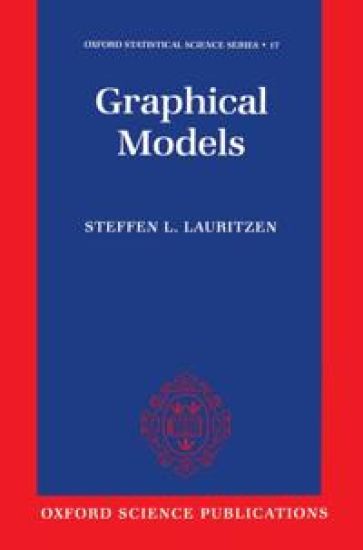
Graphical Models

Graphical Models

Steffen L. Lauritzen

Oxford University Press
2026
sidottu
The idea of modelling systems using graph theory has its origin in several scientific areas: in statistical physics (the study of large particle systems), in genetics (studying inheritable properties of natural species), and in interactions in contingency tables. This new and extended edition of Graphical Models provides the basic mathematical and statistical theory of graphical models, incorporating the many advances that have been made in the field since the publication of the first edition in 1996. Lauritzen discusses basic graph theory and the fundamentals of conditional independence both in abstract form for conditional independence based on graphs and for probabilistic conditional independence. The associated Markov theory, forming the basis of all models in the book, is treated in some detail. The statistical theory based on likelihood methods and conjugate Bayesian analysis is developed for log-linear and Gaussian graphical models, as well as for graphical models involving mixed discrete and continuous data. A new and important chapter is devoted to structure estimation because this has become a dominating part of modern developments. Causal interpretation of models based on directed acyclic graphs and chain graphs are also discussed. The appendices contain some of the general mathematical results needed as background for the main contents of the book, including basic measure theory and the theory of Markov kernels, convex optimization, properties of the multivariate Gaussian distributions and derived distributions, as well as a brief exposition of the theory of exponential families.

Probabilistic Networks and Expert Systems

Probabilistic Networks and Expert Systems

Robert G. Cowell; Philip Dawid; Steffen L. Lauritzen; David J. Spiegelhalter

Springer-Verlag New York Inc.
2007
nidottu
WINNER OF THE 2001 DEGROOT PRIZE! Probabilistic expert systems are graphical networks that support the modelling of uncertainty and decisions in large complex domains, while retaining ease of calculation. Building on original research by the authors over a number of years, this book gives a thorough and rigorous mathematical treatment of the underlying ideas, structures, and algorithms, emphasizing those cases in which exact answers are obtainable. It covers both the updating of probabilistic uncertainty in the light of new evidence, and statistical inference, about unknown probabilities or unknown model structure, in the light of new data. The careful attention to detail will make this work an important reference source for all those involved in the theory and applications of probabilistic expert systems. This book was awarded the first DeGroot Prize by the International Society for Bayesian Analysis for a book making an important, timely, thorough, and notably original contribution to the statistics literature.
Probabilistic Networks and Expert Systems

Probabilistic Networks and Expert Systems

Robert G. Cowell; Philip Dawid; Steffen L. Lauritzen; David J. Spiegelhalter

Springer-Verlag New York Inc.
1999
sidottu
WINNER OF THE 2001 DEGROOT PRIZE! Probabilistic expert systems are graphical networks that support the modelling of uncertainty and decisions in large complex domains, while retaining ease of calculation. Building on original research by the authors over a number of years, this book gives a thorough and rigorous mathematical treatment of the underlying ideas, structures, and algorithms, emphasizing those cases in which exact answers are obtainable. It covers both the updating of probabilistic uncertainty in the light of new evidence, and statistical inference, about unknown probabilities or unknown model structure, in the light of new data. The careful attention to detail will make this work an important reference source for all those involved in the theory and applications of probabilistic expert systems. This book was awarded the first DeGroot Prize by the International Society for Bayesian Analysis for a book making an important, timely, thorough, and notably original contribution to the statistics literature.
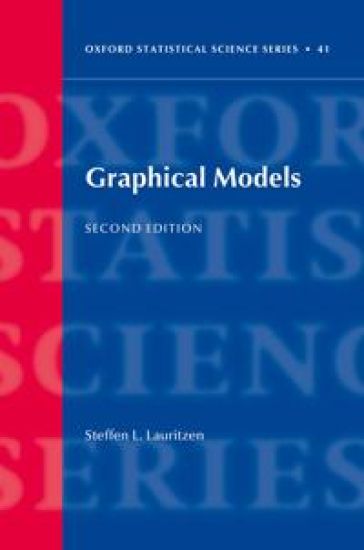
Graphical Models

Graphical Models

Steffen L. Lauritzen

Clarendon Press
1996
sidottu
The idea of modelling systems using graph theory has its origin in several scientific areas: in statistical physics (the study of large particle systems), in genetics (studying inheritable properties of natural species), and in interactions in contingency tables. The use of graphical models in statistics has increased considerably over recent years and the theory has been greatly developed and extended. This book provides the first comprehensive and authoritative account of the theory of graphical models and is written by a leading expert in the field. It contains the fundamental graph theory required and a thorough study of Markov properties associated with various type of graphs. The statistical theory of log-linear and graphical models for contingency tables, covariance selection models, and graphical models with mixed discrete-continous variables in developed detail. Special topics, such as the application of graphical models to probabilistic expert systems, are described briefly, and appendices give details of the multivarate normal distribution and of the theory of regular exponential families. The author has recently been awarded the RSS Guy Medal in Silver 1996 for his innovative contributions to statistical theory and practice, and especially for his work on graphical models.
Extremal Families and Systems of Sufficient Statistics

Extremal Families and Systems of Sufficient Statistics

Steffen L. Lauritzen

Springer-Verlag New York Inc.
1988
nidottu
The pOint of view behind the present work is that the connection between a statistical model and a statistical analysis-is a dua­ lity (in a vague sense). In usual textbooks on mathematical statistics it is often so that the statistical model is given in advance and then various in­ ference principles are applied to deduce the statistical ana­ lysis to be performed. It is however possible to reverse the above procedure: given that one wants to perform a certain statistical analysis, how can this be expressed in terms of a statistical model? In that sense we think of the statistical analysis and the stati­ stical model as two ways of expressing the same phenomenon, rather than thinking of the model as representing an idealisation of "truth" and the statistical analysis as a method of revealing that truth to the scientist. It is not the aim of the present work to solve the problem of giving the correct-anq final mathematical description of the quite complicated relation between model andanalysis. We have rather restricted ourselves to describe a particular aspect of this, formulate it in mathematical terms, and then tried to make a rigorous and consequent investigation of that mathematical struc­ ture.