
Kirjojen hintavertailu – 12 859 819 kirjaa ja 27 kauppaa

Kirjailija

Steffen Rendle

Kirjat ja teokset yhdessä paikassa: 3 kirjaa, julkaisuja vuosilta 2010–2014, suosituimpiin kuuluu Context-Aware Ranking with Factorization Models. Vertaile teosten hintoja ja tarkista saatavuus suomalaisista kirjakaupoista.

3 kirjaa

Kirjojen julkaisuvuodet: 2010–2014.

Context-Aware Ranking with Factorization Models

Context-Aware Ranking with Factorization Models

Steffen Rendle

Springer-Verlag Berlin and Heidelberg GmbH Co. K
2014
nidottu
Context-aware ranking is an important task with many applications. E.g. in recommender systems items (products, movies, ...) and for search engines webpages should be ranked. In all these applications, the ranking is not global (i.e. always the same) but depends on the context. Simple examples for context are the user for recommender systems and the query for search engines. More complicated context includes time, last actions, etc. The major problem is that typically the variable domains (e.g. customers, products) are categorical and huge, the observations are very sparse and only positive events are observed. In this book, a generic method for context-aware ranking as well as its application are presented. For modelling a new factorization based on pairwise interactions is proposed and compared to other tensor factorization approaches. For learning, the `Bayesian Context-aware Ranking' framework consisting of an optimization criterion and algorithm is developed. The second main part of the book applies this general theory to the three scenarios of item, tag and sequential-set recommendation. Furthermore extensions of time-variant factors and one-class problems are studied. This book generalizes and builds on work that has received the `WWW 2010 Best Paper Award', the `WSDM 2010 Best Student Paper Award' and the `ECML/PKDD 2009 Best Discovery Challenge Award'.
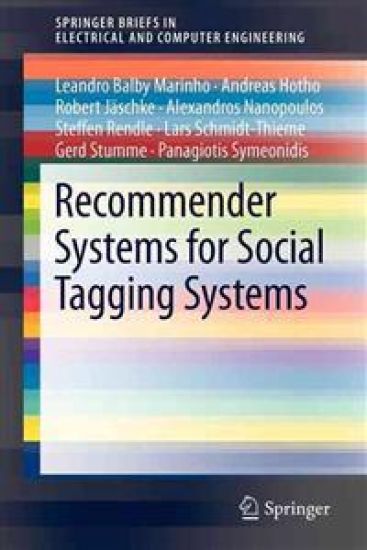
Recommender Systems for Social Tagging Systems

Recommender Systems for Social Tagging Systems

Leandro Balby Marinho; Andreas Hotho; Robert Jäschke; Alexandros Nanopoulos; Steffen Rendle; Lars Schmidt-Thieme; Gerd Stumme; Panagiotis Symeonidis

Springer-Verlag New York Inc.
2012
nidottu
Social Tagging Systems are web applications in which users upload resources (e.g., bookmarks, videos, photos, etc.) and annotate it with a list of freely chosen keywords called tags. This is a grassroots approach to organize a site and help users to find the resources they are interested in. Social tagging systems are open and inherently social; features that have been proven to encourage participation. However, with the large popularity of these systems and the increasing amount of user-contributed content, information overload rapidly becomes an issue. Recommender Systems are well known applications for increasing the level of relevant content over the “noise” that continuously grows as more and more content becomes available online. In social tagging systems, however, we face new challenges. While in classic recommender systems the mode of recommendation is basically the resource, in social tagging systems there are three possible modes of recommendation: users, resources, or tags. Therefore suitable methods that properly exploit the different dimensions of social tagging systems data are needed. In this book, we survey the most recent and state-of-the-art work about a whole new generation of recommender systems built to serve social tagging systems. The book is divided into self-contained chapters covering the background material on social tagging systems and recommender systems to the more advanced techniques like the ones based on tensor factorization and graph-based models.
Context-Aware Ranking with Factorization Models

Context-Aware Ranking with Factorization Models

Steffen Rendle

Springer-Verlag Berlin and Heidelberg GmbH Co. K
2010
sidottu
Context-aware ranking is an important task with many applications. E.g. in recommender systems items (products, movies, ...) and for search engines webpages should be ranked. In all these applications, the ranking is not global (i.e. always the same) but depends on the context. Simple examples for context are the user for recommender systems and the query for search engines. More complicated context includes time, last actions, etc. The major problem is that typically the variable domains (e.g. customers, products) are categorical and huge, the observations are very sparse and only positive events are observed. In this book, a generic method for context-aware ranking as well as its application are presented. For modelling a new factorization based on pairwise interactions is proposed and compared to other tensor factorization approaches. For learning, the `Bayesian Context-aware Ranking' framework consisting of an optimization criterion and algorithm is developed. The second main part of the book applies this general theory to the three scenarios of item, tag and sequential-set recommendation. Furthermore extensions of time-variant factors and one-class problems are studied. This book generalizes and builds on work that has received the `WWW 2010 Best Paper Award', the `WSDM 2010 Best Student Paper Award' and the `ECML/PKDD 2009 Best Discovery Challenge Award'.