Kirjojen hintavertailu – 12 859 818 kirjaa ja 27 kauppaa

Kirjailija

Sten Jonsson

Kirjat ja teokset yhdessä paikassa: 6 kirjaa, julkaisuja vuosilta 1996–2020, suosituimpiin kuuluu A Comparative History of Bank Failures. Vertaile teosten hintoja ja tarkista saatavuus suomalaisista kirjakaupoista.

Nimi esiintyy myös muodoissa: Sten Jönsson

6 kirjaa

Kirjojen julkaisuvuodet: 1996–2020.

A Comparative History of Bank Failures
Starting with Medici and Fugger and ending with Barings and Royal Bank of Scotland under neo-liberal de-regulation, the author gives an account of how a number of banks failed over a 500 year-period. The author offers an explanation of the leading ideas about the world and good society at the time, and summarizes this narrative using Streeck & Schmitter’s three bases for regulation of society: Community (spontaneous solidarity), State (hierarchical control), and Market (dispersed competition). The bank failures are presented in the context of social philosophies of the day (scholasticism, mercantilism, neo-liberalism, and libertarianism), and the changing business practices (Bills of Exchange, rents and financial instruments of various kinds). The dominating explanation of financial crises has been market-related. Here, the author argues that managerial failures are an important contributor. He demonstrates the failure of management to act on early signals such as existential risk, strategic stress syndrome, and lack of proper oversight by top management. The author encourages a return to ethical principles for banks, suggesting that his ethical aspect should be at the core of the credit process of banks in the future. With its interdisciplinary approach, this book will be an important contribution to the discussion surrounding bank failures. It will interest any scholar looking at the origins of financial crises and will be particularly useful for post-graduate students of economic and financial history, banking, finance and accounting.

A Comparative History of Bank Failures
Starting with Medici and Fugger and ending with Barings and Royal Bank of Scotland under neo-liberal de-regulation, the author gives an account of how a number of banks failed over a 500 year-period. The author offers an explanation of the leading ideas about the world and good society at the time, and summarizes this narrative using Streeck & Schmitter’s three bases for regulation of society: Community (spontaneous solidarity), State (hierarchical control), and Market (dispersed competition). The bank failures are presented in the context of social philosophies of the day (scholasticism, mercantilism, neo-liberalism, and libertarianism), and the changing business practices (Bills of Exchange, rents and financial instruments of various kinds). The dominating explanation of financial crises has been market-related. Here, the author argues that managerial failures are an important contributor. He demonstrates the failure of management to act on early signals such as existential risk, strategic stress syndrome, and lack of proper oversight by top management. The author encourages a return to ethical principles for banks, suggesting that his ethical aspect should be at the core of the credit process of banks in the future. With its interdisciplinary approach, this book will be an important contribution to the discussion surrounding bank failures. It will interest any scholar looking at the origins of financial crises and will be particularly useful for post-graduate students of economic and financial history, banking, finance and accounting.

Ledarskapsboken

Ledarskapsboken

Sten Jönsson

Liber
2015
nidottu
I Ledarskapsboken ger framträdande forskare en mångfacetterad bild av ledare och ledarskapsbegreppet. I denna andra upplaga har i huvudsak de befintliga texterna uppdaterats för att spegla det rådande forskningsläget. Läs merStarka och tydliga ledare sätts på piedestaler och hyllas som samtidens hjältar och ledarskap utmålas som något som brustit, framhålls som en konkurrensfördel eller presenteras som något som måste utövas bättre. Bristande ledarskap är problemet. Bättre ledarskap är lösningen. Men vad ledarskap är för något råder det ingen enighet kring. Det finns ingen forskningsfront där spjutspetskunskapen ligger prydligt samlad. Istället består ledarskapets forskningsfront av en mängd olika begreppsliga traditioner, teoretiska idékomplex och metodmässiga variationer. Forskningsfronten påminner mer om ett kalejdoskop än en rak linje. Beroende på hur man vrider på frågorna framträder olika mönster som alla innehåller fragment av varandra, men som långt ifrån ger samma bild. Om författarnaRedaktörer är Sten Jönsson, professor emeritus vid Handelshögskolan vid Göteborgs universitet, och Lars Strannegård, professor i företagsekonomi vid Handelshögskolan i Stockholm.
Företagsekonomins frågor

Företagsekonomins frågor

Nils Brunsson; Johan Alvehus; Mats Alvesson; Björn Axelsson; Erik Bjurström; Bino Catasús; Karin Holmblad Brunsson; Håkan Håkansson; Anders Ivarsson Westerberg; Bengt Jacobsson; Bengt Johannisson; Sten Jönsson; Dan Kärreman; Johnny Lind; Maria Mårtensson; Olov Olson; Lars Strannegård; Elisabeth Sundin; Stefan Tengblad; Andreas Werr

SNS Förlag
2010
nidottu
Företagsekonomins frågor kan användas som introduktion till företagsekonomistudierna, men den vänder sig också till alla andra som vill få en lättläst inblick i vad modern företagsekonomi handlar om. Denna titel har tidigare givits ut av SNS förlag men ingår numera i Studentlitteraturs sortiment.
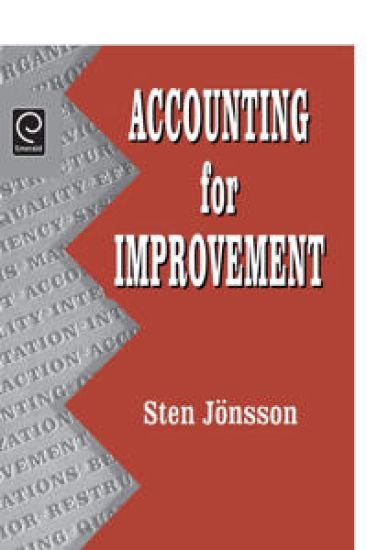
Accounting for Improvement

Accounting for Improvement

Sten Jonsson

Elsevier Science Ltd
2004
nidottu
"Accounting for Improvement" offers concrete and constructive demonstrations of the possibilities of designing participative forms of organization. Field experiment cases illustrate how the operational level can assume a new significance in competitiveness and strategic positioning. In this way, the relevance of the accounting function to the improvement of productivity and quality is restored. Several broadly applicable lessons can be learnt, among them: how companies can strengthen their competitive base by patient improvement; how people with operative jobs can take command of their work situation and improve it in quality as well as efficiency. New bottom-up, people-orientated, empirically-founded approaches to decentralised participative management demonstrate a place for individuals and teamwork in today's "lost relevance" and "smart machine" environment.
Accounting for Improvement

Accounting for Improvement

Sten Jonsson

Pergamon Press
1996
sidottu
Accounting for Improvement offers concrete and constructive demonstrations of the possibilities of designing participative forms of organization. Field experiment cases illustrate how the operational level can assume a new significance in competitiveness and strategic positioning. In this way, the relevance of the accounting function to the improvement of productivity and quality is restored. Several broadly applicable lessons can be learnt, among them: how companies can strengthen their competitive base by patient improvement; how people with operative jobs can take command of their work situation and improve it in quality as well as efficiency. New bottom-up, people-orientated, empirically-founded approaches to decentralised participative management demonstrate a place for individuals and teamwork in today's "lost relevance" and "smart machine" environment.