Kirjojen hintavertailu – 12 903 735 kirjaa ja 27 kauppaa

Kirjailija

Stéphane Crépey

Kirjat ja teokset yhdessä paikassa: 6 kirjaa, julkaisuja vuosilta 2010–2025, suosituimpiin kuuluu Financial Modeling. Vertaile teosten hintoja ja tarkista saatavuus suomalaisista kirjakaupoista.

Nimi esiintyy myös muodoissa: Stephane Crepey

6 kirjaa

Kirjojen julkaisuvuodet: 2010–2025.

XVA Analysis

XVA Analysis

Stéphane Crépey

TAYLOR FRANCIS LTD
2025
sidottu
XVA Analysis: Probabilistic, Risk Measure, and Machine Learning Issues offers readers an up-to-date and comprehensive exploration of the X-Value Adjustment (XVA) universe and of the embedded risk measure issues inherent within it. The book tackles this subject through the triple lens of ?nance (wealth transfers), stochastic analysis (enlargement of ?ltration and BSDEs), and numerical computations. The traditional Credit Valuation Adjustment (CVA) desk compensates the trading desks for the cash flows that they lose in case of defaults of their counterparties. The Treasury of the bank funds the activity of the trading desks and of the CVA desk at the risk-free rate. The CVA desk and the Treasury charge their costs to the clients of the bank at a valuation level ensuring corresponding PnL processes that are martingales relative to a fininsurance probability measure calibrated to the market and consistent with the physical probability measure given the market. The management of the bank charges to the clients of the bank an additional risk premium, turning the overall dividend process of the bank shareholders into a submartingale in line with a target hurdle rate on their capital at risk within the bank. This is the essence of the cost-of-capital XVA approach, which can also be used in reverse engineering mode, for determining the price range of a new deal that improves the implied hurdle rate of the bank shareholders. The advent of XVAs reflects a shift of paradigm regarding the pricing and risk management of financial derivatives, from hedging to balance sheet optimization. It is this approach which this book shall explore. Features· Numerous illustrative figures and examples· Unprecedented coverage of neural network regression methodologies· Suitable as supplementary reading for graduate students and as a practical reference for professional quantitative analysts and risk managers.
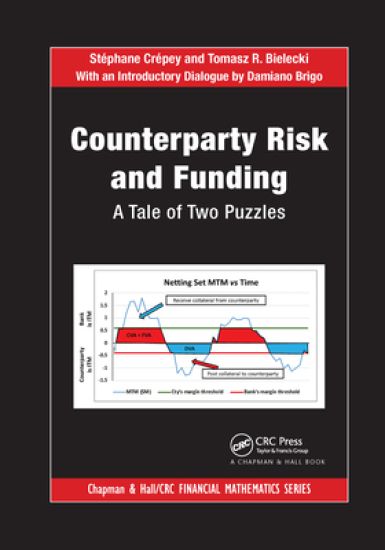
Counterparty Risk and Funding

Counterparty Risk and Funding

Stéphane Crépey; Tomasz R. Bielecki; Damiano Brigo

CRC Press
2020
nidottu
Solve the DVA/FVA Overlap Issue and Effectively Manage Portfolio Credit RiskCounterparty Risk and Funding: A Tale of Two Puzzles explains how to study risk embedded in financial transactions between the bank and its counterparty. The authors provide an analytical basis for the quantitative methodology of dynamic valuation, mitigation, and hedging of bilateral counterparty risk on over-the-counter (OTC) derivative contracts under funding constraints. They explore credit, debt, funding, liquidity, and rating valuation adjustment (CVA, DVA, FVA, LVA, and RVA) as well as replacement cost (RC), wrong-way risk, multiple funding curves, and collateral. The first part of the book assesses today’s financial landscape, including the current multi-curve reality of financial markets. In mathematical but model-free terms, the second part describes all the basic elements of the pricing and hedging framework. Taking a more practical slant, the third part introduces a reduced-form modeling approach in which the risk of default of the two parties only shows up through their default intensities. The fourth part addresses counterparty risk on credit derivatives through dynamic copula models. In the fifth part, the authors present a credit migrations model that allows you to account for rating-dependent credit support annex (CSA) clauses. They also touch on nonlinear FVA computations in credit portfolio models. The final part covers classical tools from stochastic analysis and gives a brief introduction to the theory of Markov copulas. The credit crisis and ongoing European sovereign debt crisis have shown the importance of the proper assessment and management of counterparty risk. This book focuses on the interaction and possible overlap between DVA and FVA terms. It also explores the particularly challenging issue of counterparty risk in portfolio credit modeling. Primarily for researchers and graduate students in financial mathematics, the book is also suitable for financial quants, managers in banks, CVA desks, and members of supervisory bodies.
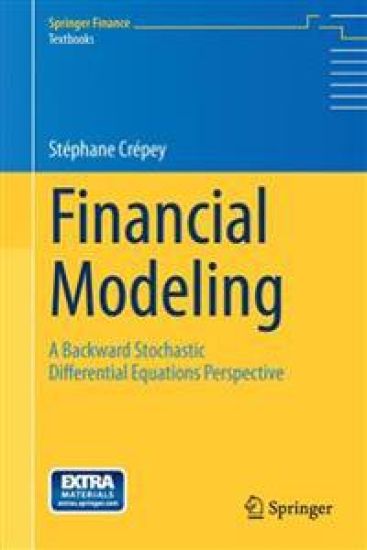
Financial Modeling

Financial Modeling

Stephane Crepey

Springer-Verlag Berlin and Heidelberg GmbH Co. K
2015
nidottu
Backward stochastic differential equations (BSDEs) provide a general mathematical framework for solving pricing and risk management questions of financial derivatives. They are of growing importance for nonlinear pricing problems such as CVA computations that have been developed since the crisis. Although BSDEs are well known to academics, they are less familiar to practitioners in the financial industry. In order to fill this gap, this book revisits financial modeling and computational finance from a BSDE perspective, presenting a unified view of the pricing and hedging theory across all asset classes. It also contains a review of quantitative finance tools, including Fourier techniques, Monte Carlo methods, finite differences and model calibration schemes. With a view to use in graduate courses in computational finance and financial modeling, corrected problem sets and Matlab sheets have been provided. Stéphane Crépey’s book starts with a few chapters on classical stochastic processes material, and then... fasten your seatbelt... the author starts traveling backwards in time through backward stochastic differential equations (BSDEs). This does not mean that one has to read the book backwards, like a manga! Rather, the possibility to move backwards in time, even if from a variety of final scenarios following a probability law, opens a multitude of possibilities for all those pricing problems whose solution is not a straightforward expectation. For example, this allows for framing problems like pricing with credit and funding costs in a rigorous mathematical setup. This is, as far as I know, the first book written for several levels of audiences, with applications to financial modeling and using BSDEs as one of the main tools, and as the song says: "it's never as good as the first time". Damiano Brigo, Chair of Mathematical Finance, Imperial College LondonWhile the classical theory of arbitrage free pricinghas matured, and is now well understood and used by the finance industry, the theory of BSDEs continues to enjoy a rapid growth and remains a domain restricted to academic researchers and a handful of practitioners. Crépey’s book presents this novel approach to a wider community of researchers involved in mathematical modeling in finance. It is clearly an essential reference for anyone interested in the latest developments in financial mathematics. Marek Musiela, Deputy Director of the Oxford-Man Institute of Quantitative Finance
Counterparty Risk and Funding

Counterparty Risk and Funding

Stéphane Crépey; Tomasz R. Bielecki; Damiano Brigo

CRC Press Inc
2014
sidottu
Solve the DVA/FVA Overlap Issue and Effectively Manage Portfolio Credit RiskCounterparty Risk and Funding: A Tale of Two Puzzles explains how to study risk embedded in financial transactions between the bank and its counterparty. The authors provide an analytical basis for the quantitative methodology of dynamic valuation, mitigation, and hedging of bilateral counterparty risk on over-the-counter (OTC) derivative contracts under funding constraints. They explore credit, debt, funding, liquidity, and rating valuation adjustment (CVA, DVA, FVA, LVA, and RVA) as well as replacement cost (RC), wrong-way risk, multiple funding curves, and collateral. The first part of the book assesses today’s financial landscape, including the current multi-curve reality of financial markets. In mathematical but model-free terms, the second part describes all the basic elements of the pricing and hedging framework. Taking a more practical slant, the third part introduces a reduced-form modeling approach in which the risk of default of the two parties only shows up through their default intensities. The fourth part addresses counterparty risk on credit derivatives through dynamic copula models. In the fifth part, the authors present a credit migrations model that allows you to account for rating-dependent credit support annex (CSA) clauses. They also touch on nonlinear FVA computations in credit portfolio models. The final part covers classical tools from stochastic analysis and gives a brief introduction to the theory of Markov copulas. The credit crisis and ongoing European sovereign debt crisis have shown the importance of the proper assessment and management of counterparty risk. This book focuses on the interaction and possible overlap between DVA and FVA terms. It also explores the particularly challenging issue of counterparty risk in portfolio credit modeling. Primarily for researchers and graduate students in financial mathematics, the book is also suitable for financial quants, managers in banks, CVA desks, and members of supervisory bodies.
Financial Modeling

Financial Modeling

Stephane Crepey

Springer-Verlag Berlin and Heidelberg GmbH Co. K
2013
sidottu
Backward stochastic differential equations (BSDEs) provide a general mathematical framework for solving pricing and risk management questions of financial derivatives. They are of growing importance for nonlinear pricing problems such as CVA computations that have been developed since the crisis. Although BSDEs are well known to academics, they are less familiar to practitioners in the financial industry. In order to fill this gap, this book revisits financial modeling and computational finance from a BSDE perspective, presenting a unified view of the pricing and hedging theory across all asset classes. It also contains a review of quantitative finance tools, including Fourier techniques, Monte Carlo methods, finite differences and model calibration schemes. With a view to use in graduate courses in computational finance and financial modeling, corrected problem sets and Matlab sheets have been provided. Stéphane Crépey’s book starts with a few chapters on classical stochastic processes material, and then... fasten your seatbelt... the author starts traveling backwards in time through backward stochastic differential equations (BSDEs). This does not mean that one has to read the book backwards, like a manga! Rather, the possibility to move backwards in time, even if from a variety of final scenarios following a probability law, opens a multitude of possibilities for all those pricing problems whose solution is not a straightforward expectation. For example, this allows for framing problems like pricing with credit and funding costs in a rigorous mathematical setup. This is, as far as I know, the first book written for several levels of audiences, with applications to financial modeling and using BSDEs as one of the main tools, and as the song says: "it's never as good as the first time". Damiano Brigo, Chair of Mathematical Finance, Imperial College LondonWhile the classical theory of arbitrage free pricinghas matured, and is now well understood and used by the finance industry, the theory of BSDEs continues to enjoy a rapid growth and remains a domain restricted to academic researchers and a handful of practitioners. Crépey’s book presents this novel approach to a wider community of researchers involved in mathematical modeling in finance. It is clearly an essential reference for anyone interested in the latest developments in financial mathematics. Marek Musiela, Deputy Director of the Oxford-Man Institute of Quantitative Finance
Paris-Princeton Lectures on Mathematical Finance 2010

Paris-Princeton Lectures on Mathematical Finance 2010

Areski Cousin; Stéphane Crépey; Olivier Guéant; David Hobson; Monique Jeanblanc; Jean-Michel Lasry; Jean-Paul Laurent; Pierre-Louis Lions; Peter Tankov

Springer-Verlag Berlin and Heidelberg GmbH Co. K
2010
nidottu
The Paris-Princeton Lectures in Financial Mathematics, of which this is the fourth volume, publish cutting-edge research in self-contained, expository articles from outstanding specialists - established or on the rise! The aim is to produce a series of articles that can serve as an introductory reference source for research in the field. The articles are the result of frequent exchanges between the finance and financial mathematics groups in Paris and Princeton. The present volume sets standards with five articles by: 1. Areski Cousin, Monique Jeanblanc and Jean-Paul Laurent, 2. Stéphane Crépey, 3. Olivier Guéant, Jean-Michel Lasry and Pierre-Louis Lions, 4. David Hobson and 5. Peter Tankov.