
Kirjojen hintavertailu – 12 903 725 kirjaa ja 27 kauppaa

Kirjailija

Stephane Dauzere-Peres

Kirjat ja teokset yhdessä paikassa: 2 kirjaa, julkaisuja vuosilta 1994–2017, suosituimpiin kuuluu An Integrated Approach in Production Planning and Scheduling. Vertaile teosten hintoja ja tarkista saatavuus suomalaisista kirjakaupoista.

Nimi esiintyy myös muodoissa: Stéphane Dauzère-Pérès

2 kirjaa

Kirjojen julkaisuvuodet: 1994–2017.

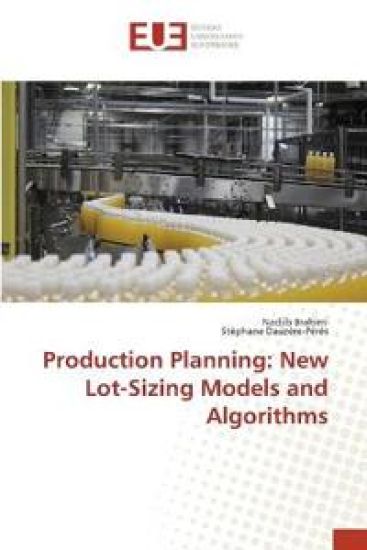
Production Planning

Production Planning

Nadjib Brahimi; Stéphane Dauzère-Pérès

Editions Universitaires Europeennes
2017
pokkari
In classical dynamic lot sizing problems with single level production, it has always been considered that production can start as early as the first period of the planning horizon. In this book, we show that usually, and naturally, this is not possible in several situations. Consider, for example the situation where raw materials arrive in different periods of the planning horizon with limited quantities. This imposes that production between two arrivals of raw material should exceed the available quantity between these periods. Thus some demands cannot be produced before a certain availability date. The book consists of the study of multi item lot sizing with time windows. After a review on capacitated multi-item lot sizing problems, we present several Lagrangian heuristics to solve the capacitated multi-item lot sizing problem with time windows. These heuristics are analyzed and compared. Numerical results showing the performance of each heuristic on different problem classes and data scenarios are presented. The results show that most of the presented Lagrangian heuristics are effective and robust.
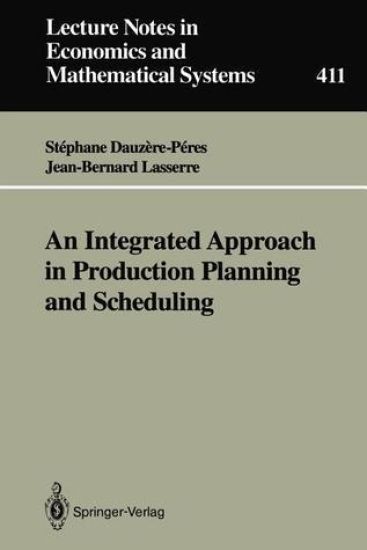
An Integrated Approach in Production Planning and Scheduling

An Integrated Approach in Production Planning and Scheduling

Stephane Dauzere-Peres; Jean-Bernard Lasserre

Springer-Verlag Berlin and Heidelberg GmbH Co. K
1994
nidottu
Production Management is a large field concerned with all the aspects related to production, from the very bottom decisions at the machine level, to the top-level strategic decisicns. In this book, we are concerned with production planning and scheduling aspects. Traditional production planning methodologies are based on a now widely ac­ cepted hierarchical decom?osition into several planning decision levels. The higher in the hierarchy, the more aggregate are the models and the more important are the decisions. In this book, we only consider the last two decision levels in the hierarchy, namely, the mid-term (or tacticaQ planning level and the short-term (or operationaQ scheduling level. In the literature and in practice, the decisions are taken in sequence and in a top-down approach from the highest level in the hierarchy to the bottom level. The decisions taken at some level in the hierarchy are constrained by those already taken at upper levels and in turn, must translate into feasible objectives for the next lower levels in the hierarchy. It is a common sense remark to say that the whole hierarchical decision process is coherent if the interactions between different levels in the hierarchy are taken into account so that a decision taken at some level in the hierarchy translates into a feasible objective for the next decision level in the hierarchy. However, and surpris­ ingly enough, this crucial consistency issue is rarely investigated and few results are available in the literature.