Kirjojen hintavertailu – 12 859 819 kirjaa ja 27 kauppaa

Kirjailija

Stephanie Pezard

Kirjat ja teokset yhdessä paikassa: 36 kirjaa, julkaisuja vuosilta 2011–2024, suosituimpiin kuuluu Report on the Arctic Capabilities of the U.S. Armed Forces. Vertaile teosten hintoja ja tarkista saatavuus suomalaisista kirjakaupoista.

36 kirjaa

Kirjojen julkaisuvuodet: 2011–2024.

What Deters and Why

What Deters and Why

Michael J Mazarr; Arthur Chan; Alyssa Demus; Bryan Frederick; Alireza Nader; Stephanie Pezard; Julia A Thompson; Elina Treyger

RAND
2019
nidottu
The challenge of deterring territorial aggression is taking on renewed importance, yet discussion of it has lagged in U. S. military and strategy circles. The authors aim to provide a fresh look, with two primary purposes: to review established concepts about deterrence, and to provide a framework for evaluating the strength of deterrent relationships. They focus on a specific type of deterrence: extended deterrence of interstate aggression.
Fit for Duty?

Fit for Duty?

Sean Robson; Maria C Lytell; Carra S Sims; Stephanie Pezard; Thomas Manacapilli; Amanda Anderson; Therese Bohusch; Abigail Haddad

RAND
2017
nidottu
Military occupations can be physically demanding, yet few attempts have been made to determine the physical readiness of today's airmen to perform their jobs. As part of a broader Air Force effort to measure the physical readiness of airmen to perform their jobs, this report describes a methodology for establishing physical fitness standards for four physically demanding Air Force occupational specialties.
European Relations with Russia

European Relations with Russia

Stephanie Pezard; Andrew Radin; Thomas S Szayna; F Stephen Larrabee

RAND
2017
nidottu
Russia's 2014 annexation of Crimea has challenged the integrity of Europe's territorial borders and had a broader negative impact on the European security environment. This report analyzes how Europeans perceive the Russian threat--whether European states regard Russia's policy in eastern and northern Europe as a security priority, how they have responded to Russian behavior, and how officials see the future of Russo-European relations.
Maintaining Arctic Cooperation with Russia

Maintaining Arctic Cooperation with Russia

Stephanie Pezard; Abbie Tingstad; Kristin Van Abel; Scott Stephenson

RAND
2017
pokkari
This report examines potential transformations that could alter Russia's current cooperative stance in the Arctic. It analyzes current security challenges related to climate and geography, economy, territorial claims, and military power, suggests some ways in which these could undermine Arctic cooperation, and offers recommendations for the U. S. government to manage the risks to cooperation.
Russia & the West After the Ukrainian Crisis

Russia & the West After the Ukrainian Crisis

F. Stephen Larrabee; Stephanie Pezard; Andrew Radin; Nathan Chandler; Keith Crane; Thomas S. Szayna

RAND
2017
pokkari
Given Russia's annexation of Crimea and continued aggression in eastern Ukraine, Europe must reassess its approach to a regional security environment previously thought to be stable and relatively benign. This report analyzes the vulnerability of European states to possible forms of Russian influence, pressure, and intimidation and examines four areas of potential European vulnerability: military, trade and investment, energy, and politics.
Defense Institution Building

Defense Institution Building

Walter L. Perry; Stuart E. Johnson; Stephanie Pezard; Gillian S. Oak; David Stebbins; Chaoling Feng

RAND
2016
pokkari
This report presents an analysis of a range of defense institution building (DIB) programs and activities, recommends a set of goals and objectives for achieving them, identifies partner nation and DIB activity selection criteria, develops a strategy for coordinating DIB activities, and recommends procedures for achieving accountability and assessment.
Achieving Peace in Northern Mali

Achieving Peace in Northern Mali

Stephanie Pezard; Michael Shurkin

RAND
2015
pokkari
This report examines the prospects for stabilization in Mali following the political and military crisis that began in 2012. To this end, it examines Mali s peace settlements since the early 1990s to identify flaws and successes. The report also explores whether Mali s neighbor Niger owes its current stability to a more favorable context, shrewd policies, or sheer luck, and whether it might offer a model of resilience for Mali."
Evaluating the Impact of the Department of Defense Regional Centers for Security Studies

Evaluating the Impact of the Department of Defense Regional Centers for Security Studies

Larry Hanauer; Stuart E. Johnson; Christopher Springer; Chaoling Feng; Michael J. McNerney; Stephanie Pezard; Shira Efron

RAND
2014
pokkari
The five U. S. Department of Defense (DoD) Regional Centers for Security Studies have been helping partner nations build strategic capacity for almost 20 years. They are high-impact components of U. S. security cooperation and engagement efforts, despite their relatively small budgets. This study analyzes the centers contributions to DoD policy priorities and the ways in which they assess their programs."
Lessons from Department of Defense Disaster Relief Efforts in the Asia-Pacific Region

Lessons from Department of Defense Disaster Relief Efforts in the Asia-Pacific Region

Jennifer D. P. Moroney; Stephanie Pezard; Laurel E. Miller; Jeffrey Engstrom; Peter Chalk; Abby Doll

RAND
2013
pokkari
The Department of Defense has long played a major role in humanitarian assistance/disaster response (HA/DR) operations due to its unique capabilities, manpower, and forward-deployed resources. The Asia-Pacific region is of particular importance because it bears the brunt of the majority of the world's natural disasters and is home to key U. S. allies. In an effort to improve the effectiveness of such operations, this report analyzes recent HA/DR operations in Burma, Indonesia, Pakistan, and Japan, and identifies lessons that can be applied in the future.
Democratization in the Arab World

Democratization in the Arab World

Laurel E. Miller; Jeffrey Martini; F. Stephen Larrabee; Angel Rabasa; Stephanie Pezard; Julie E. Taylor; Tewodaj Mengistu

RAND
2012
pokkari
Daunting challenges lie ahead for Arab countries where revolutions have upended longstanding authoritarian regimes. These unexpected events created new uncertainties in a troubled region: Would the Arab Spring lead to a flowering of democracy? Would loosening of the political systems in these countries unleash dangerous forces of extremism or ethno-sectarian conflict? Would new autocrats replace the old ones? Through a comparative analysis of past democratization experiences over nearly four decades and a detailed look at recent uprisings in the Arab world, this volume explores the conditions and decisions that are most likely to influence whether democratization will succeed in Arab countries undergoing political transitions. It also identifies the main challenges to democracy in these countries, analyzes how other countries have made similar transitions, and suggests what the United States and the international community can do to help strengthen fledgling democracies in the Arab world.
From Insurgency to Stability

From Insurgency to Stability

Angel Rabasa; John Gordon; Peter Chalk; Audra K. Grant; Scott K. McMahon; Stephanie Pezard; Caroline Reilly; David Ucko; Rebecca Zimmerman

RAND
2011
nidottu
This book examines six case studies of insurgencies from around the world to determine the key factors necessary for a successful transition from counterinsurgency to a more stable situation. The authors review the causes of each insurgency and the key players involved, and examine what the government did right - or wrong - to bring the insurgency to an end and to transition to greater stability.
From Insurgency to Stability

From Insurgency to Stability

Angel Rabasa; John Gordon; Peter Chalk; Christopher S. Chivvis; Audra K. Grant; Scott K. McMahon; Laurel E. Miller; Marco Overhaus; Stephanie Pezard

RAND
2011
pokkari
This book identifies the procedures and capabilities that the U. S. Department of Defense, other agencies of the U. S. government, U. S. allies and partners, and international organizations require in order to support the transition from counterinsurgency, when the military takes primary responsibility for security and economic operations, to stability and reconstruction, when police and civilian government agencies take the lead.
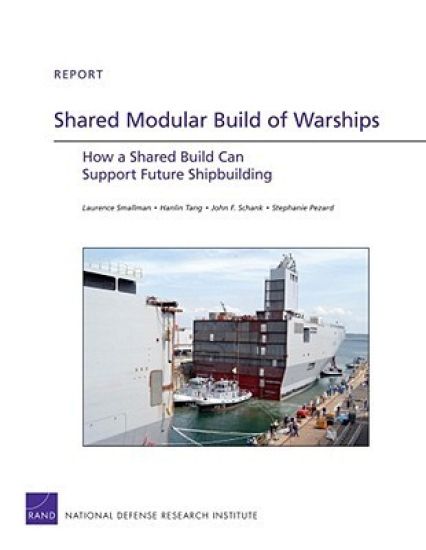
Shared Modular Build of Warships

Shared Modular Build of Warships

Laurence Smallman; Tang Hanlin; John F. Schank; Stephanie Pezard

RAND
2011
pokkari
Some recent shipbuilding programs in the United States and Europe have involved multiple shipyards constructing major modules of each ship for final integration and testing at one shipyard. The Navy needs to decide what it wants from a shared-build strategy, then monitor and manage the program to ensure that it delivers the required outcome, as well as the vessels called for in the program.