

Kirjailija
Stephen Bass
Kirjat ja teokset yhdessä paikassa: 6 kirjaa, julkaisuja vuosilta 2004–2020, suosituimpiin kuuluu The Forest Certification Handbook. Vertaile teosten hintoja ja tarkista saatavuus suomalaisista kirjakaupoista.
6 kirjaa
Kirjojen julkaisuvuodet: 2004–2020.
Strategies for National Sustainable Development
Jeremy Carew-Reid; Robert Prescott-Allen; Stephen Bass; Barry Dalal-Clayton
Routledge
2013
nidottu
The IUCN Strategies for Sustainable Development Handbook Series This handbook is one in a series being produced by IUCN and its partners to assist countries and communities implement Agenda 21, the action programme of the United Nations Conference on Environment and Development. The series will include handbooks on national strategies for sustainable development, local strategies, assessing progress towards sustainability, biodiversity action plans, .involving indigenous peoples, and on integrating population and resource use planning; and regular companion volumes of case studies addressing the key issues of concern to strategy implementation. Many international agreements and action plans now call for countries to undertake national strategies. These strategies seek to involve communities in united approaches to sustainable development. Some are sectoral, such as tropical forest strategies, others are thematic, covering topics such as biodiversity, education or climate change. Still others, such as national conservation strategies and national environment action plans, are evolving to become more comprehensive processes, drawing together economic, social and environmental development actions. This handbook is for people involved in strategies. It draws on experiences in different regions of the world to present options and examples of the role of strategies in sustainable development. Originally published in 1995
Plantations are playing an increasingly important part in the development and the economies of the South. Plantation Politics is the first book to examine their rationale and purpose, exposing the misconceptions and myths that have surrounded their role, and describing the contribution they can make to sustainable development. At their best, industrial plantations can become a major asset to local development by providing raw materials, infrastructure, employment, income and environmental and recreational services. At their worst, plantations, usually imposed from a 'top-down' perspective and ignoring local needs, values and rights, have monopolized land in times of food shortage, degraded wild animal and plant populations, and destroyed habitats and landscapes. The contributors analyse the conditions appropriate for both simple and complex plantations, and the contributions each can make. Complex plantations, whether established from scratch or within natural forest, are more suitable in most cases, where they are subject to numerous different claims and needs. However, their ownership, management and silviculture present new challenges ? challenges which, without the carefully researched guidelines offered here, current policy and research may well be ill-equipped to take up. Caroline Sargent is the Director and Stephen Bass is the Associate Director of the Forestry Programme at the International Institute for Environment and Development. Originally published in 1992
Strategies for National Sustainable Development
Jeremy Carew-Reid; Robert Prescott-Allen; Stephen Bass; Barry Dalal-Clayton
Earthscan Ltd
2009
sidottu
The IUCN Strategies for Sustainable Development Handbook Series This handbook is one in a series being produced by IUCN and its partners to assist countries and communities implement Agenda 21, the action programme of the United Nations Conference on Environment and Development. The series will include handbooks on national strategies for sustainable development, local strategies, assessing progress towards sustainability, biodiversity action plans, .involving indigenous peoples, and on integrating population and resource use planning; and regular companion volumes of case studies addressing the key issues of concern to strategy implementation. Many international agreements and action plans now call for countries to undertake national strategies. These strategies seek to involve communities in united approaches to sustainable development. Some are sectoral, such as tropical forest strategies, others are thematic, covering topics such as biodiversity, education or climate change. Still others, such as national conservation strategies and national environment action plans, are evolving to become more comprehensive processes, drawing together economic, social and environmental development actions. This handbook is for people involved in strategies. It draws on experiences in different regions of the world to present options and examples of the role of strategies in sustainable development. Originally published in 1995
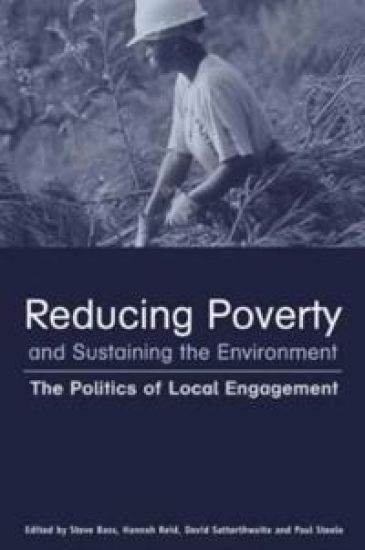
Reducing Poverty and Sustaining the Environment
Stephen Bass; Hannah Reid; David Satterthwaite; Paul Steele
Earthscan Ltd
2005
nidottu
'A valuable contribution to our collective knowledge about governance, poverty and the environment' Frances Seymour, World Resources Institute 'Detailed and realistic documentation of contemporary development and governance relationships and trends' Melissa Leach, Institute of Development Studies There are growing signs that development work by governments, aid agencies and non-government organisations ignores the fact that environmental quality matters to the poor. There are also indications that some environmental work is pushing 'people-out' protection methodologies. Yet recently, an extensive range of project, programme and policy level activities has focused attention on the important links between poverty and the environment, and the benefit of entrenching these links in policy-making processes at all levels. The role that politics plays in all of this is of overriding importance. This volume is the first to address the role of politics in environmental issues that matter to the poor through a series of case studies. It describes experiences at regional, national and local levels in low and middle income countries including China, Tanzania, Nigeria, South Africa, Pakistan, Colombia, Peru, India, Saint Lucia and countries in East Africa. Ultimately the book demonstrates how understanding the national and local political context is crucial for addressing poverty-environment issues such as environmental health, access to natural resources for livelihoods and security, and coping with environmental disasters. The editors advocate ways in which political processes can be used to make positive changes - from the perspectives of both poverty reduction and the environment.
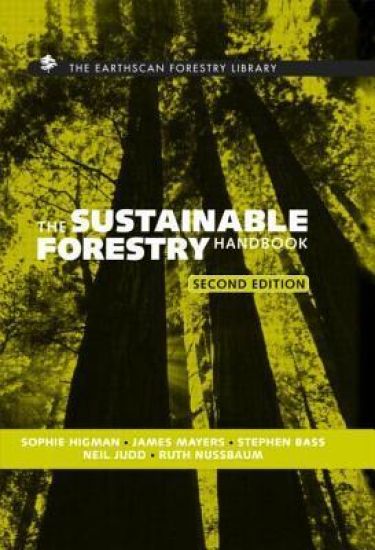
The Sustainable Forestry Handbook
Neil Judd; Sophie Higman; Stephen Bass; James Mayers; Ruth Nussbaum
Earthscan Ltd
2004
sidottu
"Provides a guide to the practicalities of implementing international standards for sustainable forest management. This highly practical handbook is aimed at forest managers"-- Provided by publisher.