Kirjojen hintavertailu – 12 859 828 kirjaa ja 27 kauppaa

Kirjailija

Stephen Bottomley

Kirjat ja teokset yhdessä paikassa: 6 kirjaa, julkaisuja vuosilta 2007–2025, suosituimpiin kuuluu Contemporary Australian Corporate Law. Vertaile teosten hintoja ja tarkista saatavuus suomalaisista kirjakaupoista.

6 kirjaa

Kirjojen julkaisuvuodet: 2007–2025.

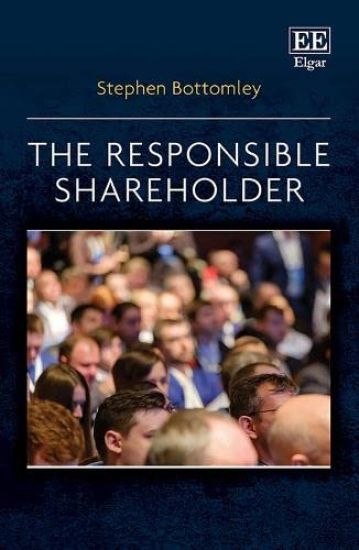
The Responsible Shareholder

The Responsible Shareholder

Stephen Bottomley

Edward Elgar Publishing Ltd
2021
sidottu
Examining the role of shareholders in modern companies, this timely book argues that more should be expected of shareholders, both morally and legally. It explores the privileged position of shareholders within the corporate law system and the unique rights and duties awarded to them in contrast to other corporate actors. Introducing the concept of shareholders as responsible agents whose actions and inactions should be judged on that basis, Stephen Bottomley unites a number of distinct corporate governance discussions including stewardship, activism and shareholder liability. The Responsible Shareholder argues that when companies cause harm to the environment, inflict injury on workers, or commit financial fraud, it is not just the actions of the directors, managers, advisers or regulators that should be scrutinized. Instead of consigning shareholders to a passive or marginal role in the drive for greater corporate responsibility, this book recommends that it is time to hold this key constituency in the company decision-making structure accountable. Comparative and interdisciplinary, this book will be a key resource for students and scholars of corporate law and governance, business law and insolvency law. It will also be of value to company law policy makers, corporate interest groups and think tanks engaged in corporate law reform.

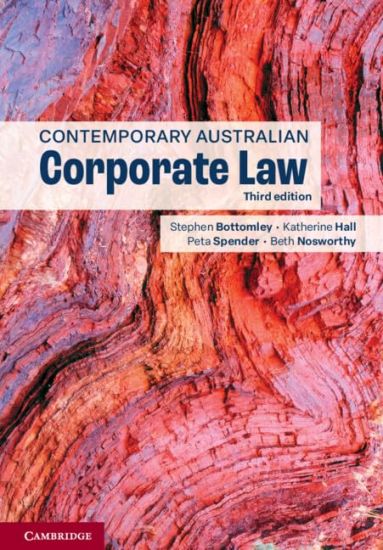
Contemporary Australian Corporate Law

Contemporary Australian Corporate Law

Stephen Bottomley; Kath Hall; Peta Spender; Beth Nosworthy

Cambridge University Press
2020
pokkari
Contemporary Australian Corporate Law is a highly-regarded introduction to corporate law in Australia that provides an authoritative, contextual and critical analysis of the law governing Australian corporations and financial markets. It explores the rules, principles, doctrines and policies that constitute corporate law in Australia within their legal, social, economic and political contexts. Clearly and precisely written, this edition has been thoroughly updated and refined to reflect current Australian corporate law, including recent case law, changes to the Corporations Act 2001 and the impact on the corporate sector of the Financial Services Royal Commission. Written by leading legal scholars, Contemporary Australian Corporate Law will assist students to develop a critically informed understanding of corporate law and the role of corporations in contemporary society.
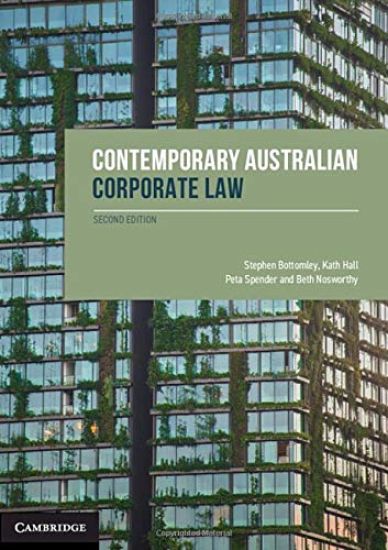
Contemporary Australian Corporate Law

Contemporary Australian Corporate Law

Stephen Bottomley; Kath Hall; Peta Spender; Beth Nosworthy

Cambridge University Press
2017
pokkari
Contemporary Australian Corporate Law provides an authoritative, contextual and critical analysis of Australian corporate and financial markets law, designed to engage today's LL. B. and JD students. Written by leading corporate law scholars, the text provides a number of features including: a well-structured presentation of topics for Australian corporate law courses, consistent application of theory with discussion of corporate law principles (both theoretical and historical), comprehensive discussion of case law with modern examples, and integration of corporate law and corporate governance, all with clarity, insight and technical excellence. Central concepts are enhanced with dynamic and relevant discussions of corporate law in context, including debates relating to the role of corporations in society, the global convergence of corporate law as well as corporations and human rights. Exploring the social, political and economic forces which shape modern corporations law, Contemporary Australian Corporate Law encourages a forward-thinking approach to understanding key concepts within the field.
The Constitutional Corporation

The Constitutional Corporation

Stephen Bottomley

Routledge
2016
nidottu
Corporate laws are based on the idea that the interests of shareholders should be the primary concern of company directors. However, some argue that the proper role for shareholders is to sit back and let the corporation's managers do their job, or that the pursuit of shareholders' interests detracts from the concerns of employees or victims of corporate wrongdoing or other stakeholders. Stephen Bottomley argues that instead of consigning shareholders to this passive role, they should be given opportunities to be active members of corporations. Corporations are constitutional arrangements rather than mere contractual agreements. They are decision-making organizations in which questions of process and structure are important. Thus, instead of using economic criteria such as efficiency as the sole measure for deciding what constitutes 'good' corporate governance, this book examines whether ideas of accountability, deliberation and contestability provide a valuable framework for assessing corporate structures and process and for encouraging greater shareholder participation.
The Constitutional Corporation

The Constitutional Corporation

Stephen Bottomley

Ashgate Publishing Limited
2007
sidottu
Corporate laws are based on the idea that the interests of shareholders should be the primary concern of company directors. However, some argue that the proper role for shareholders is to sit back and let the corporation's managers do their job, or that the pursuit of shareholders' interests detracts from the concerns of employees or victims of corporate wrongdoing or other stakeholders. Stephen Bottomley argues that instead of consigning shareholders to this passive role, they should be given opportunities to be active members of corporations. Corporations are constitutional arrangements rather than mere contractual agreements. They are decision-making organizations in which questions of process and structure are important. Thus, instead of using economic criteria such as efficiency as the sole measure for deciding what constitutes 'good' corporate governance, this book examines whether ideas of accountability, deliberation and contestability provide a valuable framework for assessing corporate structures and process and for encouraging greater shareholder participation.