Kirjojen hintavertailu – 12 859 818 kirjaa ja 27 kauppaa

Kirjailija

Stephen Fineman

Kirjat ja teokset yhdessä paikassa: 11 kirjaa, julkaisuja vuosilta 1996–2026, suosituimpiin kuuluu Supporting the Jobless. Vertaile teosten hintoja ja tarkista saatavuus suomalaisista kirjakaupoista.

11 kirjaa

Kirjojen julkaisuvuodet: 1996–2026.

Supporting the Jobless

Supporting the Jobless

Stephen Fineman

TAYLOR FRANCIS LTD
2026
nidottu
The problems of unemployment soon reach the desks and consulting rooms of professional helpers. But, when joblessness is the ‘social disease’, what role is there for the professional who sees the symptoms but cannot offer the cure—a job? Stephen Fineman in his book Supporting the Jobless (first published in 1990) reveals, through a sensitive portrait of their lives and dilemmas, the sense of crisis that these professionals feel in the face of unemployment. The book covers four professions—medicine, specifically general practice; the clergy; the police; and the probation service. They represent the spectrum of social care provision and very different professional and organizational cultures. The author looks closely at how helpers respond to their jobless clients. Some cling to vestiges of their traditional professionalism, while others try to develop more effective support, only to encounter rigid professional restraints intent on self-protection. The author considers whether professionals are flexible enough to overcome these restraints and change their practice and organization to respond to their clients’ needs. This volume is a practical and accessible study of the human cost of unemployment from the professionals’ viewpoint. Based on detailed research and case studies, it offers unusual accounts of joblessness to students of sociology, social psychology, and management. It gives professionals constructive suggestions for improving the service they offer clients who find themselves out of work.
Supporting the Jobless

Supporting the Jobless

Stephen Fineman

TAYLOR FRANCIS LTD
2024
sidottu
The problems of unemployment soon reach the desks and consulting rooms of professional helpers. But, when joblessness is the ‘social disease’, what role is there for the professional who sees the symptoms but cannot offer the cure—a job? Stephen Fineman in his book Supporting the Jobless (first published in 1990) reveals, through a sensitive portrait of their lives and dilemmas, the sense of crisis that these professionals feel in the face of unemployment. The book covers four professions—medicine, specifically general practice; the clergy; the police; and the probation service. They represent the spectrum of social care provision and very different professional and organizational cultures. The author looks closely at how helpers respond to their jobless clients. Some cling to vestiges of their traditional professionalism, while others try to develop more effective support, only to encounter rigid professional restraints intent on self-protection. The author considers whether professionals are flexible enough to overcome these restraints and change their practice and organization to respond to their clients’ needs. This volume is a practical and accessible study of the human cost of unemployment from the professionals’ viewpoint. Based on detailed research and case studies, it offers unusual accounts of joblessness to students of sociology, social psychology, and management. It gives professionals constructive suggestions for improving the service they offer clients who find themselves out of work.
Work

Work

Stephen Fineman

Oxford University Press
2012
nidottu
The image of a job captures our imagination from an early age, usually prompted by the question 'What do you want to be when you grow up?'. Work -- paid, unpaid, voluntary, or obligatory -- is woven into the fabric of all human societies. For many of us, it becomes part of our identity. For others it is a tedious necessity. Living is problematic without paid work, and for many it is catastrophic. Steve Fineman tells the fascinating story of work - how we strive for security, reward, and often, meaning. Looking at how we classify 'work'; the cultural and social factors that influence the way we work; the ethics of certain types of work; and the factors that will affect the future of work, from globalization to technology, this Very Short Introduction considers work as a concept and as a practical experience, drawing upon ideas from psychology, sociology, management, and social history. ABOUT THE SERIES: The Very Short Introductions series from Oxford University Press contains hundreds of titles in almost every subject area. These pocket-sized books are the perfect way to get ahead in a new subject quickly. Our expert authors combine facts, analysis, perspective, new ideas, and enthusiasm to make interesting and challenging topics highly readable.
Organizing Age

Organizing Age

Stephen Fineman

Oxford University Press
2011
sidottu
Age is the silent shaper of work organizations and their human resource practices. It has become a potent feature of how society is structured and how it views itself. Age assumptions mould the behaviours of young and old alike, and are used as political tools by policy makers and managers. Organizing Age asks the perennial question - can age ever not matter? Drawing on range of social scientific and popular writings, this book casts a critical eye over the social construction and politicization of age in and beyond organizations. Amongst other topics, it discusses: the historical roots of age in society; how we 'perform' our age in different settings; the social impact of defining age groups as generations; ageism; the effect of an age-cluster on an organization's processes and members' experience; the rituals of retirement and the birth of the retirement industry; the impact of economic recession in challenging some of our assumptions about age; and the increasing politicization of the growing 'grey' population. Organizing Age provides an accessible introduction to the current and emerging themes around this topic, which will be an invaluable resource for students, academics, and policy makers.
Organizing Age

Organizing Age

Stephen Fineman

Oxford University Press
2011
nidottu
Age is the silent shaper of work organizations and their human resource practices. It has become a potent feature of how society is structured and how it views itself. Age assumptions mould the behaviours of young and old alike, and are used as political tools by policy makers and managers. Organizing Age asks the perennial question - can age ever not matter? Drawing on range of social scientific and popular writings, this book casts a critical eye over the social construction and politicization of age in and beyond organizations. Amongst other topics, it discusses: the historical roots of age in society; how we 'perform' our age in different settings; the social impact of defining age groups as generations; ageism; the effect of an age-cluster on an organization's processes and members' experience; the rituals of retirement and the birth of the retirement industry; the impact of economic recession in challenging some of our assumptions about age; and the increasing politicization of the growing 'grey' population. Organizing Age provides an accessible introduction to the current and emerging themes around this topic, which will be an invaluable resource for students, academics, and policy makers.
Organizing & Organizations

Organizing & Organizations

Stephen Fineman; Yiannis Gabriel; David B P Sims

SAGE Publications Ltd
2009
nidottu
Organizing and Organizations is well loved by students and lecturers for its accessible, conversational tone and insightful real-life examples introducing the study of organizations and organizational behaviour. Fineman, Gabriel and Sims, eminent academics in the field, cover a wealth of key concepts, research and literature leaving students informed and engaged. The Fourth Edition builds on the strengths of previous editions, to provide you with a textbook that continues to stand out from the rest. This new edition has been fully developed to include: - New chapters on Influence and Power, and Innovation and Change. - A new section within each chapter that highlights the theoretical links informing the chapters. - New review questions to test and apply your understanding of the ideas in each chapter. - New 'reading on' sections that direct you to free links to highly recommended journal articles relating to each chapter's coverage, and found on the companion website. - New critical review questions at the end of each chapter to encourage debate. - Each chapter is now enlivened with pictorial illustrations. - A fully updated glossary of key concepts in the study of organizations Organizing and Organizations integrates a strong critical approach throughout.
Organizing & Organizations

Organizing & Organizations

Stephen Fineman; Yiannis Gabriel; David B P Sims

SAGE Publications Ltd
2009
sidottu
Organizing and Organizations is well loved by students and lecturers for its accessible, conversational tone and insightful real-life examples introducing the study of organizations and organizational behaviour. Fineman, Gabriel and Sims, eminent academics in the field, cover a wealth of key concepts, research and literature leaving students informed and engaged. The Fourth Edition builds on the strengths of previous editions, to provide you with a textbook that continues to stand out from the rest. This new edition has been fully developed to include: - New chapters on Influence and Power, and Innovation and Change. - A new section within each chapter that highlights the theoretical links informing the chapters. - New review questions to test and apply your understanding of the ideas in each chapter. - New 'reading on' sections that direct you to free links to highly recommended journal articles relating to each chapter's coverage, and found on the companion website. - New critical review questions at the end of each chapter to encourage debate. - Each chapter is now enlivened with pictorial illustrations. - A fully updated glossary of key concepts in the study of organizations Organizing and Organizations integrates a strong critical approach throughout.
Understanding Emotion at Work

Understanding Emotion at Work

Stephen Fineman

SAGE Publications Inc
2003
sidottu
`Most folks in organizations dichotomize reason and emotion, often treating emotion as an uncommon or marginal occurrence. Written in a clear and lively style, Steve Fineman's book, Understanding Emotion at Work, dispels this notion as he demonstrates how emotions infuse most practices in organizational life, including leading, decision making, organizational change, gender relations, stress, and downsizing. Sprinkled with vivid examples, Fineman captures the positive benefits of emotions at work as well as the darker side of feelings and despair. Scholars, students and practitioners alike will glean important insights from the lens of emotion that Fineman brings to the subtleties of organizational life' - Linda L Putnam, Texas A&M University `Stephen Fineman has written a wise and engaging text about emotions and how they play out in and around organizations. He underscores, with a range of fine examples, thoughtful commentary and careful scholarship, the essential role of emotions in organizational life. He applies his lens to such issues as recruitment, leadership, decision making and change. He extends the reach of emotions into the virtual world of work and he makes apparent the heavy costs to people and their organizations of toxic emotions that stem from bullying,harassment and downsizing. A must-read in any curriculum dealing with the study of organization' - Peter Frost, Edgar F. Kaiser Professor of Organizational Behaviour, Faculty of Commerce and Business Administration, University of British Columbia, Canada Author of Toxic Emotions at Work HBS Press 2003 `Going to work can be a great joy, a great pain, or a mixture of the two. This clearly written, engaging and authoritative book demonstrates the vital necessity of understanding how emotions permeate work organisations at every level and in every situation. No student of work and its organisation can afford to neglect this important area of study. And no writer on work and organisation is better placed to go to the heart of these matters than Stephen Fineman' - Professor Tony J Watson, Professor of Organisational and Managerial Behaviour, Nottingham Business School `In this book, Professor Stephen Fineman has done more of what he does best writing eloquently and perceptively about emotions in organizations. In this case, he is writing directly for students, both undergraduates and postgraduates, and uses a wide range of disciplinary insights to show how emotions are inextricably embedded in organizational life. His book helps to launch students on a voyage of self-discovery to learn for themselves how emotions impact upon them and their colleagues. As someone who has long challenged the "emotion-less" view of emotion that characterizes much of the research on this phenomenon, he uses his considerable skills to convey the importance, richness and nuance of emotion. Nor does he shrink away from tackling the darker side of organizational emotional life challenging students to reflect on the agony, as well as the ecstasy, that passionate emotions can cause. This book is a valuable resource for teachers wanting to introduce students to organizations, and a fascinating and astute aid for students interested in learning about them - Professor Cynthia Hardy, Department of Management, University of Melbourne `Organizational life is shot through with emotions, spawning a growing interest in topics ranging from emotional intelligence to violence at work. Stephen Fineman provides a much-needed survey of these topics, capturing their sprawling breadth without sacrificing depth. Moreover, he succeeds in conveying the everyday feel of emotions in organizational life in a way that is both engaging and informative' - Blake Ashforth, Jerry and Mary Ann Chapman Professor of Business, W P Carey School of Business, Arizona State University Understanding Emotion at Work gets to the heart of what binds and breaks organizations: emotion. It explores beyond the surface of work to the rich emotional life bubbling underneath, showing what employees and managers constantly deal with but are often ill-equipped to do so. This is the first introductory book on emotions and it's aimed specifically at students of management and organization studies. Written accessibly, it avoids pat prescriptions, but leaves the reader with challenging questions about the intrisic nature of emotions to the design and management of organizations. Drawing on a rich discipline-field, including psychology, sociology and organizational theory, Stephen Fineman explores a number of familiar and not so familiar work arenas. He examines the way emotion penetrates leadership, decision-making and organizational change as well as newer topics like the virtual side of organizations. Finally, he addresses the darker side of emotion in the context of bullying, violence, sexual harassment and downsizing. Understanding Emotion at Work will shed light on this growing subject for advanced undergraduates and postgraduates studying organizational behaviour, HRM or organizational psychology.

Understanding Emotion at Work

Understanding Emotion at Work

Stephen Fineman

SAGE PUBLICATIONS INC
2003
nidottu
`Most folks in organizations dichotomize reason and emotion, often treating emotion as an uncommon or marginal occurrence. Written in a clear and lively style, Steve Fineman's book, Understanding Emotion at Work, dispels this notion as he demonstrates how emotions infuse most practices in organizational life, including leading, decision making, organizational change, gender relations, stress, and downsizing. Sprinkled with vivid examples, Fineman captures the positive benefits of emotions at work as well as the darker side of feelings and despair. Scholars, students and practitioners alike will glean important insights from the lens of emotion that Fineman brings to the subtleties of organizational life' - Linda L Putnam, Texas A&M University `Stephen Fineman has written a wise and engaging text about emotions and how they play out in and around organizations. He underscores, with a range of fine examples, thoughtful commentary and careful scholarship, the essential role of emotions in organizational life. He applies his lens to such issues as recruitment, leadership, decision making and change. He extends the reach of emotions into the virtual world of work and he makes apparent the heavy costs to people and their organizations of toxic emotions that stem from bullying,harassment and downsizing. A must-read in any curriculum dealing with the study of organization' - Peter Frost, Edgar F. Kaiser Professor of Organizational Behaviour, Faculty of Commerce and Business Administration, University of British Columbia, Canada Author of Toxic Emotions at Work HBS Press 2003 `Going to work can be a great joy, a great pain, or a mixture of the two. This clearly written, engaging and authoritative book demonstrates the vital necessity of understanding how emotions permeate work organisations at every level and in every situation. No student of work and its organisation can afford to neglect this important area of study. And no writer on work and organisation is better placed to go to the heart of these matters than Stephen Fineman' - Professor Tony J Watson, Professor of Organisational and Managerial Behaviour, Nottingham Business School `In this book, Professor Stephen Fineman has done more of what he does best writing eloquently and perceptively about emotions in organizations. In this case, he is writing directly for students, both undergraduates and postgraduates, and uses a wide range of disciplinary insights to show how emotions are inextricably embedded in organizational life. His book helps to launch students on a voyage of self-discovery to learn for themselves how emotions impact upon them and their colleagues. As someone who has long challenged the "emotion-less" view of emotion that characterizes much of the research on this phenomenon, he uses his considerable skills to convey the importance, richness and nuance of emotion. Nor does he shrink away from tackling the darker side of organizational emotional life challenging students to reflect on the agony, as well as the ecstasy, that passionate emotions can cause. This book is a valuable resource for teachers wanting to introduce students to organizations, and a fascinating and astute aid for students interested in learning about them - Professor Cynthia Hardy, Department of Management, University of Melbourne `Organizational life is shot through with emotions, spawning a growing interest in topics ranging from emotional intelligence to violence at work. Stephen Fineman provides a much-needed survey of these topics, capturing their sprawling breadth without sacrificing depth. Moreover, he succeeds in conveying the everyday feel of emotions in organizational life in a way that is both engaging and informative' - Blake Ashforth, Jerry and Mary Ann Chapman Professor of Business, W P Carey School of Business, Arizona State University Understanding Emotion at Work gets to the heart of what binds and breaks organizations: emotion. It explores beyond the surface of work to the rich emotional life bubbling underneath, showing what employees and managers constantly deal with but are often ill-equipped to do so. This is the first introductory book on emotions and it's aimed specifically at students of management and organization studies. Written accessibly, it avoids pat prescriptions, but leaves the reader with challenging questions about the intrisic nature of emotions to the design and management of organizations. Drawing on a rich discipline-field, including psychology, sociology and organizational theory, Stephen Fineman explores a number of familiar and not so familiar work arenas. He examines the way emotion penetrates leadership, decision-making and organizational change as well as newer topics like the virtual side of organizations. Finally, he addresses the darker side of emotion in the context of bullying, violence, sexual harassment and downsizing. Understanding Emotion at Work will shed light on this growing subject for advanced undergraduates and postgraduates studying organizational behaviour, HRM or organizational psychology.
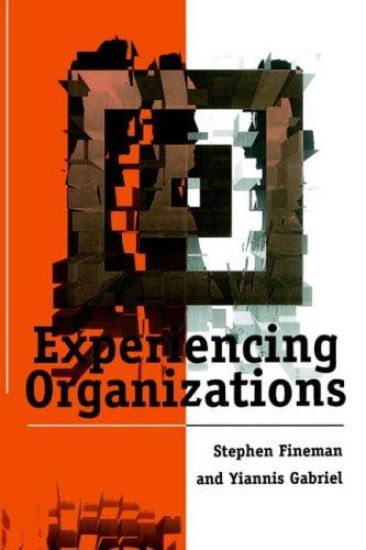
Experiencing Organizations

Experiencing Organizations

Stephen Fineman; Yiannis Gabriel

SAGE Publications Ltd
1996
nidottu
Told through the fresh, sharp eyes of new organizational recruits, these sometimes comic, often traumatic, but always vivid and revealing accounts of organizations have much to say to learners and old hands alike. Grouped in sections on `images', `winning and losing' and `survival and injuries', the narratives encompass a wide gamut of themes and issue. These include: power and politics in organizations; organizational cultures and change; gender and discrimination; appearances and realities; leaders and followers; and emotion, motivation and stress. The authors also focus on the coldly competitive features of businesses where processes such as restructuring, rationalization and downsizing are increasingly commonplace. Throughout, commentaries by Stephen Fineman and Yiannis Gabriel highlight particular points of analysis and learning, while each chapter concludes with questions for discussion and a selected bibliography enabling further reading.
Experiencing Organizations

Experiencing Organizations

Stephen Fineman; Yiannis Gabriel

SAGE Publications Ltd
1996
sidottu
Told through the fresh, sharp eyes of new organizational recruits, these sometimes comic, often traumatic, but always vivid and revealing accounts of organizations have much to say to learners and old hands alike. Grouped in sections on `images', `winning and losing' and `survival and injuries', the narratives encompass a wide gamut of themes and issue. These include: power and politics in organizations; organizational cultures and change; gender and discrimination; appearances and realities; leaders and followers; and emotion, motivation and stress. The authors also focus on the coldly competitive features of businesses where processes such as restructuring, rationalization and downsizing are increasingly commonplace. Throughout, commentaries by Stephen Fineman and Yiannis Gabriel highlight particular points of analysis and learning, while each chapter concludes with questions for discussion and a selected bibliography enabling further reading.