Kirjojen hintavertailu – 12 859 818 kirjaa ja 27 kauppaa

Kirjailija

Stephen Finlay

Kirjat ja teokset yhdessä paikassa: 4 kirjaa, julkaisuja vuosilta 2014–2020, suosituimpiin kuuluu Confusion of Tongues. Vertaile teosten hintoja ja tarkista saatavuus suomalaisista kirjakaupoista.

4 kirjaa

Kirjojen julkaisuvuodet: 2014–2020.

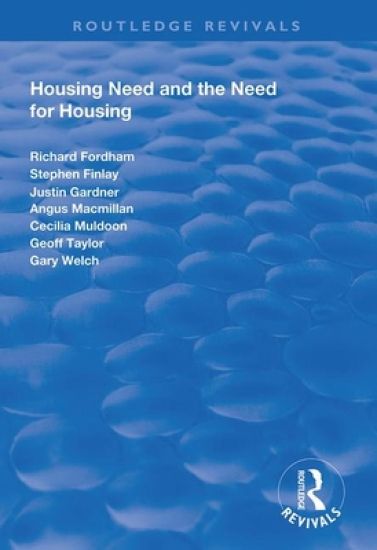
Housing Need and the Need for Housing

Housing Need and the Need for Housing

Richard Fordham; Stephen Finlay; Justin Gardener; Angus Macmillan; Cecilia Muldoon; Geoff Taylor; Gary Welch

Routledge
2020
nidottu
First published in 1998, this book addresses a central issue in housing: that of ‘need’ and how to meet it. Need refers either to individual household circumstances or to the aggregate requirement for new (social and market) housing. The book develops a new policy mechanism to address the present fragmented policy situation. The mechanism now used to allocate finance and new social housing numbers is complex and ineffective in terms of meeting needs. The book’s proposals are rooted in clear definitions of the key terms, especially that of housing need, which suffers from lack of any clear definition. The analysis is developed using a large database of survey information covering England and Wales. The proposed policy mechanism should be of great interest at a time when radical change to local government are being considered. The proposed mechanism would greatly increase value for money of public time and expenditure on (planning for) social housing.
Housing Need and the Need for Housing

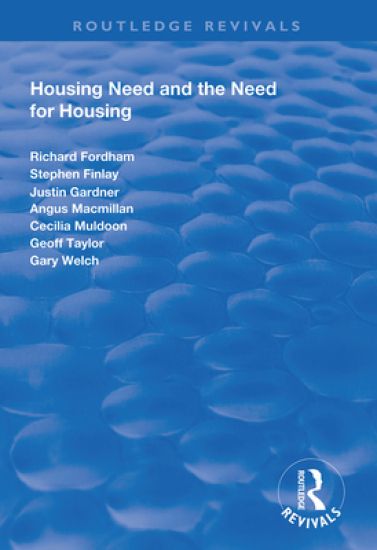
Housing Need and the Need for Housing

Richard Fordham; Stephen Finlay; Justin Gardener; Angus Macmillan; Cecilia Muldoon; Geoff Taylor; Gary Welch

Routledge
2019
sidottu
First published in 1998, this book addresses a central issue in housing: that of ‘need’ and how to meet it. Need refers either to individual household circumstances or to the aggregate requirement for new (social and market) housing. The book develops a new policy mechanism to address the present fragmented policy situation. The mechanism now used to allocate finance and new social housing numbers is complex and ineffective in terms of meeting needs. The book’s proposals are rooted in clear definitions of the key terms, especially that of housing need, which suffers from lack of any clear definition. The analysis is developed using a large database of survey information covering England and Wales. The proposed policy mechanism should be of great interest at a time when radical change to local government are being considered. The proposed mechanism would greatly increase value for money of public time and expenditure on (planning for) social housing.

Confusion of Tongues

Confusion of Tongues

Stephen Finlay

Oxford University Press Inc
2016
nidottu
Can normative words like "good," "ought," and "reason" be defined in entirely non-normative terms? Confusion of Tongues argues that they can, advancing a new End-Relational theory of the meaning of this language as providing the best explanation of the many different ways it is ordinarily used. Philosophers widely maintain that analyzing normative language as describing facts about relations cannot account for special features of particularly moral and deliberative uses of normative language, but Stephen Finlay argues that the End-Relational theory systematically explains these on the basis of a single fundamental principle of conversational pragmatics. These challenges comprise the central problems of metaethics, including the connection between normative judgment and motivation, the categorical character of morality, the nature of intrinsic value, and the possibility of normative disagreement. Finlay's linguistic analysis has deep implications for the metaphysics, epistemology, and psychology of morality, as well as for the nature and possibility of normative ethical theory. Most significantly it supplies a nuanced answer to the ancient Euthyphro Question of whether we desire things because we judge them good, or vice versa. Normative speech and thought may ultimately be just a manifestation of our nature as intelligent animals motivated by contingent desires for various conflicting ends.
Confusion of Tongues

Confusion of Tongues

Stephen Finlay

Oxford University Press Inc
2014
sidottu
Can normative words like "good," "ought," and "reason" be defined in entirely non-normative terms? Confusion of Tongues argues that they can, advancing a new End-Relational theory of the meaning of this language as providing the best explanation of the many different ways it is ordinarily used. Philosophers widely maintain that analyzing normative language as describing facts about relations cannot account for special features of particularly moral and deliberative uses of normative language, but Stephen Finlay argues that the End-Relational theory systematically explains these on the basis of a single fundamental principle of conversational pragmatics. These challenges comprise the central problems of metaethics, including the connection between normative judgment and motivation, the categorical character of morality, the nature of intrinsic value, and the possibility of normative disagreement. Finlay's linguistic analysis has deep implications for the metaphysics, epistemology, and psychology of morality, as well as for the nature and possibility of normative ethical theory. Most significantly it supplies a nuanced answer to the ancient Euthyphro Question of whether we desire things because we judge them good, or vice versa. Normative speech and thought may ultimately be just a manifestation of our nature as intelligent animals motivated by contingent desires for various conflicting ends.