Kirjailija
Stephen Hester
Kirjat ja teokset yhdessä paikassa: 14 kirjaa, julkaisuja vuosilta 1992–2026, suosituimpiin kuuluu Deviance in Classrooms (RLE Edu M). Vertaile teosten hintoja ja tarkista saatavuus suomalaisista kirjakaupoista.
14 kirjaa
Kirjojen julkaisuvuodet: 1992–2026.
Descriptions of Deviances critically engages with the two hitherto dominant perspectives in the sociology of deviance and criminology, and thereby clarifies the key differences between these theoretical points of view and the ethnomethodological approach to deviance. Hester offers an original and exemplary contribution to ethnomethodology and conversation analysis that not only illuminates the production of descriptions of deviance in the context of referral consultations, but also explores the relations between different ‘layers’ of organization – sequential, categorical and factual – that are operative and discoverable within talk-in-interaction. By connecting the analysis of these materials to previous ethnomethodological work on crime and deviance, Descriptions of Deviance articulates and publicizes, what is now, a very substantial submerged corpus of ethnomethodological studies that are directly relevant to the sociology of deviance and criminology, but which have hardly received any attention from mainstream sociologists and criminologists.

A Sociology of Crime has an outstanding reputation for its distinctive and systematic contribution to the criminological literature. Through detailed examples and analysis, it shows how crime is a product of processes of criminalisation constituted through the interactional and organizational use of language. In this welcome second edition, the book reviews and evaluates the current state of criminological theory from this "grammatical" perspective. It maintains and develops its critical and subversive stance but greatly widens its theoretical range, including dedicated chapters on gender, race, class and the post-als including postcolonialism. It now also provides questions, exercises and further readings alongside its detailed analysis of a set of international examples, both classical and contemporary.
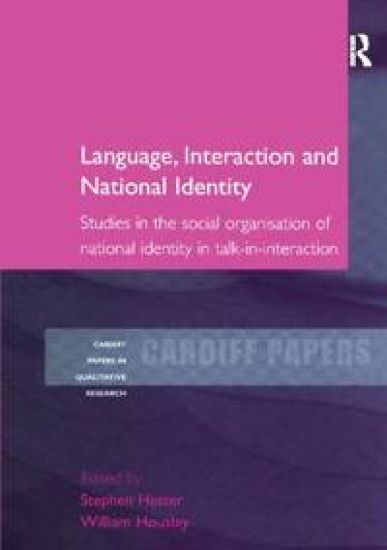
Contemporary political and public discourse has come alive with the issues and conflicts surrounding questions of national identity. Despite the widespread sociological attention it has drawn as a result, most studies of national identity have been conducted at considerable analytical distance from the lived reality of national identity talk. This collection brings together the work of contemporary researchers, situating the talk and interaction in which national identities are actually expressed and used. The book presents detailed investigations of how persons actually use national identity in their talk, the interactional uses to which such expressions are put, and the interactional consequences of such identity talk. The studies are based on transcribed tape recordings of naturally occurring talk across a variety of different countries and settings, illuminating not only situated national identity talk as a phenomenon in its own right, but also providing empirically grounded research for traditional sociological theorising about issues of integration, devolution and exclusion.
Presenting original research studies by leading scholars in the field, Orders of Ordinary Action considers how ethnomethodology provides for an 'alternate' sociology by respecifying sociological phenomena as locally accomplished members' activities. Following an introduction by the editors and a seminal statement of ethnomethodology's analytic stance by its founder, Harold Garfinkel, the book then comprises two parts. The first introduces studies of practical action and organization, whilst the second provides studies of practical reasoning and situated logic in various settings. By organizing the book in this way, the collection demonstrates the relevance of ethnomethodological investigations to established topics and issues and indicates the contribution that ethnomethodology can make to the understanding of human action in any and all social contexts. Both individually and collectively, these contributions illustrate how taking an ethnomethodological approach opens up for investigation phenomena that are taken for granted in conventional sociological theorizing.
Disaffection From School (RLE Edu M)
David Hargreaves; Stephen Hester; Frank Mellor
Routledge
2014
nidottu
A large number of pupils are, or are liable to become, disaffected with their schooling. In this comprehensive account of the problem, Ken Reid suggests that school can and should do much more to prevent and overcome disaffected behaviour, as manifested by such factors as absenteeism, disruption and underachievement. The book covers disruptive behaviour in its broader context and examines the search for an explanation within schools themselves. Formal and multidisciplinary approaches to the problem are also fully treated. The author has drawn on his considerable school and research experience and the book is well illustrated with examples and case histories. Ken Reid argues that questions about attitudes and approaches in teaching and in pastoral care provoke a continued challenge, and stresses that if such questions are not faced squarely the long-germ prognosis for secondary education in Britain may be bleak. Teachers in training and all those involved in the education and welfare of difficult or disadvantaged children, especially teachers, heads and social workers, will find Disaffection from School both challenging in its analysis and helpful in its suggestions.
Deviance in Classrooms (RLE Edu M)
David Hargreaves; Stephen Hester; Frank Mellor
Routledge
2014
nidottu
When originally published this book reported the first major application of ‘labelling theory’ to deviance in classrooms. The authors explore the nature of classroom rules, show how they constitute a pervasive feature of the classroom, and examine the ways in which teachers use these rules as grounds for imputing ‘deviance’ to pupils. A theory of social typing is developed to show how teachers come to define certain pupils as deviant persons such as ‘troublemakers’ and several case-studies are used to document this analysis. Finally, the teachers’ reactions to disruptive classroom conduct are examined as complex strategic attempts at social control in the classroom. The book has a double focus on deviance theory and the process of teaching.
Deviance in Classrooms (RLE Edu M)
David Hargreaves; Stephen Hester; Frank Mellor
Routledge
2011
sidottu
When originally published this book reported the first major application of ‘labelling theory’ to deviance in classrooms. The authors explore the nature of classroom rules, show how they constitute a pervasive feature of the classroom, and examine the ways in which teachers use these rules as grounds for imputing ‘deviance’ to pupils. A theory of social typing is developed to show how teachers come to define certain pupils as deviant persons such as ‘troublemakers’ and several case-studies are used to document this analysis. Finally, the teachers’ reactions to disruptive classroom conduct are examined as complex strategic attempts at social control in the classroom. The book has a double focus on deviance theory and the process of teaching.
Disaffection From School (RLE Edu M)
David Hargreaves; Stephen Hester; Frank Mellor
Routledge
2011
sidottu
A large number of pupils are, or are liable to become, disaffected with their schooling. In this comprehensive account of the problem, Ken Reid suggests that school can and should do much more to prevent and overcome disaffected behaviour, as manifested by such factors as absenteeism, disruption and underachievement. The book covers disruptive behaviour in its broader context and examines the search for an explanation within schools themselves. Formal and multidisciplinary approaches to the problem are also fully treated. The author has drawn on his considerable school and research experience and the book is well illustrated with examples and case histories. Ken Reid argues that questions about attitudes and approaches in teaching and in pastoral care provoke a continued challenge, and stresses that if such questions are not faced squarely the long-germ prognosis for secondary education in Britain may be bleak. Teachers in training and all those involved in the education and welfare of difficult or disadvantaged children, especially teachers, heads and social workers, will find Disaffection from School both challenging in its analysis and helpful in its suggestions.
Presenting original research studies by leading scholars in the field, Orders of Ordinary Action considers how ethnomethodology provides for an 'alternate' sociology by respecifying sociological phenomena as locally accomplished members' activities. Following an introduction by the editors and a seminal statement of ethnomethodology's analytic stance by its founder, Harold Garfinkel, the book then comprises two parts. The first introduces studies of practical action and organization, whilst the second provides studies of practical reasoning and situated logic in various settings. By organizing the book in this way, the collection demonstrates the relevance of ethnomethodological investigations to established topics and issues and indicates the contribution that ethnomethodology can make to the understanding of human action in any and all social contexts. Both individually and collectively, these contributions illustrate how taking an ethnomethodological approach opens up for investigation phenomena that are taken for granted in conventional sociological theorizing.
An Invitation to Ethnomethodology
David J. Francis; Stephen Hester
SAGE Publications Inc
2004
sidottu
This book offers a new and rigorous approach to observational sociology that is grounded in ethnomethodology and conversation analysis. Throughout the authors encourage the reader to explore the social world at first hand, beginning with the immediate family context and then moving out into the public realm and organizational life. Examples of observational analysis are given with reference to topic areas such as family life, education, medicine, crime and deviance, and the reader is shown how to conduct their own inquiries, using methods and materials that are readily and ordinarily available. Drawing on both original material and published studies, Francis and Hester demonstrate how observational sociology can be carried out with an attention to detail typically overlooked by more traditional ethonographic approaches.
The Montreal Massacre: A Story of Membership Categorization Analysis adopts an ethnomethodological viewpoint to analyze how the murder of women by a lone gunman at the Ecole Polytechnique in Montreal was presented to the public via media publication over a two-week period in 1989. All that the public came to know and understand of the murders, the murderer, and the victims was constituted in the description and commentaries produced by the media. What the murders became, therefore, was an expression of the methods used to describe and evaluate them, and central to these methods was membership category analysis - the human practice of perceiving people, places, and events as ""members"" of ""categories,"" and to use these to explain actions. This is evident in the various versions comprising the overall story of the Massacre: it was a crime; it was a tragedy; it was a horror story. The killer's story is also based on his own categorial analysis (he said his victims were ""feminists""). The media commentators formulated the significance of the murders in categorial terms: it implicated a wider problem, that of violence against women, and thus the reasons for the murders were shown to be categorial matters. As a contribution to sociology, and as a demonstration of the significance of ethnomethodology for understanding social life, the book reveals the methodical and particularly categorial character of how sense is made of events such as this and how such methodical and categorial resources are central to human interaction.
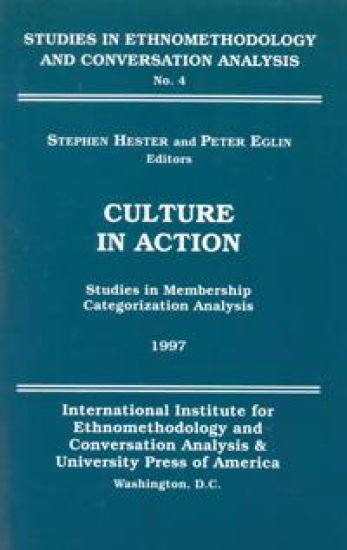
This collection of new studies in ethnomethodology addresses sociology's classical questions by developing that strand of ethnomethodological inquiry dealing with membership categorization. This book provides detailed studies of members' use of membership categories across various settings from the O. J. Simpson trial, via TV commercials and news headlines, to school staff and referral meetings. The studies show that category use is occasional, that culture is always internal to action; accordingly sociology's key theoretical problems and substantive areas are re-specified in terms of members' methods of membership categorization. This is the first collection of original, unpublished studies by internationally renowned practitioners of ethnomethodology of members' uses of the descriptive resources of language to describe persons. Co-published with The International Institute for Ethnomethodology and Conversation Analysis.
The authors take three particular sociological perspectives, and use them to offer a distinct and critical reading of criminology, highlighting the ways that crime is, first and foremost, a matter of social definition. They provide a good introductory text which will be of great value to students.