Kirjojen hintavertailu – 12 859 818 kirjaa ja 27 kauppaa

Kirjailija

Stephen Jessee

Kirjat ja teokset yhdessä paikassa: 4 kirjaa, julkaisuja vuosilta 2024–2026, suosituimpiin kuuluu Majority Opinions. Vertaile teosten hintoja ja tarkista saatavuus suomalaisista kirjakaupoista.

4 kirjaa

Kirjojen julkaisuvuodet: 2024–2026.

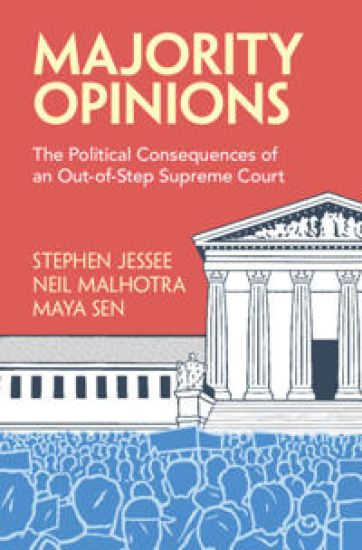
Majority Opinions

Majority Opinions

Stephen Jessee; Neil Malhotra; Maya Sen

Cambridge University Press
2026
pokkari
The Supreme Court's composition tends to remain stable over time, yet its docket and rulings change, affecting our understanding of the Court's broader political ramifications. In Majority Opinions, Stephen Jessee, Neil Malhotra and Maya Sen examine how the Supreme Court's alignment with public opinion shifts dramatically, shaping its legitimacy, approval, and vulnerability to reform. Introducing an empirical method and framework that systematically compares Americans' preferences on case outcomes with the Court's actual rulings, the authors uncover yawning gaps and unexpected alignments across issues and terms. They show how changes in court composition-Amy Coney Barrett replacing Ruth Bader Ginsburg, for example-can shift the Court's trajectory rightward, while docket choices can move rulings closer to public sentiment after unpopular rulings. Examining how the Supreme Court navigates a polarized political environment, the authors reveal how its choices have profoundly affect influence, legitimacy, and national policy.
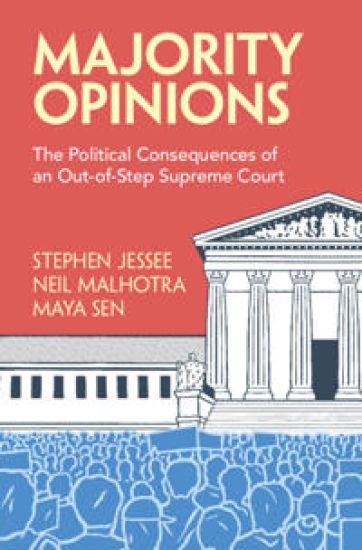
Majority Opinions

Majority Opinions

Stephen Jessee; Neil Malhotra; Maya Sen

Cambridge University Press
2026
sidottu
The Supreme Court's composition tends to remain stable over time, yet its docket and rulings change, affecting our understanding of the Court's broader political ramifications. In Majority Opinions, Stephen Jessee, Neil Malhotra and Maya Sen examine how the Supreme Court's alignment with public opinion shifts dramatically, shaping its legitimacy, approval, and vulnerability to reform. Introducing an empirical method and framework that systematically compares Americans' preferences on case outcomes with the Court's actual rulings, the authors uncover yawning gaps and unexpected alignments across issues and terms. They show how changes in court composition-Amy Coney Barrett replacing Ruth Bader Ginsburg, for example-can shift the Court's trajectory rightward, while docket choices can move rulings closer to public sentiment after unpopular rulings. Examining how the Supreme Court navigates a polarized political environment, the authors reveal how its choices have profoundly affect influence, legitimacy, and national policy.

A Liberal Education

A Liberal Education

Brendan Apfeld; Emanuel Coman; John Gerring; Stephen Jessee

Cambridge University Press
2024
pokkari
Enlisting a natural experiment, global surveys, and historical data, this book examines the university's evolution and its contemporary impact. Its authors conduct an unprecedented big-data comparative study of the consequences of higher education on ideology, democratic citizenship, and more. They conclude that university education has a profound effect on social and political attitudes across the world, greater than that registered by social class, gender, or age. A university education enhances political trust and participation, reduces propensities to crime and corruption, and builds support for democracy. It generates more tolerant attitudes toward social deviance, enhances respect for rationalist inquiry and scientific authority, and usually encourages support for Leftist parties and movements. It does not nurture support for taxation, redistribution, or the welfare state, and may stimulate opposition to these policies. These effects are summarized by the co-authors as liberal, understood in its classic, nineteenth-century meaning.
A Liberal Education

A Liberal Education

Brendan Apfeld; Emanuel Coman; John Gerring; Stephen Jessee

Cambridge University Press
2024
sidottu
Enlisting a natural experiment, global surveys, and historical data, this book examines the university's evolution and its contemporary impact. Its authors conduct an unprecedented big-data comparative study of the consequences of higher education on ideology, democratic citizenship, and more. They conclude that university education has a profound effect on social and political attitudes across the world, greater than that registered by social class, gender, or age. A university education enhances political trust and participation, reduces propensities to crime and corruption, and builds support for democracy. It generates more tolerant attitudes toward social deviance, enhances respect for rationalist inquiry and scientific authority, and usually encourages support for Leftist parties and movements. It does not nurture support for taxation, redistribution, or the welfare state, and may stimulate opposition to these policies. These effects are summarized by the co-authors as liberal, understood in its classic, nineteenth-century meaning.