Kirjojen hintavertailu – 12 903 724 kirjaa ja 27 kauppaa

Kirjailija

Stephen M. Walt

Kirjat ja teokset yhdessä paikassa: 8 kirjaa, julkaisuja vuosilta 1990–2019, suosituimpiin kuuluu The Hell of Good Intentions. Vertaile teosten hintoja ja tarkista saatavuus suomalaisista kirjakaupoista.

Nimi esiintyy myös muodoissa: Stephen M Walt

8 kirjaa

Kirjojen julkaisuvuodet: 1990–2019.

The Hell of Good Intentions: America's Foreign Policy Elite and the Decline of U.S. Primacy
From the New York Times-bestselling author Stephen M. Walt, The Hell of Good Intentions dissects the faults and foibles of recent American foreign policy--explaining why it has been plagued by disasters like the "forever wars" in Iraq and Afghanistan and outlining what can be done to fix it. In 1992, the United States stood at the pinnacle of world power and Americans were confident that a new era of peace and prosperity was at hand. Twenty-five years later, those hopes have been dashed. Relations with Russia and China have soured, the European Union is wobbling, nationalism and populism are on the rise, and the United States is stuck in costly and pointless wars that have squandered trillions of dollars and undermined its influence around the world. The root of this dismal record, Walt argues, is the American foreign policy establishment's stubborn commitment to a strategy of "liberal hegemony." Since the end of the Cold War, Republicans and Democrats alike have tried to use U. S. power to spread democracy, open markets, and other liberal values into every nook and cranny of the planet. This strategy was doomed to fail, but its proponents in the foreign policy elite were never held accountable and kept repeating the same mistakes. Donald Trump won the presidency promising to end the misguided policies of the foreign policy "Blob" and to pursue a wiser approach. But his erratic and impulsive style of governing, combined with a deeply flawed understanding of world politics, are making a bad situation worse. The best alternative, Walt argues, is a return to the realist strategy of "offshore balancing," which eschews regime change, nation-building, and other forms of global social engineering. The American people would surely welcome a more restrained foreign policy, one that allowed greater attention to problems here at home. This long-overdue shift will require abandoning the futile quest for liberal hegemony and building a foreign policy establishment with a more realistic view of American power. Clear-eyed, candid, and elegantly written, Stephen M. Walt's The Hell of Good Intentions offers both a compelling diagnosis of America's recent foreign policy follies and a proven formula for renewed success.

Man, the State, and War

Man, the State, and War

Kenneth Waltz; Stephen M. Walt

Columbia University Press
2018
sidottu
What are the causes of war? How might the world be made more peaceful? In this landmark work of international relations theory, first published in 1959, the eminent realist scholar Kenneth N. Waltz offers a foundational analysis of the nature of conflict between states. He explores works by both classic political philosophers, such as St. Augustine, Hobbes, Kant, and Rousseau, and modern psychologists and anthropologists to discover ideas intended to explain war among states and related prescriptions for peace. Waltz influentially distinguishes among three “images” of the origins of war: those that blame individual leaders or human nature, those rooted in states’ internal composition, and those concerning the structure of the international system. With a foreword by Stephen M. Walt on the legacy and continued relevance of Waltz’s work, this anniversary edition brings new life to a perennial international relations classic.
Man, the State, and War

Man, the State, and War

Kenneth Waltz; Stephen M. Walt

Columbia University Press
2018
pokkari

Halvin toimitettuna 32,40 €

What are the causes of war? How might the world be made more peaceful? In this landmark work of international relations theory, first published in 1959, the eminent realist scholar Kenneth N. Waltz offers a foundational analysis of the nature of conflict between states. He explores works by both classic political philosophers, such as St. Augustine, Hobbes, Kant, and Rousseau, and modern psychologists and anthropologists to discover ideas intended to explain war among states and related prescriptions for peace. Waltz influentially distinguishes among three “images” of the origins of war: those that blame individual leaders or human nature, those rooted in states’ internal composition, and those concerning the structure of the international system. With a foreword by Stephen M. Walt on the legacy and continued relevance of Waltz’s work, this anniversary edition brings new life to a perennial international relations classic.
The Hell of Good Intentions

The Hell of Good Intentions

Stephen M Walt

Farrar, Straus Giroux Inc
2018
sidottu
From the New York Times-bestselling author Stephen M. Walt, The Hell of Good Intentions dissects the faults and foibles of recent American foreign policy--explaining why it has been plagued by disasters like the "forever wars" in Iraq and Afghanistan and outlining what can be done to fix it. In 1992, the United States stood at the pinnacle of world power and Americans were confident that a new era of peace and prosperity was at hand. Twenty-five years later, those hopes have been dashed. Relations with Russia and China have soured, the European Union is wobbling, nationalism and populism are on the rise, and the United States is stuck in costly and pointless wars that have squandered trillions of dollars and undermined its influence around the world. The root of this dismal record, Walt argues, is the American foreign policy establishment's stubborn commitment to a strategy of "liberal hegemony." Since the end of the Cold War, Republicans and Democrats alike have tried to use U. S. power to spread democracy, open markets, and other liberal values into every nook and cranny of the planet. This strategy was doomed to fail, but its proponents in the foreign policy elite were never held accountable and kept repeating the same mistakes. Donald Trump won the presidency promising to end the misguided policies of the foreign policy "Blob" and to pursue a wiser approach. But his erratic and impulsive style of governing, combined with a deeply flawed understanding of world politics, are making a bad situation worse. The best alternative, Walt argues, is a return to the realist strategy of "offshore balancing," which eschews regime change, nation-building, and other forms of global social engineering. The American people would surely welcome a more restrained foreign policy, one that allowed greater attention to problems here at home. This long-overdue shift will require abandoning the futile quest for liberal hegemony and building a foreign policy establishment with a more realistic view of American power. Clear-eyed, candid, and elegantly written, Stephen M. Walt's The Hell of Good Intentions offers both a compelling diagnosis of America's recent foreign policy follies and a proven formula for renewed success.

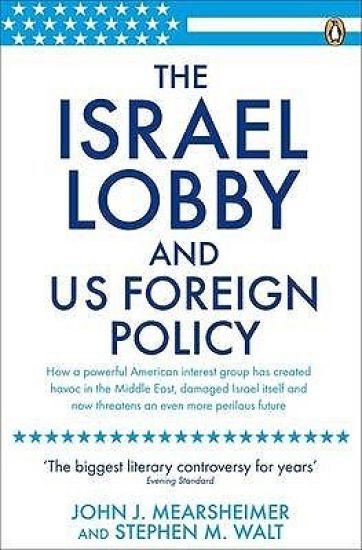
The Israel Lobby and US Foreign Policy

The Israel Lobby and US Foreign Policy

John J Mearsheimer; Stephen M Walt

Penguin Books Ltd
2008
pokkari

Halvin toimitettuna 20,30 €

Does America’s pro-Israel lobby wield inappropriate control over US foreign policy? This book has created a storm of controversy by bringing out into the open America’s relationship with the Israel lobby: a loose coalition of individuals and organizations that actively work to shape foreign policy in a way that is profoundly damaging both to the United States and Israel itself. Israel is an important, valued American ally, yet Mearsheimer and Walt show that, by encouraging unconditional US financial and diplomatic support for Israel and promoting the use of its power to remake the Middle East, the lobby has jeopardized America’s and Israel’s long-term security and put other countries – including Britain – at risk.
Taming American Power

Taming American Power

Stephen M. Walt

WW Norton Co
2006
nidottu
A provocative analysis of the strategies employed by foreign states to counter U. S. global dominance evaluates how international responses work to undermine America's foreign policy goals, explaining why the U. S. must utilize a foreign policy that is not fear-based. First serial, Boston Review. Reprint.
Revolution and War

Revolution and War

Stephen M. Walt

Cornell University Press
1997
pokkari
Revolution within a state almost invariably leads to intense security competition between states, and often to war. In Revolution and War, Stephen M. Walt explains why this is so, and suggests how the risk of conflicts brought on by domestic upheaval might be reduced in the future. In doing so, he explores one of the basic questions of international relations: What are the connections between domestic politics and foreign policy? Walt begins by exposing the flaws in existing theories about the relationship between revolution and war. Drawing on the theoretical literature about revolution and the realist perspective on international politics, he argues that revolutions cause wars by altering the balance of threats between a revolutionary state and its rivals. Each state sees the other as both a looming danger and a vulnerable adversary, making war seem both necessary and attractive. Walt traces the dynamics of this argument through detailed studies of the French, Russian, and Iranian revolutions, and through briefer treatment of the American, Mexican, Turkish, and Chinese cases. He also considers the experience of the Soviet Union, whose revolutionary transformation led to conflict within the former Soviet empire but not with the outside world. An important refinement of realist approaches to international politics, this book unites the study of revolution with scholarship on the causes of war.
The Origins of Alliances

The Origins of Alliances

Stephen M. Walt

Cornell University Press
1990
pokkari
"The Origins of Alliances offers a different way of thinking about our security and thus about our diplomacy. It ought to be read by anyone with a serious interest in understanding why our foreign policy is so often self-defeating." -New Republic How are alliances made? In this book, Stephen M. Walt makes a significant contribution to this topic, surveying theories of the origins of international alliances and identifying the most important causes of security cooperation between states. In addition, he proposes a fundamental change in the present conceptions of alliance systems. Contrary to traditional balance-of-power theories, Walt shows that states form alliances not simply to balance power but in order to balance threats. Walt begins by outlining five general hypotheses about the causes of alliances. Drawing upon diplomatic history and a detailed study of alliance formation in the Middle East between 1955 and 1979, he demonstrates that states are more likely to join together against threats than they are to ally themselves with threatening powers. Walt also examines the impact of ideology on alliance preferences and the role of foreign aid and transnational penetration. His analysis show, however, that these motives for alignment are relatively less important. In his conclusion, he examines the implications of "balance of threat" for U. S. foreign policy.