Kirjojen hintavertailu – 12 867 300 kirjaa ja 27 kauppaa

Kirjailija

Stephen Spender

Kirjat ja teokset yhdessä paikassa: 12 kirjaa, julkaisuja vuosilta 1978–2022, suosituimpiin kuuluu Thirties Poets. Vertaile teosten hintoja ja tarkista saatavuus suomalaisista kirjakaupoista.

12 kirjaa

Kirjojen julkaisuvuodet: 1978–2022.

Thirties Poets

Thirties Poets

W H Auden; C Day Lewis; Stephen Spender

Buenos Aires Poetry
2022
pokkari
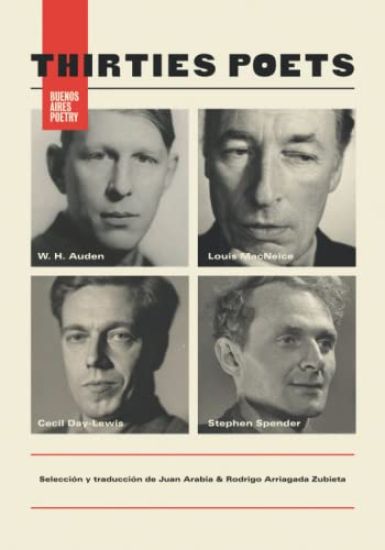
Se llam Thirties (as como Auden Group y War Generation...) a un conjunto de poetas ingleses de la d cada del 30 (W. H. Auden, Louis MacNeice, Cecil Day-Lewis, Stephen Spender, entre otros), que asumi un rol activo frente a la contingencia de una sociedad en crisis, con variables colectivas dram ticas y urgentes. Este grupo era, por un lado, ep gono de la Primera Guerra Mundial, con su r mora de cerca de diez millones de muertos; por el otro, antesala de la Segunda, con sus siguientes millones de vidas por cobrar." Los Thirties" autores que hicieron propaganda de una poes a al servicio del socialismo La burgues a tiene que esperar un poco de dolor, una penitencia ]. A. T. Tolley, en The poetry of the Thirties, sencillamente dec a hacia 1975: "Un cambio que est asociado en los nuevos poetas de los a os treinta: la aparici n de una preocupaci n por temas pol ticos". Para una mayor indagaci n cr tica, se recomienda tanto el libro de Tolley (London: Gollancz, 1975), as como el estudio de Desmond Ernest Stewart: Poets of the thirties, London, Routledge & K. Paul, 19692. Hoy en d a, sin embargo, estas conexiones pueden despreciarse. En un homenaje a Louis MacNeice, Auden escribi "Desde un punto de vista literario, el v nculo period stico contempor neo de los nombres de Auden, Day-Lewis, MacNeice, Spender, es y siempre fue absurdo". Y Day-Lewis, en su autobiograf a (The buried day), fue a n m s enf tico: "Aunque Auden, Spender, MacNeice y yo nos conocemos personalmente desde mediados de los a os treinta, ninguno de nosotros ni siquiera hab a conocido a los otros tres hasta despu s de la publicaci n de New Signatures (...). No sab amos que ramos un movimiento hasta que los cr ticos nos dijeron que lo ramos". Sin embargo, no s lo una poca los se ala. Adem s de pasar por la Universidad de Oxford, estos poetas sintieron la obligaci n social de preocuparse por los asuntos p blicos, adoptando de esta forma una dicci n m s cercana para todos, adecuada a la experiencia y representaciones que el mundo le proporcionaba a sus s bditos. Adem s, tanto Day-Lewis (que le dedica a Auden su libro The Magnetic Mountain, as como el poema "Epilogue: For W. H. Auden") como MacNeice (en "Postcript to Iceland: for W. H. Auden") as como Spender (en "One More New Bocthed Beginning", donde recuerda a MacNeice) comparten algo m s que una etiqueta de la cr tica, que se hace notoriamente visible en sus trabajos po ticos: la autorreferencialidad de un espec fico proyecto. Dicho de otro modo, estos poetas (pese a sus individualidades) estaban inmersos dentro de una interacci n mucho m s amplia, como bien anota Desmond Ernest Stewart en materia de industria cultural: "Faber & Faber lideraron el campo en la publicaci n de muchos de los principales poetas, dramaturgos, arquitectos y cineastas de los a os treinta, hasta tal punto que Faber & Faber mismo podr a ser considerado como parte del fen meno de los a os 30. En cierto modo, esto fue un desarrollo sorprendente, ya que las opiniones pol ticas de los escritores en muchos casos deben haber ido directamente en contra de las creencias pol ticas de T. S. Eliot, la influencia literaria dominante en Faber & Faber durante este per odo, y de Geoffrey Faber, el fundador de la firma". Si bien la lista podr a haber sido m s inclusiva, por ejemplo Tolley recuerda a otros poetas de Oxford, como Rex Warner, Norman Cameron o John Betjeman, "the big four", forjan una metaliteratura, capaz de ser le da o analizada en conjunto.

The Struggle of the Modern

The Struggle of the Modern

Stephen Spender

University of California Press
2022
sidottu
Shelley said, in his Defence of Poetry, that poetry should be both centre and circumference of knowledge. In his new book, Spender takes Shelley's claim and relates it to modern literature. He points out that, ever since the Industrial Revolution, writers have been conscious of there being a problem of creating literature in the industrial era. All the discussions of tradition, symbolism, myth and the rest are part of a conscious strategy of writers to come to terms with a modern world which they feel presents quite special problems for them. Spender shows how Matthew Arnold's idea that criticism might be more important than poetry in our time, was taken over by poets who wrote criticism, and how in tern they have become superseded by critics who write poetry. The critical intelligence tens to absorb creative energy. He discusses the difference between the creative and critical functions and things that the present tendency of criticism to supersede creativity, and for poetry to become an academic exercise conducted by poets who are dons, is having a stifling effect on poetry. He thinks that there is an increasing tendency for the most creative activity of literature to become shut off from life and fermented, and that literature should be related much more to contemporary history, and less to dogmatic principles of academic criticism. This is a book in which the writer tried to reassert the relationship of literature to modern life. He believes that this relationship was the pre-occupation of writers in the 1920s and 1930, but that since then literature has become increasingly split into the writing of the new academics and that of aggressive anti-intellectuals. He things that contemporary criticism should be on a much wider basis, and take into account the history and the society in which we live, as well as the abstract principles which recent critics have evolved. This title is part of UC Press's Voices Revived program, which commemorates University of California Press's mission to seek out and cultivate the brightest minds and give them voice, reach, and impact. Drawing on a backlist dating to 1893, Voices Revived makes high-quality, peer-reviewed scholarship accessible once again using print-on-demand technology. This title was originally published in 1963.
The Struggle of the Modern

The Struggle of the Modern

Stephen Spender

University of California Press
2022
nidottu
Shelley said, in his Defence of Poetry, that poetry should be both centre and circumference of knowledge. In his new book, Spender takes Shelley's claim and relates it to modern literature. He points out that, ever since the Industrial Revolution, writers have been conscious of there being a problem of creating literature in the industrial era. All the discussions of tradition, symbolism, myth and the rest are part of a conscious strategy of writers to come to terms with a modern world which they feel presents quite special problems for them. Spender shows how Matthew Arnold's idea that criticism might be more important than poetry in our time, was taken over by poets who wrote criticism, and how in tern they have become superseded by critics who write poetry. The critical intelligence tens to absorb creative energy. He discusses the difference between the creative and critical functions and things that the present tendency of criticism to supersede creativity, and for poetry to become an academic exercise conducted by poets who are dons, is having a stifling effect on poetry. He thinks that there is an increasing tendency for the most creative activity of literature to become shut off from life and fermented, and that literature should be related much more to contemporary history, and less to dogmatic principles of academic criticism. This is a book in which the writer tried to reassert the relationship of literature to modern life. He believes that this relationship was the pre-occupation of writers in the 1920s and 1930, but that since then literature has become increasingly split into the writing of the new academics and that of aggressive anti-intellectuals. He things that contemporary criticism should be on a much wider basis, and take into account the history and the society in which we live, as well as the abstract principles which recent critics have evolved. This title is part of UC Press's Voices Revived program, which commemorates University of California Press's mission to seek out and cultivate the brightest minds and give them voice, reach, and impact. Drawing on a backlist dating to 1893, Voices Revived makes high-quality, peer-reviewed scholarship accessible once again using print-on-demand technology. This title was originally published in 1963.
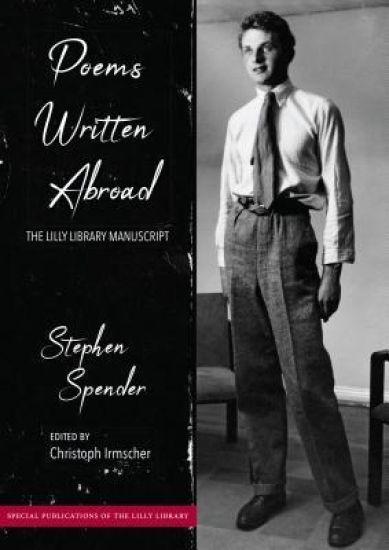
Poems Written Abroad

Poems Written Abroad

Stephen Spender

Indiana University Press
2019
sidottu
Poems Written Abroad is the first publication of the earliest collection of poetry by the famous poet, novelist, literary critic, translator, and radical, Sir Stephen Spender (1909-1995). Spender wrote and compiled this manuscript in 1927, when he was living in Nantes and Lausanne. In tone and diction, Spender's poems range from creatively traditional to unexpectedly innovative. They reflect his reading in Shakespeare and French poetry, as well as his absorption in music and modern art. They also document his struggles with his sexual identity and his emerging desire to devote his life, at whatever cost, to the writing of poetry. This beautiful facsimile edition, authorized by the Spender estate, faithfully reproduces the features of the original manuscript now held by the Lilly Library, including the frontispiece, an ink drawing by Spender himself, and little-known photographs of the poet. The editor's extensive introduction and detailed explanatory notes situate Spender's juvenilia in the context of his life and work and the history of modern poetry. The volume will appeal to readers with interests in modern poetry, gender studies, and fine books.
New Collected Poems of Stephen Spender

New Collected Poems of Stephen Spender

Stephen Spender

Faber Faber
2018
nidottu
Stephen Spender, along with his friends W. H. Auden, Louis MacNeice and C. Day Lewis, rose to prominence in the 1930s, writing powerfully of the fear and paranoia of a continent heading towards war. By the time of his death in 1995 he had established a distinguished reputation as a poet, critic, editor and translator. This New Collected Poems, edited by Michael Brett, gathers seven decades of verse from Poems (1933) to Dolphins (1994) and the late uncollected work. Reordering the thematic principle of the 1985 Collected Poems, this edition returns to a book-by-book chronology and allows the reader to experience, for the first time, the full development and range of his career.
The Struggle of the Modern

The Struggle of the Modern

Stephen Spender

Literary Licensing, LLC
2013
sidottu
The Struggle of the Modern is a non-fiction book written by Stephen Spender. The book is an exploration of modernism, a cultural and artistic movement that emerged in the early 20th century. Spender examines the key figures and ideas of modernism, including T. S. Eliot, James Joyce, Virginia Woolf, and Pablo Picasso, and how they challenged traditional values and conventions. Spender also explores the political and social contexts that gave rise to modernism, including the aftermath of World War I, the rise of fascism in Europe, and the changing roles of women in society. He argues that modernism was a response to the upheavals of the time, and that it sought to break down the barriers between art and life, and between different forms of artistic expression. The Struggle of the Modern is a thoughtful and insightful analysis of one of the most important cultural movements of the 20th century. It is a must-read for anyone interested in modern art, literature, and culture. Personal Reflections About Those Qualities In Literature And Art, In The Present Century, That Mr. Spender Regards As Modern. This scarce antiquarian book is a facsimile reprint of the old original and may contain some imperfections such as library marks and notations. Because we believe this work is culturally important, we have made it available as part of our commitment for protecting, preserving, and promoting the world's literature in affordable, high quality, modern editions, that are true to their original work.
Selected Poems of Stephen Spender

Selected Poems of Stephen Spender

Stephen Spender

Faber Faber
2009
nidottu
Stephen Spender, the son of a journalist, was born in London in 1909. He was educated at University College, Oxford, where he met, among others, W. H. Auden, Christopher Isherwood and Louis MacNeice, with whom he was to develop a poetics of engagement, writing powerfully of the confusion and alarm of 1930s Europe. He visited Spain during the Civil War, in 1937, where he assisted the Republican cause with propaganda activity. His post-war memoir World within World was recognised as one of the most illuminating literary autobiographies to have come out of the 1930s and 1940s, distilling a distinctively personal, humanistic socialism. His poetry has been praised for its exploratory candour, its personal approach to the stresses of modernity, and its exact portraiture of social and political upheaval. Grey Gowrie's new selection offers a timely and incisive revaluation of Spender's substantial poetic corpus.
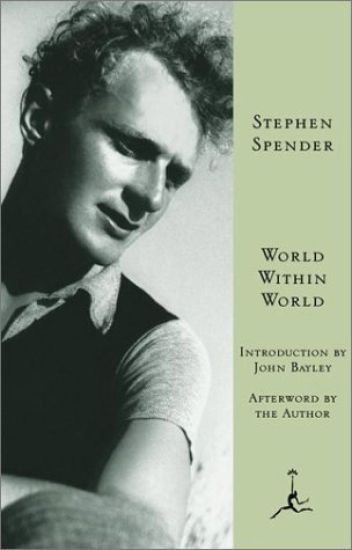
World Within World: The Autobiography of Stephen Spender
"In this book I am mainly concerned with a few themes: love; poetry; politics; the life of literature.... I believe obstinately that, if I am able to write with truth about what has happened to me, this can help others.... In this belief I have risked being indiscreet, and I have written occasionally of experiences which seem strange to me myself, and which I have not seen discussed else-where." So begins Stephen Spender's autobiography, widely acclaimed as the twentieth century's greatest memoir. Spender was one of his generation's most celebrated poets, a writer living at the intersection of literature and politics in Europe between the two world wars. His portraits of his friends—Virginia Woolf, T. S. Eliot, W. H. Auden, W. B. Yeats, and Christopher Isherwood—render a romantic world of literary genius. Spender uses a poet's language to create an honest and tender exploration of amity and the many possibilities of love. First published in 1951, World Within World simultaneously shocked and bedazzled the literary establishment for its frank discussion of Eros in the modern world. Out of print for several years, this Modern Library edition includes a new Introduction by the critic John Bayley and an Afterword Spender wrote in 1994 describing his reaction to the charges that David Leavitt plagiarized this autobiography in a novel. "World Within World is without any question the best autobiography in English written in the twentieth century."—John Bayley, from his new Introduction"Superb...[Spender's] best writing charges us with his own best qualities: the moral earnestness, the lucid piety, the lyrical intelligence."—The New York Times Book Review