Kirjojen hintavertailu – 12 903 725 kirjaa ja 27 kauppaa

Kirjailija

Stephen Webb

Kirjat ja teokset yhdessä paikassa: 26 kirjaa, julkaisuja vuosilta 1989–2027, suosituimpiin kuuluu 1956: A Year of Wonder in Science Fiction and Beyond. Vertaile teosten hintoja ja tarkista saatavuus suomalaisista kirjakaupoista.

26 kirjaa

Kirjojen julkaisuvuodet: 1989–2027.

Evidence-based Social Work

Evidence-based Social Work

Mel Gray; Debbie Plath; Stephen Webb

Routledge
2009
nidottu
Evidence-based practice is now a core element of many governments’ approaches to policy-making and social intervention. It has become a powerful movement that promises to change the content and structure of social work and its allied professions. Its emergence has generated much debate and raised challenging questions, however, particularly at the interface of research, policy, and practice. This book provides a critical analysis of evidence-based practice in social work. It introduces readers to the fast changing research, policy, legislative, and practice context. It discusses what constitutes knowledge in social work, the values and beliefs that lie behind EBP and problems of implementation, formalisation and resource management. Reflecting on the challenges of transferring evidence-based practice to frontline social work practice, the authors argue that social work practice is not easily measured and systematised into best practice guidelines that disseminate proven diagnostic and effective intervention knowledge. Using Actor Network Theory for the first time in the social work literature, Evidence-based Social Work illuminates how adopting the methodology and language of evidence-based practice fundamentally alters the conditions under which social work takes place. This book is vital reading for academics, practitioners, and students with an interest in contemporary social work practice and research.
Palaeopathology of Aboriginal Australians

Palaeopathology of Aboriginal Australians

Stephen Webb

Cambridge University Press
2009
pokkari
While their health has suffered enormously because of the arrival of the Europeans, it is assumed that Aboriginal people enjoyed good health before 1788. Using data collected from all parts of the continent, this 1995 book studies the health of Australia's original inhabitants over 50,000 years. It represents the first continental survey of its kind and is the first to quantify and describe key aspects of Australian hunter-gatherer health. The book takes a theoretical approach to Upper Pleistocene regional epidemiology and presents empirical data of the health of late Pleistocene and Holocene populations. Major categories of disease described are: stress, osteoarthritis, fractures, congenital deformations, neoplasms and non-specific and treponemal infections. The author also describes surgical techniques used by Aboriginal people. Offering fresh insight into the study of Australian prehistory and Aboriginal culture, this book will be accessible to specialists and general readers alike. It illuminates the origins of human disease, and will fill a gap in our knowledge of health in the Australasian region.
Out of this World

Out of this World

Stephen Webb

Springer-Verlag New York Inc.
2004
sidottu
This book is an attempt to share some of the fascinating and exciting ideas of modern theoretical physics with a non-mathematical audience. I also hope to give some appreciation of the exceptionally creative people who have generated these ideas. I had no intention of writing a comprehen­ sive history of these ideas, however; I apologize to those physicists whose important contributions I may have omitted. Several people have contributed directly to the writing of this book, and I would like to take this chance to thank them. Clive Horwood of Praxis Publishing and Paul Farrell of Copernicus Books have both been supportive of the project. Anna Painter has been an exceptionally thorough editor and has provided invaluable advice. Dr John Mason and Lyman Lyons both offered constructive criticism of an early draft. The errors that remai- and errors and misinterpretations are inevitable in any attempt to explain the subtle ideas of theoretical physics without the aid of mathematics - are my sole responsibility. I would like to thank Ron, Ronnie, Peter, Jackie, Emily, and Abigail for their support. And, most importantly, I would like to thank Heike and Jessica for their patience. Stephen Webb Milton Keynes, April 2004 1X FIGURE CREDITS I would like to acknowledge the following sources and copyright holders for granting permission to use their images. Figure 8 is from the Wilson A. Bentley collection. Figure 14 is courtesy ofNASA.
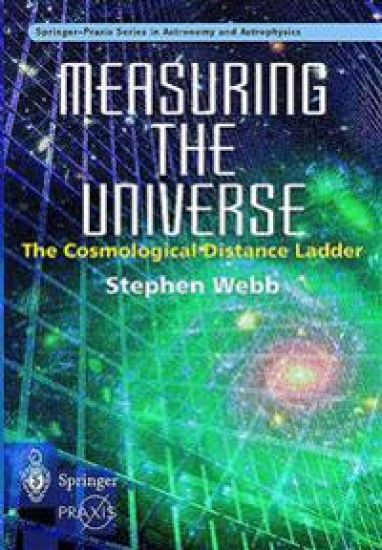
Measuring the Universe

Measuring the Universe

Stephen Webb

Springer London Ltd
1999
nidottu
Distance determination - finding out how far away different astronomical objects are - is an essential and currently highly topical subject in astronomy. A great deal of progress has been made during the last part of the 20th century. Measuring the Universe provides a unified treatment of the various techniques used for distance determination. It begins by describing methods to measure distances on Earth then gradually climbs the "distance ladder" to enable us to estimate the distance to the farthest objects, ending with a discussion of particle horizons within an expanding and inflationary universe. Aimed at first-year undergraduates of astronomy and astrophysics, the book emphasises general physical principles rather than mathematical detail. The text is enhanced and complemented by the use of many worked examples, and questions and problem solving exercises at the end of each chapter.
Palaeopathology of Aboriginal Australians

Palaeopathology of Aboriginal Australians

Stephen Webb

Cambridge University Press
1995
sidottu
While their health has suffered enormously because of the arrival of the Europeans, it is assumed that Aboriginal people enjoyed good health before 1788. Using data collected from all parts of the continent, this 1995 book studies the health of Australia's original inhabitants over 50,000 years. It represents the first continental survey of its kind and is the first to quantify and describe key aspects of Australian hunter-gatherer health. The book takes a theoretical approach to Upper Pleistocene regional epidemiology and presents empirical data of the health of late Pleistocene and Holocene populations. Major categories of disease described are: stress, osteoarthritis, fractures, congenital deformations, neoplasms and non-specific and treponemal infections. The author also describes surgical techniques used by Aboriginal people. Offering fresh insight into the study of Australian prehistory and Aboriginal culture, this book will be accessible to specialists and general readers alike. It illuminates the origins of human disease, and will fill a gap in our knowledge of health in the Australasian region.