Kirjojen hintavertailu – 12 859 818 kirjaa ja 27 kauppaa

Kirjailija

Steven D. Smith

Kirjat ja teokset yhdessä paikassa: 26 kirjaa, julkaisuja vuosilta 1996–2026, suosituimpiin kuuluu Bailey's Dam. Vertaile teosten hintoja ja tarkista saatavuus suomalaisista kirjakaupoista.

Nimi esiintyy myös muodoissa: Steven D Smith

26 kirjaa

Kirjojen julkaisuvuodet: 1996–2026.

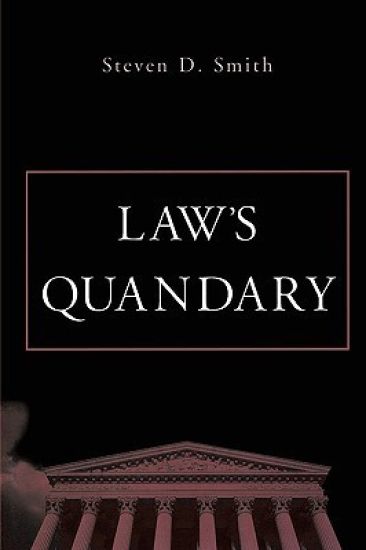
Law’s Quandary

Law’s Quandary

Steven D. Smith

Harvard University Press
2007
nidottu
This lively book reassesses a century of jurisprudential thought from a fresh perspective, and points to a malaise that currently afflicts not only legal theory but law in general. Steven Smith argues that our legal vocabulary and methods of reasoning presuppose classical ontological commitments that were explicitly articulated by thinkers from Aquinas to Coke to Blackstone, and even by Joseph Story. But these commitments are out of sync with the world view that prevails today in academic and professional thinking. So our law-talk thus degenerates into "just words"--or a kind of nonsense. The diagnosis is similar to that offered by Holmes, the Legal Realists, and other critics over the past century, except that these critics assumed that the older ontological commitments were dead, or at least on their way to extinction; so their aim was to purge legal discourse of what they saw as an archaic and fading metaphysics. Smith's argument starts with essentially the same metaphysical predicament but moves in the opposite direction. Instead of avoiding or marginalizing the "ultimate questions," he argues that we need to face up to them and consider their implications for law.
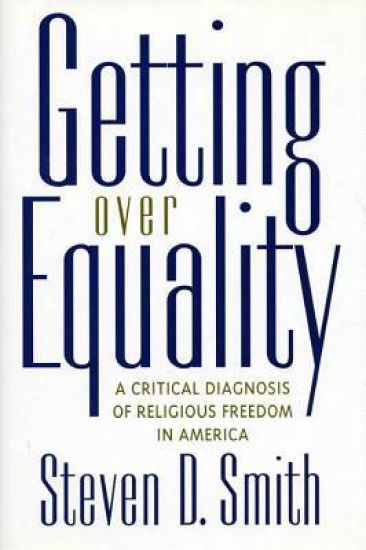
Getting Over Equality

Getting Over Equality

Steven D. Smith

New York University Press
2001
sidottu
Questions of religious freedom continue to excite passionate public debate. Proposals involving school prayer and the posting of the Ten Commandments in schools and courtrooms perennially spur controversy. But there is also a sense that the prevailing discourse is exhausted, that no one seems to know how to think about religious freedom in a way that moves beyond our stale, counterproductive thinking on this issue. In Getting over Equality, Steven D. Smith, one of the most important voices now writing about religious liberty, provocatively contends that we must get over our presumption mistakenly believed to be rooted in the Constitution that all religions are equally true and virtuous and "authentically American." Smith puts forth an alternative view, that the courts should promote an ideal of tolerance rather than equality and neutrality. Examining such controversial examples as the animal sacrifice case, the peyote case, and the problem of aid to parochial schools, Smith delineates a way for us to tolerate and respect contrary creeds without sacrificing or diluting our own beliefs and without pretending to believe in a spurious "equality" among the variety of diverse faiths.
Ponds and Lakes of the White Mountains

Ponds and Lakes of the White Mountains

Steven D. Smith

Countryman Press Inc.
1999
nidottu
The second revised edition of this companion to the ponds and lakes of New Hampshire's White mountains celebrates their rich diversity: You can hike, ski, snowshoe, swim, paddle a canoe, watch birds or moose, or simply linger by a sunny shore. Expanded fishing information tells you where to cast a line for small-mouth bass, perch, native speckled trout, and more. The ponds that Smith describes range from a tree-lined roadside beauty perfect for a spontaneous swim to an isolated mountain tarn reached only after a day of serious hiking or snowshoeing. He weaves into the text anecdotes and quotations culled from old guidebooks and local history. Additional information includes a bibliography and the author's lists of everything from the best ponds for a family hike to the best rocks to sit on. Each of the 68 descriptions include: * A trail description * Directions to road or trailhead access, with a topographical map * A summary of hiking facts, pond and lake statistics, activities, and fishing opportunities * Descriptions of nearby overlooks that offer bird's-eye views * Notes on visiting in winter
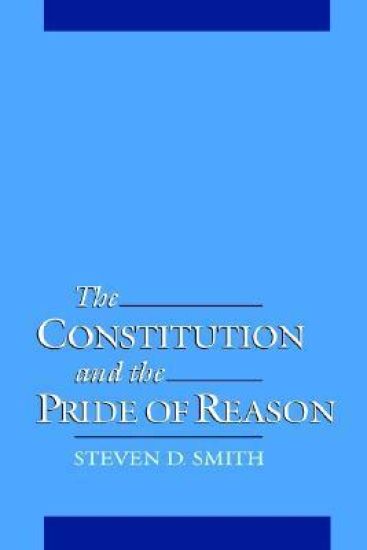
The Constitution and the Pride of Reason

The Constitution and the Pride of Reason

Steven D. Smith

Oxford University Press Inc
1998
sidottu
Examining the perennial claim that constitutional law somehow embodies a commitment to governance by "reason," this book shows how the lofty intentions of yesterday's framers and today's scholars have culminated in rampant confusion and elaborate sophistry. The Constitution and the Pride of Reason gives readers a provocative overview of the noble aspirations and tragic failures of American constitutionalism, offering iconoclastic assessments of constitutionalists ranging from Madison and Jefferson to Dworkin and Bork. "This is not a book for specialists in constitutional doctrine. It draws upon political and moral philosophy, history, constitutional theory, and political science to sustain a thesis which should interest all thinking Americans. It is also refreshingly well-written, very clear, and precise, often witty."--Gerald V. Bradley, University of Notre Dame
Against the Law

Against the Law

Paul F. Campos; Pierre Schlag; Steven D. Smith

Duke University Press
1996
sidottu
A fundamental critique of American law and legal thought, Against the Law consists of a series of essays written from three different perspectives that coalesce into a deep criticism of contemporary legal culture. Paul F. Campos, Pierre Schlag, and Steven D. Smith challenge the conventional representations of the legal system that are articulated and defended by American legal scholars. Unorthodox, irreverent, and provocative, Against the Law demonstrates that for many in the legal community, law has become a kind of substitute religion-an essentially idolatrous practice composed of systematic self-misrepresentation and self-deception. Linked by a persistent inquiry into the nature and identity of “the law,” these essays are informed by the conviction that the conventional representations of law, both in law schools and the courts, cannot be taken at face value-that the law, as commonly conceived, makes no sense. The authors argue that the relentlessly normative prescriptions of American legal thinkers are frequently futile and, indeed, often pernicious. They also argue that the failure to recognize the role that authorship must play in the production of legal thought plagues both the teaching and the practice of American law. Ranging from the institutional to the psychological and metaphysical deficiencies of the American legal system, the depth of criticism offered by Against the Law is unprecedented. In a departure from the nearly universal legitimating and reformist tendencies of American legal thought, this book will be of interest not only to the legal academics under attack in the book, but also to sociologists, historians, and social theorists. More particularly, it will engage all the American lawyers who suspect that there is something very wrong with the nature and direction of their profession, law students who anticipate becoming part of that profession, and those readers concerned with the status of the American legal system.
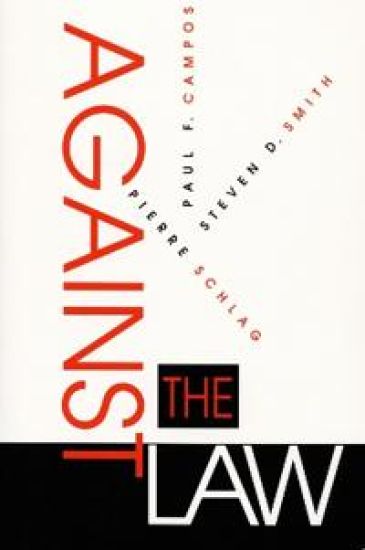
Against the Law

Against the Law

Paul F. Campos; Pierre Schlag; Steven D. Smith

Duke University Press
1996
pokkari
A fundamental critique of American law and legal thought, Against the Law consists of a series of essays written from three different perspectives that coalesce into a deep criticism of contemporary legal culture. Paul F. Campos, Pierre Schlag, and Steven D. Smith challenge the conventional representations of the legal system that are articulated and defended by American legal scholars. Unorthodox, irreverent, and provocative, Against the Law demonstrates that for many in the legal community, law has become a kind of substitute religion-an essentially idolatrous practice composed of systematic self-misrepresentation and self-deception. Linked by a persistent inquiry into the nature and identity of “the law,” these essays are informed by the conviction that the conventional representations of law, both in law schools and the courts, cannot be taken at face value-that the law, as commonly conceived, makes no sense. The authors argue that the relentlessly normative prescriptions of American legal thinkers are frequently futile and, indeed, often pernicious. They also argue that the failure to recognize the role that authorship must play in the production of legal thought plagues both the teaching and the practice of American law. Ranging from the institutional to the psychological and metaphysical deficiencies of the American legal system, the depth of criticism offered by Against the Law is unprecedented. In a departure from the nearly universal legitimating and reformist tendencies of American legal thought, this book will be of interest not only to the legal academics under attack in the book, but also to sociologists, historians, and social theorists. More particularly, it will engage all the American lawyers who suspect that there is something very wrong with the nature and direction of their profession, law students who anticipate becoming part of that profession, and those readers concerned with the status of the American legal system.