Kirjojen hintavertailu – 12 903 724 kirjaa ja 27 kauppaa

Kirjailija

Steven E. Lobell

Kirjat ja teokset yhdessä paikassa: 8 kirjaa, julkaisuja vuosilta 2003–2025, suosituimpiin kuuluu Understanding Near Crises and Escalation in World Politics. Vertaile teosten hintoja ja tarkista saatavuus suomalaisista kirjakaupoista.

8 kirjaa

Kirjojen julkaisuvuodet: 2003–2025.

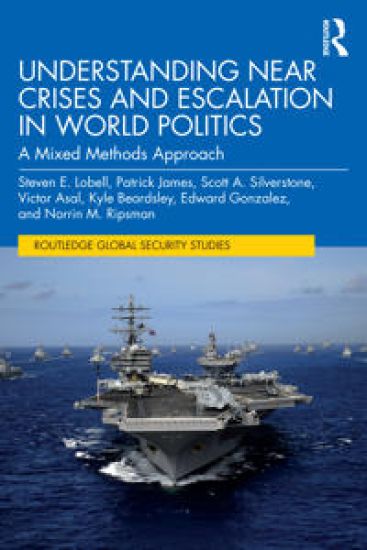
Understanding Near Crises and Escalation in World Politics

Understanding Near Crises and Escalation in World Politics

Steven E. Lobell; Patrick James; Scott A. Silverstone; Victor Asal; Kyle Beardsley; Edward Gonzalez; Norrin M. Ripsman

TAYLOR FRANCIS LTD
2025
nidottu

Halvin toimitettuna 64,60 €

This book introduces the near crisis phase of conflict and escalation. These time-sensitive disputes between states, and even with violent non-state actors, do not involve significant risk of military escalation, at least in the moment. Investigating how and why some near crises escalate, while others do not, requires an explanation of the different dynamics of international disputes and the policy tools that states and international institutions can employ. We ask an expanded set of questions about specific cases and general patterns of conflict behavior, such as: why did Israeli leaders respond to Hezbollah’s 2006 cross-border raid with escalation, resulting in the Second Lebanon War, while in previous instances the Israelis limited their retaliation? Why didn’t the 2015 Iranian Ballistic Missile Test or the 1995 Norwegian Black Brant Missile Launch escalate, while the 2009 North Korea Missile Movement and the 1995 Taiwan Straits dispute tipped into a full-blown crisis, and why did the 2008 Russia-Georgia conflict escalate from near crisis to war? We use primary sources and newly created data on near crises to answer these questions and others. The overall conclusion is that an ounce of prevention at the near crisis phase is worth a pound of cure in averting a full-blown crisis or war. This book will be of great interest to students of security studies, conflict studies, foreign policy, and international relations.
Understanding Near Crises and Escalation in World Politics

Understanding Near Crises and Escalation in World Politics

Steven E. Lobell; Patrick James; Scott A. Silverstone; Victor Asal; Kyle Beardsley; Edward Gonzalez; Norrin M. Ripsman

TAYLOR FRANCIS LTD
2025
sidottu
This book introduces the near crisis phase of conflict and escalation. These time-sensitive disputes between states, and even with violent non-state actors, do not involve significant risk of military escalation, at least in the moment. Investigating how and why some near crises escalate, while others do not, requires an explanation of the different dynamics of international disputes and the policy tools that states and international institutions can employ. We ask an expanded set of questions about specific cases and general patterns of conflict behavior, such as: why did Israeli leaders respond to Hezbollah’s 2006 cross-border raid with escalation, resulting in the Second Lebanon War, while in previous instances the Israelis limited their retaliation? Why didn’t the 2015 Iranian Ballistic Missile Test or the 1995 Norwegian Black Brant Missile Launch escalate, while the 2009 North Korea Missile Movement and the 1995 Taiwan Straits dispute tipped into a full-blown crisis, and why did the 2008 Russia-Georgia conflict escalate from near crisis to war? We use primary sources and newly created data on near crises to answer these questions and others. The overall conclusion is that an ounce of prevention at the near crisis phase is worth a pound of cure in averting a full-blown crisis or war. This book will be of great interest to students of security studies, conflict studies, foreign policy, and international relations.
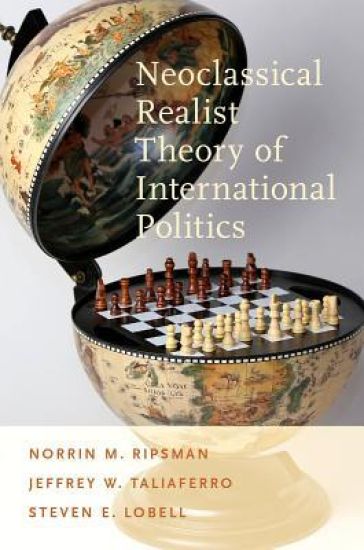
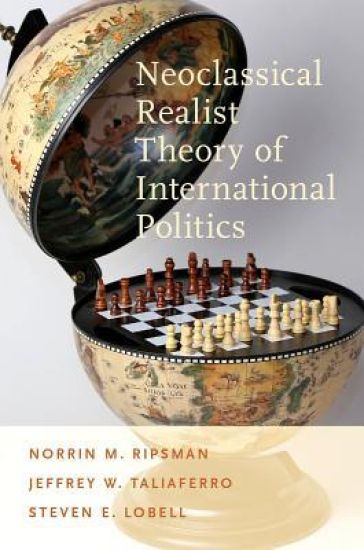
Neoclassical Realist Theory of International Politics

Neoclassical Realist Theory of International Politics

Norrin M. Ripsman; Jeffrey W. Taliaferro; Steven E. Lobell

Oxford University Press Inc
2016
nidottu
Since Gideon Rose's 1998 review article in the journal World Politics and especially following the release of Lobell, Ripsman, and Taliaferro's 2009 edited volume Neoclassical Realism, the State, and Foreign Policy, neoclassical realism has emerged as major theoretical approach to the study of foreign policy on both sides of the Atlantic. Proponents of neoclassical realism claim that it is the logical extension of the Kenneth Waltz's structural realism into the realm of foreign policy. In Neoclassical Realist Theory of International Relations, Norrin M. Ripsman, Jeffrey W. Taliaferro, and Steven E. Lobell argue that neoclassical realism is far more than an extension of Waltz's structural realism or an effort to update the classical realism of Hans Morgenthau, E. H. Carr, and Henry Kissinger with the language of modern social science. Rejecting the artificial distinction that Waltz draws between theories of international politics and theories of foreign policy, the authors contend neoclassical realism can explain and predict phenomena ranging from short-term crisis-behavior, to foreign policy, to patterns of grand strategic adjustment by individual states up to long-term patterns of international outcomes. It is, therefore, a more powerful theory of international politics than structural realism. Yet it is also a more intuitively satisfying approach than liberal Innenpolitik theories or constructivism. The authors detail the variables and assumptions of neoclassical realist theory, address various aspects of theory construction and methodology, lay out the areas of convergence and sharp disagreement with other leading theoretical approaches -- liberalism, constructivism, analytic eclecticism, and foreign policy analysis (FPA) --- and demonstrate how neoclassical realist theory can be used to resolve longstanding puzzles and debates in international relations theory.
Neoclassical Realist Theory of International Politics

Neoclassical Realist Theory of International Politics

Norrin M. Ripsman; Jeffrey W. Taliaferro; Steven E. Lobell

Oxford University Press Inc
2016
sidottu
Since Gideon Rose's 1998 review article in the journal World Politics and especially following the release of Lobell, Ripsman, and Taliaferro's 2009 edited volume Neoclassical Realism, the State, and Foreign Policy, neoclassical realism has emerged as major theoretical approach to the study of foreign policy on both sides of the Atlantic. Proponents of neoclassical realism claim that it is the logical extension of the Kenneth Waltz's structural realism into the realm of foreign policy. In Neoclassical Realist Theory of International Relations, Norrin M. Ripsman, Jeffrey W. Taliaferro, and Steven E. Lobell argue that neoclassical realism is far more than an extension of Waltz's structural realism or an effort to update the classical realism of Hans Morgenthau, E. H. Carr, and Henry Kissinger with the language of modern social science. Rejecting the artificial distinction that Waltz draws between theories of international politics and theories of foreign policy, the authors contend neoclassical realism can explain and predict phenomena ranging from short-term crisis-behavior, to foreign policy, to patterns of grand strategic adjustment by individual states up to long-term patterns of international outcomes. It is, therefore, a more powerful theory of international politics than structural realism. Yet it is also a more intuitively satisfying approach than liberal Innenpolitik theories or constructivism. The authors detail the variables and assumptions of neoclassical realist theory, address various aspects of theory construction and methodology, lay out the areas of convergence and sharp disagreement with other leading theoretical approaches -- liberalism, constructivism, analytic eclecticism, and foreign policy analysis (FPA) --- and demonstrate how neoclassical realist theory can be used to resolve longstanding puzzles and debates in international relations theory.
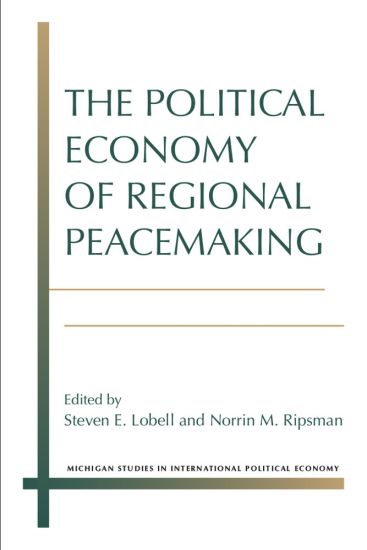
The Political Economy of Regional Peacemaking

The Political Economy of Regional Peacemaking

Steven E. Lobell; Norrin M. Ripsman

The University of Michigan Press
2016
nidottu
In The Political Economy of Regional Peacemaking, scholars examine the efficacy of trade agreements, economic sanctions, and other strategies of economic statecraft for the promotion of peace both between rival states and across conflict-ridden regions more generally. In the introduction, Steven E. Lobell and Norrin M. Ripsman pose five central questions: (1) What types of economic statecraft, including incentives and sanctions, can interested parties employ? (2) Who are the appropriate targets in the rival states—state leaders, economic and social elites, or society as whole? (3) When should specific economic instruments be used to promote peace—prior to negotiations, during negotiations, after signature of the treaty, or during implementation of the treaty? (4) What are the limits and risks of economic statecraft and economic interdependence? (5) How can economic statecraft be used to move from a bilateral peace agreement to regional peace? The chapters that follow are grouped in three sections, corresponding to the three stages of peacemaking: reduction or management of regional conflict; peacemaking or progress toward a peace treaty; and maintenance of bilateral peace and the regionalization of the peace settlement. In each chapter, the contributors consider the five key questions from a variety of methodological, historical, cultural, and empirical perspectives, drawing data from the Pacific, the Middle East, Europe, Asia, and Latin America. The conclusion expands on several themes found in the chapters and proposes an agenda for future research.
The Political Economy of Regional Peacemaking

The Political Economy of Regional Peacemaking

Steven E. Lobell; Norrin M. Ripsman

The University of Michigan Press
2016
sidottu
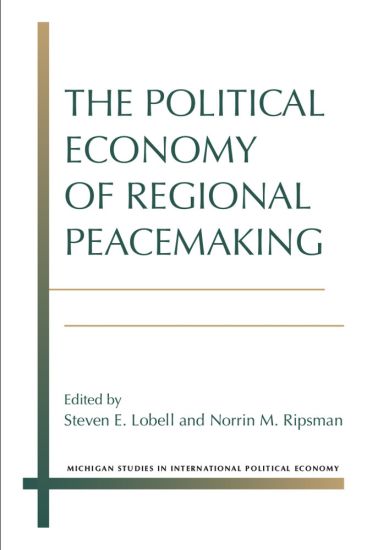
In The Political Economy of Regional Peacemaking, scholars examine the efficacy of trade agreements, economic sanctions, and other strategies of economic statecraft for the promotion of peace both between rival states and across conflict-ridden regions more generally. In the introduction, Steven E. Lobell and Norrin M. Ripsman pose five central questions: (1) What types of economic statecraft, including incentives and sanctions, can interested parties employ? (2) Who are the appropriate targets in the rival states—state leaders, economic and social elites, or society as whole? (3) When should specific economic instruments be used to promote peace—prior to negotiations, during negotiations, after signature of the treaty, or during implementation of the treaty? (4) What are the limits and risks of economic statecraft and economic interdependence? (5) How can economic statecraft be used to move from a bilateral peace agreement to regional peace? The chapters that follow are grouped in three sections, corresponding to the three stages of peacemaking: reduction or management of regional conflict; peacemaking or progress toward a peace treaty; and maintenance of bilateral peace and the regionalization of the peace settlement. In each chapter, the contributors consider the five key questions from a variety of methodological, historical, cultural, and empirical perspectives, drawing data from the Pacific, the Middle East, Europe, Asia, and Latin America. The conclusion expands on several themes found in the chapters and proposes an agenda for future research.
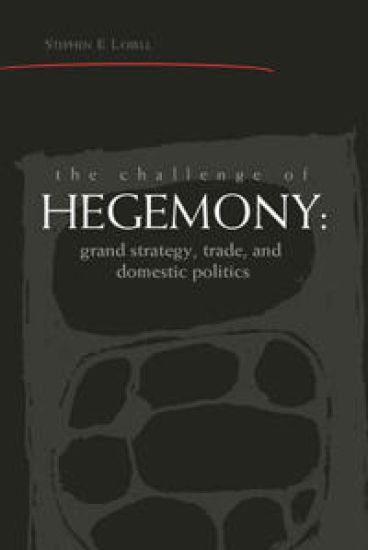
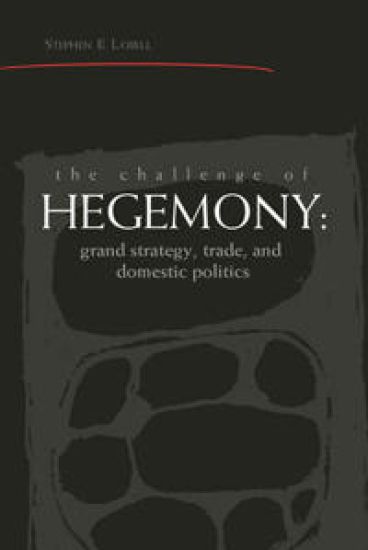
The Challenge of Hegemony

The Challenge of Hegemony

Steven E. Lobell

The University of Michigan Press
2005
nidottu
The Challenge of Hegemony explains how international forces subtly influence foreign, economic, and security policies of declining world powers. Using detail-rich case studies, this sweeping study integrates domestic and systemic policy to explain these countries' grand strategies. The book concludes with a discussion of the implications for the future of American foreign policy." His conceptually rigorous and tightly reasoned study . . . reminds us that power is never value neutral but organizes commercial systems in liberal or imperial terms."---Perspectives on Politics"Lobell's book is tightly written, nicely argued and thoroughly researched to a fault. He seems to delight in historical detail. The complexity of his approach is refreshing." ---International Affairs"The Challenge of Hegemony is a pleasure to read. It is both theoretically sophisticated and empirically rich." ---International Studies Review"The Challenge of Hegemony offers a compelling reinterpretation of key historical cases and provides wise guidance as to how the United States should wield its power today."--Charles A. Kupchan, Council on Foreign Relations"Lobell demonstrates clearly how the international environment confronting great powers interacts with their domestic political coalitions to produce different grand strategies. Through a masterful sweep of history, Lobell shows us the alternative trajectories before the United States today." --David A. Lake, University of California, San Diego
The Challenge of Hegemony

The Challenge of Hegemony

Steven E. Lobell

The University of Michigan Press
2003
sidottu
The Challenge of Hegemony explains how international forces subtly influence foreign, economic, and security policies of declining world powers. Using detail-rich case studies, this sweeping study integrates domestic and systemic policy to explain these countries' grand strategies. The book concludes with a discussion of the implications for the future of American foreign policy." His conceptually rigorous and tightly reasoned study . . . reminds us that power is never value neutral but organizes commercial systems in liberal or imperial terms."---Perspectives on Politics"Lobell's book is tightly written, nicely argued and thoroughly researched to a fault. He seems to delight in historical detail. The complexity of his approach is refreshing." ---International Affairs"The Challenge of Hegemony is a pleasure to read. It is both theoretically sophisticated and empirically rich." ---International Studies Review"The Challenge of Hegemony offers a compelling reinterpretation of key historical cases and provides wise guidance as to how the United States should wield its power today."--Charles A. Kupchan, Council on Foreign Relations"Lobell demonstrates clearly how the international environment confronting great powers interacts with their domestic political coalitions to produce different grand strategies. Through a masterful sweep of history, Lobell shows us the alternative trajectories before the United States today." --David A. Lake, University of California, San Diego