Kirjojen hintavertailu – 12 903 725 kirjaa ja 27 kauppaa

Kirjailija

Steven G. Medema

Kirjat ja teokset yhdessä paikassa: 6 kirjaa, julkaisuja vuosilta 1990–2019, suosituimpiin kuuluu Gardiner C.Mean's Institutional and Post-Keynesian Economics. Vertaile teosten hintoja ja tarkista saatavuus suomalaisista kirjakaupoista.

6 kirjaa

Kirjojen julkaisuvuodet: 1990–2019.

The Role of Government in the History of Economic Thought

The Role of Government in the History of Economic Thought

Steven G. Medema; Peter Boettke

Duke University Press
2006
sidottu
The Role of Government in the History of Economic Thought examines a controversial area of economic analysis: the appropriate role of government within the economic system. If the first two-thirds of the twentieth century were dominated by the active involvement of economists in government policymaking, blurring the lines between the spheres of economics and politics, then the last several decades have witnessed something of a reversion to the classical economics of Adam Smith and John Stuart Mill. This volume offers a comprehensive and integrated history of the evolution of the relationship between governments and economies, examining the British classical tradition, the American progressive movement, and corporatist ideology.
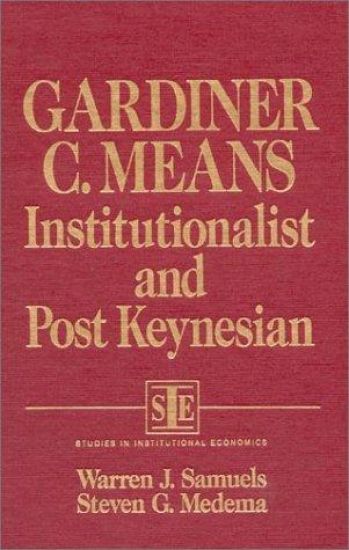
Gardiner C.Mean's Institutional and Post-Keynesian Economics

Gardiner C.Mean's Institutional and Post-Keynesian Economics

Warren J. Samuels; Steven G. Medema

M.E. Sharpe
1990
sidottu
Gardiner Means has a secure place in the history of 20th century economic thought, as the co-author with A. A. Berle of "The Modern Corporation and Private Property". But according to Samuels and Medema, Means should be remembered for major contributions in both micro- and macroeconomics. The authors discuss Means's ideas of administered pricing and profit maximization within the giant corporation, the possible links between industrial structure and macroeconomic performance, a theory of the firm as it relates to the market, and the micro foundations of macroeconomics. Central to Means's macroeconomics is his theory that administered pricing generates inflation and stagflation. Means, in the authors' view, was a seminal thinker and a post-Keynesian economist, as well as an institutionalist. This book also gives an precis of Means's unusual career in government and the academy.
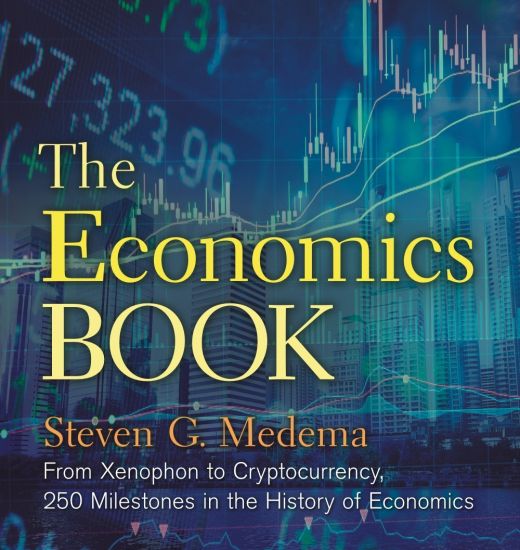
The Economics Book

The Economics Book

Steven G. Medema

Sterling
2019
sidottu
This beautiful, authoritative volume in the popular 'Sterling Milestones' series looks at the vital intersection among business, finance and money. From the philosophical dialogues of Ancient Greece and the moral contemplations of Medieval Europe to deregulation and cryptocurrency, 'The Economics Book' presents 250 milestones in the science of the production, sale and purchase of goods and services. These concise, engaging, informative essays examine the full gamut of subjects, revealing both the entertaining stories and the world-changing developments in the field. They shed thoughtful light on the field's significant subdisciplines, including: mercantilism, the Enlightenment, communism, econometrics, Keynesianism, macroeconomics, game theory, cliometrics, market design theory and the Keynesian Resurgence that emerged in the wake of the Great Recession. This vibrant, colourfully illustrated collection will captivate you with a bird's-eye view of the development of the world's markets, what has shaped and affected them and what drives them today.
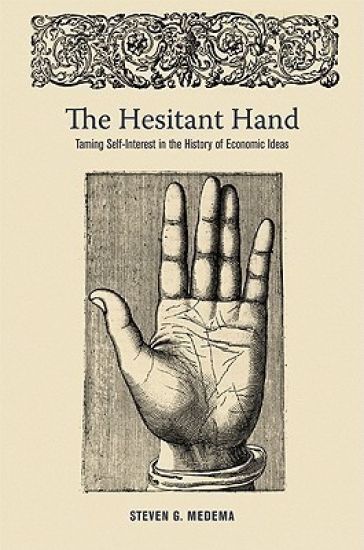
The Hesitant Hand

The Hesitant Hand

Steven G. Medema

Princeton University Press
2011
pokkari
Adam Smith turned economic theory on its head in 1776 when he declared that the pursuit of self-interest mediated by the market itself--not by government--led, via an invisible hand, to the greatest possible welfare for society as a whole. The Hesitant Hand examines how subsequent economic thinkers have challenged or reaffirmed Smith's doctrine, some contending that society needs government to intervene on its behalf when the marketplace falters, others arguing that government interference ultimately benefits neither the market nor society. Steven Medema explores what has been perhaps the central controversy in modern economics from Smith to today. He traces the theory of market failure from the 1840s through the 1950s and subsequent attacks on this view by the Chicago and Virginia schools. Medema follows the debate from John Stuart Mill through the Cambridge welfare tradition of Henry Sidgwick, Alfred Marshall, and A. C. Pigou, and looks at Ronald Coase's challenge to the Cambridge approach and the rise of critiques affirming Smith's doctrine anew. He shows how, following the marginal revolution, neoclassical economists, like the preclassical theorists before Smith, believed government can mitigate the adverse consequences of self-interested behavior, yet how the backlash against this view, led by the Chicago and Virginia schools, demonstrated that self-interest can also impact government, leaving society with a choice among imperfect alternatives. The Hesitant Hand demonstrates how government's economic role continues to be bound up in questions about the effects of self-interest on the greater good.
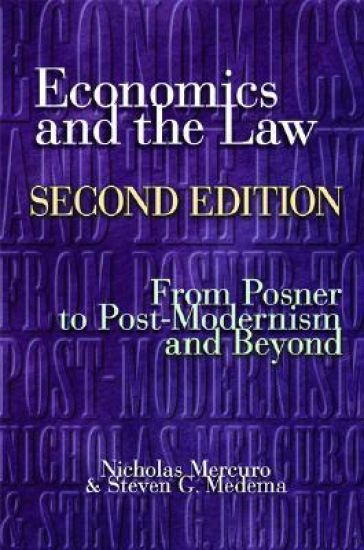
Economics and the Law

Economics and the Law

Nicholas Mercuro; Steven G. Medema

Princeton University Press
2006
pokkari
This is an expanded second edition of Nicholas Mercuro and Steven Medema's influential book Economics and the Law, whose publication in 1998 marked the most comprehensive overview of the various schools of thought in the burgeoning field of Law and Economics. Each of these competing yet complementary traditions has both redefined the study of law and exposed the key economic implications of the legal environment. The book remains true to the scope and aims of the first edition, but also takes account of the field's evolution. At the book's core is an expanded discussion of the Chicago school, Public Choice Theory, Institutional Law and Economics, and New Institutional Economics. A new chapter explores the Law and Economics literature on social norms, today an integral part of each of the schools of thought. The chapter on the New Haven and Modern Civic Republican approaches has likewise been expanded. These chapters are complemented by a discussion of the Austrian school of Law and Economics. Each chapter now includes an "At Work" section presenting applications of that particular school of thought. By providing readers with a concise, noncritical description of the broad contours of each school, this book illuminates the fundamental insights of a field with important implications not only for economics and the law, but also for political science, philosophy, public administration, and sociology.
The Economy as a Process of Valuation

The Economy as a Process of Valuation

Warren J. Samuels; Steven G. Medema; A. A. Schmid

Edward Elgar Publishing Ltd
1997
sidottu
The Economy as Process of Valuation sheds new light on the potential benefits of concept and theory formation along dynamic and evolutionary lines for understanding economic processes. The emphasis is on aspects of the economy as a process of valuation rather than as a mechanistic result of transcendental forces yielding unique determinate results. The book begins by examining instrumentalism and the process of valuation, arguing that to choose involves the process of valuation. It then focuses on Coases's work on institutions and considers the implications for a variety of subjects including the theory of the firm and the theory and policy of externalities - all aspects of the economy as a process of valuation. This is followed by analyses of the concepts of coercion and cost in economics, with special reference to one agent's interest being another agent's cost. Each elicits key aspects of analysis, valuation and the complexities and conflictual nature of valuation processes and structures. Finally, Kenneth Boulding's work on 'The Image' is examined, arguing that definitions of reality and values derive, in part from language.