Kirjojen hintavertailu – 12 903 733 kirjaa ja 27 kauppaa

Kirjailija

Steven Knapp

Kirjat ja teokset yhdessä paikassa: 7 kirjaa, julkaisuja vuosilta 1985–2021, suosituimpiin kuuluu The Bones of St. Pierre. Vertaile teosten hintoja ja tarkista saatavuus suomalaisista kirjakaupoista.

7 kirjaa

Kirjojen julkaisuvuodet: 1985–2021.

The Bones of St. Pierre

The Bones of St. Pierre

Steven Knapp

Can't Put It Down Books
2021
sidottu
As the world heads toward war, who can save France's greatest treasures? On a rainy night in New York City, Mason Wright receives a surprise visit from his old flame, Collette Moulie. Despite his misgivings, he agrees to help her and her father in a risky, and probably illegal plan to save the art treasures of France from a possible Nazi invasion. Mason immediately finds himself caught up in a world of fine art, stolen paintings, master forgeries...and the men who will stop at nothing to acquire them. Traveling to France, Mason realizes that he has suddenly become one of the most wanted men in all of Europe. Putting his life in the hands of a man he barely knows, Mason traverses the catacombs and streets of Paris, pursued by black marketeers and German spies. Mason learns early on that there is no one he can trust. Can he find his way out of France before the Blitzkrieg begins? This is the first book in the Mason Wright series.
The Secrets of St. Joanna

The Secrets of St. Joanna

Steven Knapp

Can't Put It Down Books
2020
sidottu
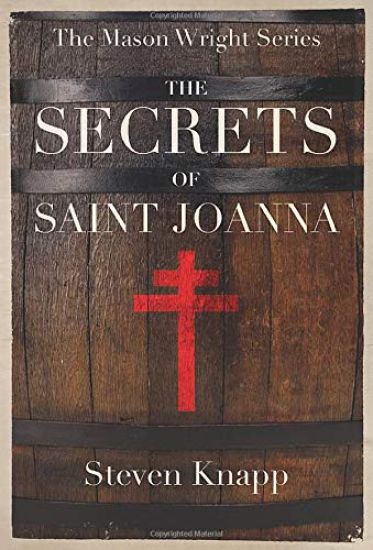
September 1940In London, a high-level British Agent is found murdered in a safe house known only to the Intelligence service-the clues lead to a mysterious order of assassins, a list of targets-and to Mason Wright. Frank "Sully" Sullivan, an American working for British Intelligence, is responsible for finding the person who murdered his friend. Unsure of Mason's involvement, he wonders if he is the man responsible, or the group's next victim. Sully is just going to have to trust him for now. Finding the answers may lie in Occupied France. Mason, Sully, and of course Collette who refuses to be left behind, follow the clues into Nazi-occupied territory to find out who is behind the killings. Joining the newly formed Resistance in a small town outside of Paris, their trail takes them through Loire Valley wine country, uncovering dark secrets of the Third Reich, and eventually leading them face to face with Mason's old nemesis. The second book in the Mason Wright Series, The Secrets of Saint Joanna will take you from the streets of wartime London, through a remote Spanish train station at the base of the Pyrenees, and into Occupied France. With the help of the owners of a local winery, some old and new friends, Mason, Sully, and Collette risk their lives in search of answers***The body from the roof had been delivered to the living room and was lying on the stretcher on the floor. The rifle was next to the body along with its case. Sully crouched down and asked the medical personnel for a rag. He lifted the blood-soaked jacket lapel of the man and reached into his breast pocket, searching for anything that would identify him. Coming up empty, he felt around the man's pant pockets-nothing. He rolled the body over and checked for back pockets, or something in his waistband: still nothing. He told the medical personnel that they could take the body to the morgue and informed them of the second one in the basement. He ordered two officers to accompany the bodies. "Do not stop for anyone," Sully told them. "If anyone asks, use my name. This is a wartime security issue and needs to be kept quiet." The men agreed as they removed the body and left. Sully returned to the middle of the room and picked up the rifle. Familiar with all types of weapons, he recognized it right away as a Mauser Carbine 98, the standard-issue weapon of the German infantry. This model had been modified with a silencer and was easily dismantled to fit in the case. With a range of up to four hundred yards, Sully was lucky to be alive. He wondered how a German agent was running around London with this weapon without anyone having any idea. Sully also believed this was far from over; John Cleary had been on to something, and Sully needed to find out what. Sully put down the rifle and moved on to the case lying next to it. He popped the two latches to find a small booklet emblazoned with a skull on the cover. Sully picked it up, pulled off the elastic strap wrapped around, and opened it. There were several pages of notes and diagrams. He thumbed through the pages, eventually arriving at one page containing a list of names. "LONDON" was written above them. He recognized just three. The name at the top with a line through it was John Cleary's; the next name on the list was his. Though it had been close, no line would be drawn through "Frank Sullivan" yet. Sully assumed this was a list of people to be eliminated, but the only other name he recognized was one he had only seen twice. Two crime scenes, two murders, Totenkopf, and a familiar name; that's all Sully had to work from. He wondered to himself: Who the hell is Mason Wright?

The Bones of St. Pierre

The Bones of St. Pierre

Steven Knapp

Can't Put It Down Books
2020
pokkari
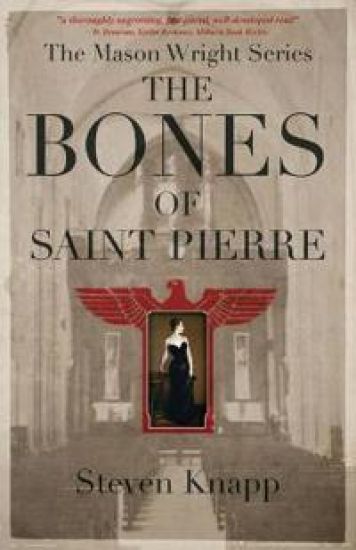
As the world heads toward war, who can save France's greatest treasures? On a rainy night in New York City, Mason Wright receives a surprise visit from his old flame, Collette Moulie. Despite his misgivings, he agrees to help her and her father in a risky, and probably illegal plan to save the art treasures of France from a possible Nazi invasion. Mason immediately finds himself caught up in a world of fine art, stolen paintings, master forgeries...and the men who will stop at nothing to acquire them. Traveling to France, Mason realizes that he has suddenly become one of the most wanted men in all of Europe. Putting his life in the hands of a man he barely knows, Mason traverses the catacombs and streets of Paris, pursued by black marketeers and German spies. Mason learns early on that there is no one he can trust. Can he find his way out of France before the Blitzkrieg begins?
The Predicament of Belief

The Predicament of Belief

Philip Clayton; Steven Knapp

Oxford University Press
2013
nidottu
Does it make sense - can it make sense - for someone who appreciates the explanatory power of modern science to continue believing in a traditional religious account of the ultimate nature and purpose of our universe? This book is intended for those who care about that question and are dissatisfied with the rigid dichotomies that dominate the contemporary debate. The extremists won't be interested - those who assume that science answers all the questions that matter, and those so certain of their religious faith that dialogue with science, philosophy, or other faith traditions seems unnecessary. But far more people today recognize that matters of faith are complex, that doubt is endemic to belief, and that dialogue is indispensable in our day. In eight probing chapters, the authors of The Predicament of Belief consider the most urgent reasons for doubting that religious claims - in particular, those embedded in the Christian tradition - are likely to be true. They develop a version of Christian faith that preserves the tradition's core insights but also gauges the varying degrees of certainty with which those insights can still be affirmed. Along the way, they address such questions as the ultimate origin of the universe, the existence of innocent suffering, the challenge of religious plurality, and how to understand the extraordinary claim that an ancient teacher rose from the dead. They end with a discussion of what their conclusions imply about the present state and future structure of churches and other communities in which Christian affirmations are made.
The Predicament of Belief

The Predicament of Belief

Philip Clayton; Steven Knapp

Oxford University Press
2011
sidottu
Does it make sense - can it make sense - for someone who appreciates the explanatory power of modern science to continue believing in a traditional religious account of the ultimate nature and purpose of our universe? This book is intended for those who care about that question and are dissatisfied with the rigid dichotomies that dominate the contemporary debate. The extremists won't be interested - those who assume that science answers all the questions that matter, and those so certain of their religious faith that dialogue with science, philosophy, or other faith traditions seems unnecessary. But far more people today recognize that matters of faith are complex, that doubt is endemic to belief, and that dialogue is indispensable in our day. In eight probing chapters, the authors of The Predicament of Belief consider the most urgent reasons for doubting that religious claims - in particular, those embedded in the Christian tradition - are likely to be true. They develop a version of Christian faith that preserves the tradition's core insights but also gauges the varying degrees of certainty with which those insights can still be affirmed. Along the way, they address such questions as the ultimate origin of the universe, the existence of innocent suffering, the challenge of religious plurality, and how to understand the extraordinary claim that an ancient teacher rose from the dead. They end with a discussion of what their conclusions imply about the present state and future structure of churches and other communities in which Christian affirmations are made.
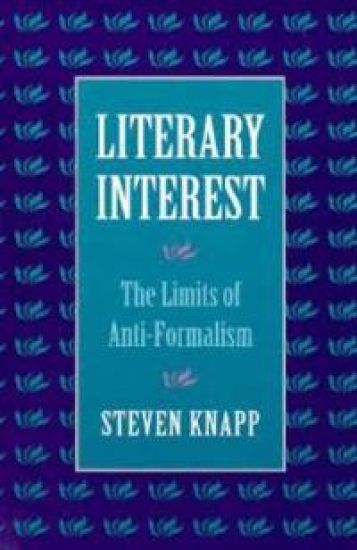
Literary Interest

Literary Interest

Steven Knapp

Harvard University Press
1993
sidottu
Is there such a thing as a specifically literary discourse, distinguishable from other modes of thought and writing? Is there any way to defend the intuition that a work of literature says something that can't be said in any other way? Drawing on recent work in the philosophies of language and action, Steven Knapp presents a challenging new definition of “the literary” in a forceful analysis that will radically change the sometimes heated debate about formalism. Formalist theorists have maintained that the uniqueness of the literary lies in the special nature of literary language. Their critics argue that to draw sharp distinctions between literary and nonliterary language is to privilege one kind of text and to insulate cultural activity from social conflict and political change. In the course of a rigorous engagement with such literary theorists, old and new, Knapp develops a provocative defense of the notion of a uniquely literary mode of discourse—a defense that challenges proponents as well as critics of formalism. He extends and deepens current debates about the literary canon, the purpose of literary study, and the aims and implications of the recent critical return to history. His bold and surprising argument has significance for the ethical and political role of literary studies that no one interested in literary theory or the philosophy of art will be able to ignore. Literary Interest will engage theorists, literary critics in all fields, and philosophers addressing issues of aesthetics and language.
Personification and the Sublime

Personification and the Sublime

Steven Knapp

Harvard University Press
1985
sidottu
Eighteenth-century and Romantic readers had a peculiar habit of calling personified abstractions "sublime." This has always seemed mysterious, since the same readers so often expressed a feeling that there was something wrong with turning ideas into people--or, worse, turning people into ideas. In this wide-ranging, carefully argued study, Steven Knapp explains the connection between personification and the aesthetics of the sublime. Personifications, such as Milton's controversial figures of Sin and Death in "Paradise Lost," were seen to embody a unique combination of imaginative power and overt fictionality, and these, Knapp shows, were exactly the conflicting requirements of the sublime in general. He argues that the uneasiness readers felt toward sublime personifications was symptomatic of broader ambivalences toward archaic beliefs, political and religious violence, and poetic fiction as such. Drawing on recent interpretations of Romanticism, allegory, and the sublime, Knapp provides important new readings of Coleridge, Wordsworth, Kant, and William Collins. His provocative thesis sheds new light on the relationship between Romanticism and the eighteenth century.