Kirjojen hintavertailu – 12 859 828 kirjaa ja 27 kauppaa

Kirjailija

Stewart D. Friedman

Kirjat ja teokset yhdessä paikassa: 24 kirjaa, julkaisuja vuosilta 1987–2024, suosituimpiin kuuluu Two-Career Families (HBR Working Parents Series). Vertaile teosten hintoja ja tarkista saatavuus suomalaisista kirjakaupoista.

24 kirjaa

Kirjojen julkaisuvuodet: 1987–2024.

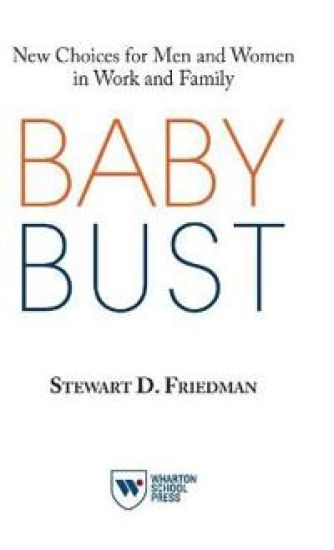
Baby Bust

Baby Bust

Stewart D. Friedman

Wharton Digital Press
2013
sidottu
Lean in. Opt out. Have it all. None of the above. A new book based on a groundbreaking cross-generational study reveals both greater freedom and new constraints for men and women in their work and family lives. Stew Friedman, founding director of The Wharton School's Work/Life Integration Project, studied two generations of Wharton college students as they graduated: Gen Xers in 1992 and Millennials in 2012. The cross-generational study produced a stark discovery—the rate of graduates who plan to have children has dropped by nearly half over the past 20 years. At the same time, men and women are now more aligned in their attitudes about dual-career relationships, and they are opting out of parenthood in equal proportions. But their reasons for doing so are quite different. In his new book, Baby Bust: New Choices for Men and Women in Work and Family, Friedman draws on this unique research to explain why so many young people are not planning to become parents. He reveals good news, that there is a greater freedom of choice now, and bad, that new constraints are limiting people's options. In light of these present realities, he offers ideas for what we can do as a society, in our organizations, and for ourselves to make it easier for men and women to choose the lives they want. In this book, Friedman addresses: + How views about work and family have changed in the past 20 years + Why men and women have different reasons for opting out of parenthood + How family has been redefined + Why we are all now part of a revolution in work and family + What choices we face in our social and educational policy + How organizations and individuals—especially men—can spur cultural change In the debates on work and family, people of all generations are calling for a reasoned, thoughtful, research-driven contribution to the discussion. In Baby Bust, Friedman offers just that: an astute assessment of how far we have come and where we need to go from here.
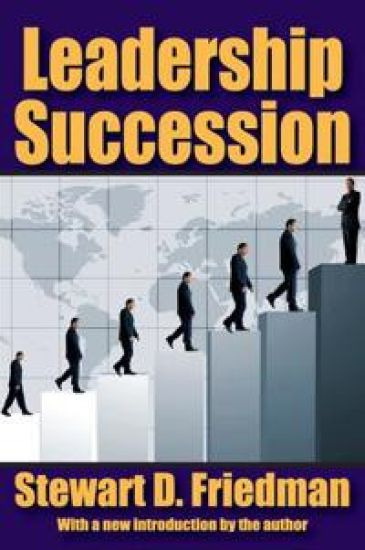
Leadership Succession

Leadership Succession

Stewart D. Friedman

AldineTransaction
2011
nidottu
This volume focuses on the most critical strategic activity in any organization, namely, who gets chosen to sit in the top echelon of the pyramid. Friedman argues that it is the quality of corporate leadership that will determine corporate winners and losers in the global competitive game. The stakes in leadership succession are high. The selection of key figures is the one human resource activity that no one belittles for being of secondary importance. Indeed, leadership succession is so important and central in many executive minds that it crowds out any other work. The succession process is often fraught with political intrigue, it lacks discipline, and excludes meaningful involvement of senior human resource executives. The contributors to this imaginative volume reveal a succession planning process that is frequently sloppy, superficial, and regularly sabotaged by senior management when they give it short shrift in terms of quality time. In addition, senior management often overrides sound decisions when it comes to filling key positions. The result is a lack of integrity throughout the human resource systems that eventually leads to a collapse of belief in the system and its governance. Noel M. Tichy, a leading figure in the studies of human resource management, has said, "Stewart Friedman is to be congratulated for a successful effort in providing a state of the art look at leadership succession. [He] provides us with an empirical database of what is happening in U. S. corporations, helpful prescriptions for future improvement of leadership succession, and a realistic assessment of the human resource executive challenges in this area."
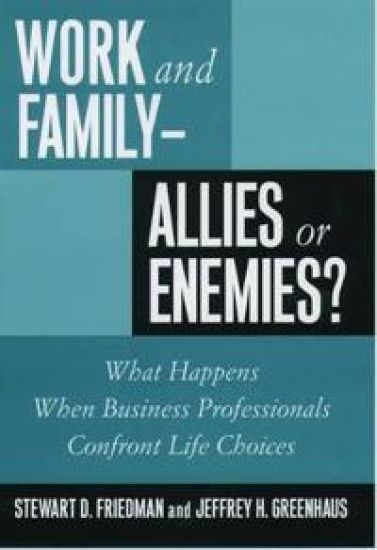
Work and Family - Allies or Enemies?

Work and Family - Allies or Enemies?

Stewart D. Friedman; Jeffrey H. Greenhaus

Oxford University Press Inc
2000
sidottu
We've come a long way since the classic book The Organization Man first introduced the 'ideal' two-person career: a full-time male breadwinner and a stay-at-home wife. What typified the '50s good life is in stark contrast to contemporary reality: in the USA 63% of all married women with children under six years old are in the workforce and 40% of all workers are part of a dual-earner couple. Work and Family - Allies or Enemies? offers a new lens for viewing the real struggles that business professionals - particularly women - face in their daily battle to find ways of 'getting a life' and 'having it all'. Based on a pioneering study that surveyed more than 800 business professionals, this volume will help readers understand and deal with the effects of gender, professional culture, and social expectations, on the evolving roles of men and women in crafting an integrated life. In this rich, inspiring, and at times disturbing look at how work and family affect the lives of men and women trying to manage the complexities of modern living, the authors argue that it is critical to learn how to manage the boundaries between work and family, to handle ambiguity, to manage multiple tasks simultaneously, and to build networks of support at work and in the community. Work and Family - Allies or Enemies? offers a prescription for success that requires that all parties - individuals, employers, and society - clarify what is important, recognize and support the whole person, and continually experiment with new ways to achieve meaningful goals.
Leadership Succession

Leadership Succession

Stewart D. Friedman

Transaction Publishers
1987
sidottu
This volume focuses on the most critical strategic activity in any organization, namely, who gets chosen to sit in the top echelon of the pyramid. Friedman argues that it is the quality of corporate leadership that will determine corporate winners and losers in the global competitive game. The stakes in leadership succession are high. The selection of key figures is the one human resource activity that no one belittles for being of secondary importance. Indeed, leadership succession is so important and central in many executive minds that it crowds out any other work. The succession process is often fraught with political intrigue, it lacks discipline, and excludes meaningful involvement of senior human resource executives. The contributors to this imaginative volume reveal a succession planning process that is frequently sloppy, superficial, and regularly sabotaged by senior management when they give it short shrift in terms of quality time. In addition, senior management often overrides sound decisions when it comes to filling key positions. The result is a lack of integrity throughout the human resource systems that eventually leads to a collapse of belief in the system and its governance. Noel M. Tichy, a leading figure in the studies of human resource management, has said, "Stewart Friedman is to be congratulated for a successful effort in providing a state of the art look at leadership succession. [He] provides us with an empirical database of what is happening in U. S. corporations, helpful prescriptions for future improvement of leadership succession, and a realistic assessment of the human resource executive challenges in this area."