Kirjojen hintavertailu – 12 859 824 kirjaa ja 27 kauppaa

Kirjailija

Stuart MacDonald

Kirjat ja teokset yhdessä paikassa: 18 kirjaa, julkaisuja vuosilta 1982–2026, suosituimpiin kuuluu The History and Philosophy of Art Education. Vertaile teosten hintoja ja tarkista saatavuus suomalaisista kirjakaupoista.

18 kirjaa

Kirjojen julkaisuvuodet: 1982–2026.

Radicalisation, Counter-Radicalisation, and Prevent

Radicalisation, Counter-Radicalisation, and Prevent

Lee Jarvis; Andrew Whiting; Stuart Macdonald

MANCHESTER UNIVERSITY PRESS
2026
nidottu
This book offers the first sustained investigation into non-elite understandings of radicalisation and counter-radicalisation policy. Drawing on original focus group research with students from universities across England and Wales, the book explores how ‘ordinary’ citizens understand radicalisation, how they make sense of counter-radicalisation initiatives like the UK Prevent Strategy, and how they evaluate its functioning and effects across society. Radicalisation, counter-radicalisation and Prevent demonstrates that these non-elite insights often contradict and diverge from traditional (elite) security knowledge and thus shed new light on wider questions around the politics of security. This has vitally important implications not only for counter-radicalisation and counter-terrorism policy but for the very study and practice of security.

Criminal Law

Criminal Law

Stuart Macdonald

pearson education limited
2026
nidottu
Build your understanding and confidence in the key concepts surrounding Criminal Law via the practical applications and assessments Criminal Law, 3rd edition, supports Undergraduates in learning and applying criminal law to problem scenarios, thereby helping you develop your critical skills and evaluate the law’s effect in today’s socio-economic context. Renowned for its student-friendly approach and excellent coverage of practical cases and articles, this updated digital edition will give you a clear overview of the law and is a must-read if you are studying the LLB or GDL/SQE1. Key Features: Case and Chapter summaries explain key aspects of each topic. End-of-chapter 'Apply the Law' exercises encourage you to check your understanding of the topics and apply what you have learned in a case scenario. Real life case files allow you to think like a lawyer and write client advice based on evidence. Fully updated with recent examples on law cases demonstrate how theory applies to real life.
Tradition and Tension

Tradition and Tension

Stuart Macdonald

MCGILL-QUEEN'S UNIVERSITY PRESS
2025
nidottu
In 1945 the Presbyterian Church was one of Canada’s largest and most culturally influential churches. This impressive standing, in the aftermath of a depression and a global war and just twenty years after much of its membership had departed to form the United Church of Canada, was a mark of the Presbyterian Church’s resilience and resourcefulness. Yet the denomination’s greatest challenges lay in the decades that followed. Tradition and Tension explores the history of the Presbyterian Church in Canada from 1945 to 1985. In the first half of this period, the church vigorously built new congregations in the suburbs, revitalized existing congregations, and took part in the religious revival of the 1950s. It opened its doors to new ethnic communities, updated its forms of worship, and revised its structures to permit the ordination of women. These renewal efforts were not without controversy within the church, however. Amid the cultural aftershocks of the 1960s, and as membership growth stalled, arguments about who was responsible for the church’s waning influence widened the rift between modernizers and traditionalists. Their common vision was lost. The place of religion in Canadian society changed dramatically in the postwar period. Tradition and Tension examines how the Presbyterian Church consciously sought to reflect these changes – and how it was transformed and even overwhelmed by them.
Radicalisation, Counter-Radicalisation, and Prevent

Radicalisation, Counter-Radicalisation, and Prevent

Lee Jarvis; Andrew Whiting; Stuart Macdonald

MANCHESTER UNIVERSITY PRESS
2024
sidottu
This book offers the first sustained investigation into non-elite understandings of radicalisation and counter-radicalisation policy. Drawing on original focus group research with students from universities across England and Wales, the book explores how ‘ordinary’ citizens understand radicalisation, how they make sense of counter-radicalisation initiatives like the UK Prevent Strategy, and how they evaluate its functioning and effects across society. Radicalisation, counter-radicalisation and Prevent demonstrates that these non-elite insights often contradict and diverge from traditional (elite) security knowledge and thus shed new light on wider questions around the politics of security. This has vitally important implications not only for counter-radicalisation and counter-terrorism policy but for the very study and practice of security.

Leaving Christianity

Leaving Christianity

Brian Clarke; Stuart Macdonald

McGill-Queen's University Press
2017
sidottu
Canadians were once church-goers. During the post-war boom of the 1950s, Canadian churches were vibrant institutions, with attendance rates even higher than in the United States, but the following decade witnessed emptying pews. What happened? In Leaving Christianity Brian Clarke and Stuart Macdonald quantitatively map the nature and extent of Canadians' disengagement with organized religion and assess the implications for Canadian society and its religious institutions. Drawing on a wide array of national and denominational statistics, they illustrate how the exodus that began with disaffected baby boomers and their parents has become so widespread that religiously unaffiliated Canadians are now the new majority. While the old mainstream Protestant churches have been the hardest hit, the Roman Catholic Church has also experienced a significant decline in numbers, especially in Quebec. Canada's civil society has historically depended on church members for support, and a massive drift away from churches has profound implications for its future. Leaving Christianity documents the true extent of the decline, the timing of it, and the reasons for this major cultural shift.
Leaving Christianity

Leaving Christianity

Brian Clarke; Stuart Macdonald

McGill-Queen's University Press
2017
nidottu
Canadians were once church-goers. During the post-war boom of the 1950s, Canadian churches were vibrant institutions, with attendance rates even higher than in the United States, but the following decade witnessed emptying pews. What happened? In Leaving Christianity Brian Clarke and Stuart Macdonald quantitatively map the nature and extent of Canadians' disengagement with organized religion and assess the implications for Canadian society and its religious institutions. Drawing on a wide array of national and denominational statistics, they illustrate how the exodus that began with disaffected baby boomers and their parents has become so widespread that religiously unaffiliated Canadians are now the new majority. While the old mainstream Protestant churches have been the hardest hit, the Roman Catholic Church has also experienced a significant decline in numbers, especially in Quebec. Canada's civil society has historically depended on church members for support, and a massive drift away from churches has profound implications for its future. Leaving Christianity documents the true extent of the decline, the timing of it, and the reasons for this major cultural shift.
Sail This Way

Sail This Way

Stuart MacDonald

Beyond Sailing
2017
pokkari
Straight-forward advice on offshore and ocean cruising under sail, based on fifty years and over 50,000 miles of experience. Sail This Way is as much about the ethos of ocean sailing as the technicalities. The book gets straight to the point and explores topics you won't learn about at a sailing school. It is a must read for anyone thinking about setting off. STUART MACDONALD Stuart MacDonald went to sea when he was seventeen and became a Captain in the Merchant Navy by the time he was thirty. He has been racing and cruising sailing boats all his life, has sailed around the world and crossed the Atlantic Ocean, the Pacific and the Indian Oceans singlehanded. He now lives and sails on the West coast of Scotland.
Terrorism Online

Terrorism Online

Lee Jarvis; Stuart MacDonald; Thomas M. Chen

Routledge
2016
nidottu
This book investigates the intersection of terrorism, digital technologies and cyberspace. The evolving field of cyber-terrorism research is dominated by single-perspective, technological, political, or sociological texts. In contrast, Terrorism Online uses a multi-disciplinary framework to provide a broader introduction to debates and developments that have largely been conducted in isolation. Drawing together key academics from a range of disciplinary fields, including Computer Science, Engineering, Social Psychology, International Relations, Law and Politics, the volume focuses on three broad themes: 1) how – and why – do terrorists engage with the Internet, digital technologies and cyberspace?; 2) what threat do these various activities pose, and to whom?; 3) how might these activities be prevented, deterred or addressed? Exploring these themes, the book engages with a range of contemporary case studies and different forms of terrorism: from lone-actor terrorists and protest activities associated with ‘hacktivist’ groups to state-based terrorism. Through the book’s engagement with questions of law, politics, technology and beyond, the volume offers a holistic approach to cyberterrorism which provides a unique and invaluable contribution to this subject matter. This book will be of great interest to students of cybersecurity, security studies, terrorism and International Relations.
Text Cases and Materials on Criminal Law MyLawChamber Pack
This package includes a physical copy of TCM Criminal Law, 1/e by MacDonald as well as access to the eText and MyLawChamber. Text, Cases and Materials on Criminal Law combines detailed commentary and analysis of the law with excerpts from a range of sources, both legal and non-legal, to help set the law in context and deepen your understanding of this core area of legal study. MyLawChamber is a complete online teaching and learning platform designed to improve results by helping students quickly master concepts, and by providing educators with a robust set of tools for easily gauging and addressing the performance of students. MyLawChamber engages students with high-quality multimedia learning experiences that help law students excel. In every exercise, students receive immediate feedback so they see mistakes right away, learn precisely which concepts are holding them back, and master concepts through targeted practice. Case Navigator (in conjunction with LexisNexis), a tool to help improve students’ case reading and comprehension skills. Virtual Lawyer, an interactive scenario-based programme to help students apply their knowledge of the law to problem questions. Pearson eText, a fully-searchable electronic version of your chosen text which you can customise, annotate, highlight and bookmark. Test banks of multiple-choice-questions providing formative assessment. For educators, MyLawChamber provides highly-visual data and performance analysis to help them quickly identify gaps in student learning. And because MyLawChamber comes from Pearson, you know it’s developed by an experienced partner committed to providing content, resources, and expertise for the best digital learning experiences.
Terrorism Online

Terrorism Online

Lee Jarvis; Stuart MacDonald; Thomas M. Chen

Routledge
2015
sidottu
This book investigates the intersection of terrorism, digital technologies and cyberspace. The evolving field of cyber-terrorism research is dominated by single-perspective, technological, political, or sociological texts. In contrast, Terrorism Online uses a multi-disciplinary framework to provide a broader introduction to debates and developments that have largely been conducted in isolation. Drawing together key academics from a range of disciplinary fields, including Computer Science, Engineering, Social Psychology, International Relations, Law and Politics, the volume focuses on three broad themes: 1) how – and why – do terrorists engage with the Internet, digital technologies and cyberspace?; 2) what threat do these various activities pose, and to whom?; 3) how might these activities be prevented, deterred or addressed? Exploring these themes, the book engages with a range of contemporary case studies and different forms of terrorism: from lone-actor terrorists and protest activities associated with ‘hacktivist’ groups to state-based terrorism. Through the book’s engagement with questions of law, politics, technology and beyond, the volume offers a holistic approach to cyberterrorism which provides a unique and invaluable contribution to this subject matter. This book will be of great interest to students of cybersecurity, security studies, terrorism and International Relations.
The Witches of Fife

The Witches of Fife

Stuart MacDonald

John Donald Short Run Press
2014
nidottu
Along the coast of Fife, in villages like Culross and Pittenweem, history records that some women were executed as witches. Nevertheless, the reality of what happened the night that Janet Cornfoot was lynched at Pittenweem is hard to grasp as one sits by the harbour watching the fishing boats unload their catch and the pleasure boats rising with the tide. How could people do this to an old woman? Why was no-one ever brought to justice? And why would anyone defend such a lynching? The task of the historian is to try to make events in the past come alive and seem less strange. The details of the witch-hunt are fascinating. Some of the anecdotes are strange. The modern reader finds it hard to imagine illness being blamed on the malevolence of a beggar woman denied charity, or the economic failure of a sea voyage being attributed to the village hag, not bad weather. Witch-hunting was related to ideas, values, attitudes and political events. It was a complicated process, involving religious and civil authorities, village tensions and the fears of the elite. The witch-hunt in Scotland also took place at a time when one of the main agendas was the creation of a righteous or godly society. As a result, religious authorities had control over aspects of people's lives which seem as strange to us today as beliefs about magic or witchcraft. It was not accidental that the witch-hunt in Scotland, and specifically in Fife, should have happened at this time. This book tells the story of what occurred over a period of a century and a half, and offers some explanation as to why it occurred.
Designs on Democracy – Architecture and Design in Scotland Post Devolution
Whilst there are some studies of architecture in Scotland post-devolution, writings on design are largely non-existent. Designs on Democracy seeks to fill that gap and ranges over the debates concerning architecture, urbanism, design and the Creative and Cultural Industries and the policies, people and places that stimulate and animate them. The book also tells a story about Scotland's creatives -where they work and how their ideas and what they create and design contribute to Scotland's democratic culture and identity.
The History and Philosophy of Art Education

The History and Philosophy of Art Education

Stuart MacDonald

Boydell & Brewer
2004
Nidottu
An investigation of the development of art and design education in Italy, France, Britain, Germany, and the United States. Dr. Macdonald investigates the continuous developments of art and design education in Italy, France, Britain, Germany, and the United States. The study traces the philosophies of teachers from the age of the guilds and the academies to today, and sets them in the context of the general education theories of their times. Stuart Macdonald clarifies the whole field of art education for research and teaching purposes. He points out that the knowledge of the principles and methods of art education is essential for a true understanding of the art of different periods. He makes clear that art education should be studied within the existing education disciplines of history, philosophy, psychology, and sociology of education. Essentially factual, using many quotations from primary sources not generally available, this book gives a disciplined grounding in a branch of the history of education, and describes the philosophies which continue to govern courses in Art and Design. This finely illustrated book provides a vivid review of the history of art teaching.
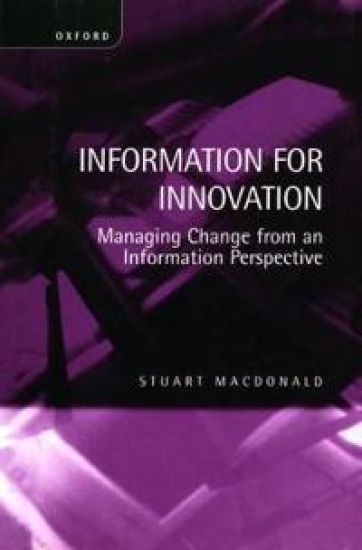
Information for Innovation

Information for Innovation

Stuart Macdonald

Oxford University Press
2000
nidottu
Information is not taken seriously. Much is said about the information age, the information economy, the information society, and particularly about information technology, but little about information itself. Information is not as other good: it has some very odd characteristics, conveniently overlooked by senior managers passionate about knowledge-based, learning organizations; by politicians and public servants, compensating with policy and programme for the information failure of organizationa and market; and by the IT and dotcom communities, bent on adding value to what they treat as just a commodity. This book looks at innovation from an information perspective; one that puts information first. Its information perspective is applied to eighteenth-century agriculture and high technology, to technology transfer and espionage, to corporate strategy and intellectual property. The results are intriguing.
Information for Innovation

Information for Innovation

Stuart Macdonald

Oxford University Press
1998
sidottu
Information is not taken seriously. Much is said about the information age, the information economy, the information society, and particularly about information technology, but little about information itself. If these are important, then so is information. But information is not as other goods: it has some peculiar characteristics. It cannot be displayed for sale without giving it away in the process. Sold, it goes to the buyer but still remains with the seller. Buying entails expressing demand in ignorance for buyers who do not know just what it is that they do not know. Such characteristics have long been recognised by economists, but it is not generally economists who have most to say about the importance of information. This privilege is exercised by senior managers, who speak passionately about knowledge-based, learning organizations; by politicians and public servants, anxious to compensate with policy and programme for the information failure of organization and market; and by specialists in telecommunications and information technology, bent on adding value to what they treat as just a commodity. All are particularly enthusiastic about the innovation which springs from information. Information usually requires new information. Finding, acquiring, and mixing this new information with that already in use presents problems, not least because complex information transactions are required rather than simple information transfer. Solutions can be devised, but only by accommodating the characteristics of information. This book contrasts the way innovation is normally regarded in a variety of areas from eighteenth-century agriculture to high technology, from technology transfer to industrial espionage, from corporate strategy to patents and independent inventors with how it appears from what is termed an 'information perspective', that is one that puts information first. The results are intriguing, suggesting that radically different approaches to innovation (and organization) should be considered.
Revolution in Miniature

Revolution in Miniature

Ernest Braun; Stuart MacDonald

Cambridge University Press
1982
pokkari
Semiconductor electronics is the major technology of our age. Its achievement and potential are vast, its application and influence ubiquitous, its social and economic consequences uncertain. Semiconductor electronics has become the vehicle for nearly all technological change and, consequently, the subject of much discussion. This revised and up dated edition is offered as a basic contribution to that vital discussion by authors who have long studied the process of technological change and who are familiar with the peculiarities of the semiconductor industry. Although it dealt with a highly technical subject, the first edition proved readily intelligible to a wide audience. The second edition is designed for that same group - those who seek an understanding of the processes at the heart of technological change.