
Kirjailija
Stuart MacIntyre
Kirjat ja teokset yhdessä paikassa: 15 kirjaa, julkaisuja vuosilta 1985–2026, suosituimpiin kuuluu Little Moscows. Vertaile teosten hintoja ja tarkista saatavuus suomalaisista kirjakaupoista.
15 kirjaa
Kirjojen julkaisuvuodet: 1985–2026.
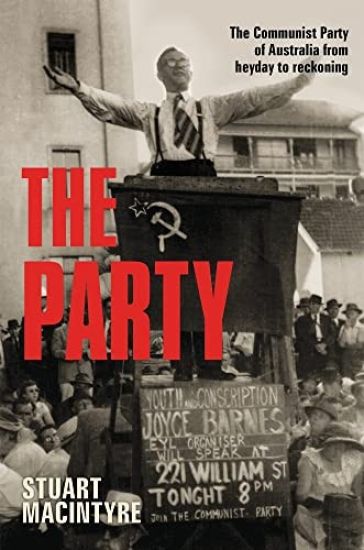
The Party: The Communist Party of Australia from Heyday to Reckoning
Stuart MacIntyre
ALLEN UNWIN
2022
sidottu

What is a fair wage? Is there a right to work? Is there a right to shelter or to good health? What are the entitlements of those who cannot work? Can opportunities be equal? For women? For Aborigines? For more than a century, Australians have addressed expectations of social justice to their governments and have had to live with the consequences. This book looks at how changing circumstances have generated changing popular aspirations, and how these in turn have been translated into public policy. It argues that social justice has no single meaning and is in fact the site of conflicting and divergent endeavours. Precisely for this reason it has a special relevance for the age of consensus. The first part of this book uses these shifting interpretations of social justice as a lodestar to chart a new course through the history of this country. The second part shows how it operates today as a focus of debate in areas ranging from education to Aboriginal land rights. The book therefore offers a new perspective on the past and a trenchant analysis of the present. It draws together a wide range of material and presents it by means of case studies that assume no specialist knowledge. It will appeal to students of Australian history, public policy and social welfare; and it is addressed to all readers with an interest in the future of their country.
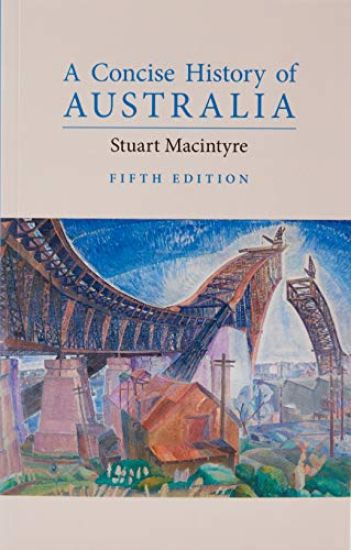
A Concise History of Australia
Stuart Macintyre
Cambridge University Press
2020
pokkari
Halvin toimitettuna 26,90 €
Stuart Macintyre, one of Australia's most highly regarded historians, revisits A Concise History of Australia to provoke readers to reconsider Australia's past and its relationship to the present. Integrating new scholarship with the historical record, the fifth edition of A Concise History of Australia brings together the long narrative of Australia's First Nations' peoples; the arrival of Europeans and the era of colonies, convicts, gold and free settlers; the foundation of a nation state; and the social, cultural, political and economic developments that created a modern Australia. As we enter the third decade of the twenty-first century, Macintyre's Australia remains one of achievements and failures. So too the future possibilities are deeply rooted in the country's past endeavours. A Concise History of Australia is an invitation to examine this past.
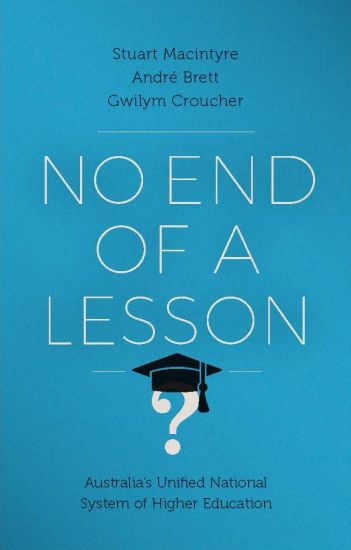
No End of a Lesson
Stuart Macintyre; Andre Brett; Gwilym Croucher
Melbourne University Press
2017
nidottu
A revolution swept through universities three decades ago, transforming them from elite institutions into a mass system of higher education. Teaching was aligned with occupational outcomes, research was directed to practical results. Campuses grew and universities became more entrepreneurial. Students had to juggle their study requirements with paid work, and were required to pay back part of the cost of their degrees. The federal government directed this transformation through the creation of a Unified National System. How did this happen? What were the gains and the losses? No End of a Lesson explores this radical reconstruction and assesses its consequences.
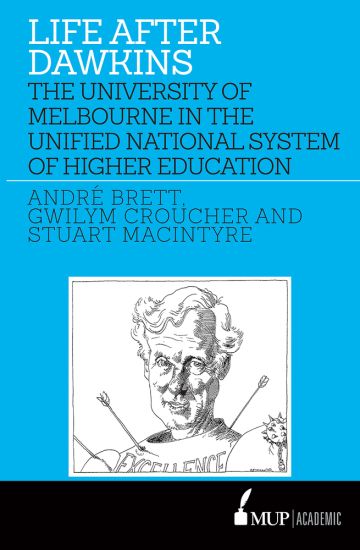
The reconstruction of higher education in Australia through the creation of the Unified National System of Higher Education at the end of the 1980s by John Dawkins is commonly seen as a watershed. It brought new ways of funding, directing and organising universities, expanding their size, reorienting their activities and setting in train a far-reaching transformation of the academic enterprise. This volume traces its impact on the balance between the University of Melbourne’s academic mission and external expectations, and how it adjusted to neutralise the impact of the change and restore the balance. At Melbourne, the Dawkins revolution changed little in the way it understood itself and conducted its affairs, but changed everything.
The reconstruction of higher education in Australia through the creation of the Unified National System of Higher Education at the end of the 1980s by John Dawkins is commonly seen as a watershed. It brought new ways of funding, directing and organising universities, expanding their size, reorienting their activities and setting in train a far-reaching transformation of the academic enterprise. This volume traces its impact on the balance between the University of Melbourne’s academic mission and external expectations, and how it adjusted to neutralise the impact of the change and restore the balance. At Melbourne, the Dawkins revolution changed little in the way it understood itself and conducted its affairs, but changed everything.
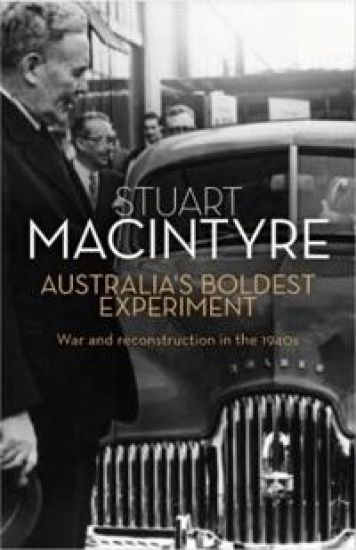
A major new account of the 1940s in Australia. In this landmark book, Stuart Macintyre explains how a country traumatised by World War I, hammered by the Depression and overstretched by World War II became a prosperous, successful and growing society by the 1950s. An extraordinary group of individuals, notably John Curtin, Ben Chifley, Nugget Coombs, John Dedman and Robert Menzies, re-made the country, planning its reconstruction against a background of wartime sacrifice and austerity. The other part of this triumphant story shows Australia on the world stage, seeking to fashion a new world order that would bring peace and prosperity. This book shows the 1940s to be a pivotal decade in Australia. At the height of his powers, Macintyre reminds us that key components of the society we take for granted – work, welfare, health, education, immigration, housing – are not the result of military endeavour but policy, planning, politics and popular resolve.
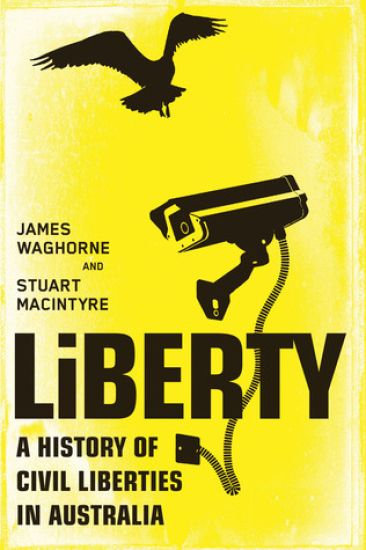
Liberty: A History of Civil Liberties in Australia
Stuart Macintyre; James Waghorne
UNIVERSITY OF NEW SOUTH WALES PRESS
2011
sidottu
A fascinating look at the history of civil liberties in Australia, this account offers a solid background to key civil liberties cases and a fresh analysis of the common law, human rights, and parliamentary democracy. From arguments over censorship in the 1930s to present-day debates on mandatory sentencing, the concept of civil liberties and its impact are discussed, tracing the formation of the Australian Council for Civil Liberties and its state-based counterparts as well as chronicling their involvement in the movement for law reform. Through major Australian historic events, this book demonstrates how the nation has been shaped by civil liberties.
What are the social sciences? What do they do? How are they practised in Australia? The Poor Relation examines the place of the social sciences-from economics and psychology to history, law and philosophy-in the teaching and research conducted by Australian universities. Across sixty years The Poor Relation charts the changing circumstances of the social sciences, and measures their contribution to public policy. In doing so it also relates the arrangements made to support them and explains why they are so persistently treated as the poor relation of science and technology.
How Organisations Connect: Investing in Communication
Gordon Boyce; Stuart Macintyre; Simon Ville
Melbourne University Press
2006
nidottu
Inter-organisational activity, whether public and private sector collaborations, university and industry partnerships or joint ventures between businesses, has benefits that range from increased market efficiency to innovative product development. Yet too often such activity can founder under the weight of differing expectations and divergent interests. How Organisations Connect shows how to avoid the pitfalls and make partnerships work. The contributors, experts from a range of disciplines, demonstrate the importance of developing strategies and establishing infrastructures that enable organisations to connect, and communicate, effectively. Their insights are backed up by case studies that include an investigation of three government and community sector partnerships in Australia, Canada and New Zealand; analysis of what makes a university-industry collaboration successful; an exploration of the changing relations between central banks and governments in Australia and New Zealand throughout the twentieth century; and a study of recent innovative developments in the supply chain networks of some British consumer industries. Through economic and business theory, historical perspectives and contemporary evidence How Organisations Connect presents both fascinating research findings and practical advice.
What if key episodes in Australia's past had turned out differently? If France had colonised part of Australia in the eighteenth century? If the ANZACS had played only a minor role in the Gallipoli landing in World War I? If Gough Whitlam's Labor government had been re-elected after its dismissal in 1975? If Aborigines had been granted citizenship much earlier? What new paths might our national history have followed? In this fascinating volume, leading Australian historians search for answers. Together, they reimagine Australia's environment, race relations, art, political life, and national identity, providing a play on actual and possible, action and result, result and consequence that is as rigorous as it is creative. It asks how our history has been written, what our nation has become, and what it might yet be.
The nation's history has probably never been more politicised than it is today. Politicians, journalists, columnists, academics and Australians from all walks of life argue passionately - and often, ideologically - about the significance of the national story: the cherished ideal of the 'fair go', the much contested facts of Indigenous dispossession, the Anzac legend, and the nation's strategic alliance with the United States. Historians have become both combatants and casualties in this war of words. In ""The History Wars"", Stuart Macintyre and Anna Clark explore how this intense public debate has polarised the nation and paralysed history departments. This edition includes a new afterword by Stuart Macintyre which recounts, with rueful irony, the outbreak of controversy that followed the book's original publication, and the further light it shed on the uses and abuses of Australian history.
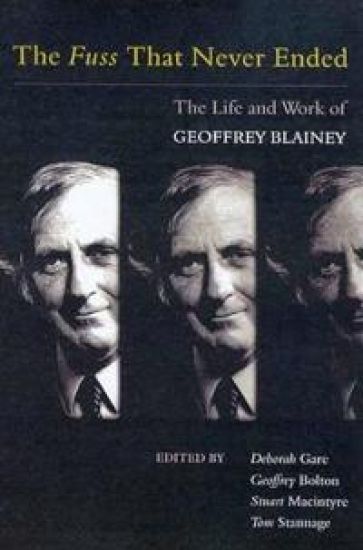
The Fuss That Never Ended
Stuart Macintyre; Deborah Gare; Geoffrey Bolton; Tom Stannage
Melbourne University Press
1999
pokkari
Geoffrey Blainey is a remarkable Australian. As a historian, he is a maverick - respected for his originality and prodigious productivity, but sometimes dismissed as a blinkered populist. He has steered Australian history into the nation's conversation. In The Fuss That Never Ended a lively and distinguished assembly of fellow historians take a fresh look at Blainey's distinguished career.

What is a fair wage? Is there a right to work? Is there a right to shelter or to good health? What are the entitlements of those who cannot work? Can opportunities be equal? For women? For Aborigines? For more than a century, Australians have addressed expectations of social justice to their governments and have had to live with the consequences. This book looks at how changing circumstances have generated changing popular aspirations, and how these in turn have been translated into public policy. It argues that social justice has no single meaning and is in fact the site of conflicting and divergent endeavours. Precisely for this reason it has a special relevance for the age of consensus. The first part of this book uses these shifting interpretations of social justice as a lodestar to chart a new course through the history of this country. The second part shows how it operates today as a focus of debate in areas ranging from education to Aboriginal land rights. The book therefore offers a new perspective on the past and a trenchant analysis of the present. It draws together a wide range of material and presents it by means of case studies that assume no specialist knowledge. It will appeal to students of Australian history, public policy and social welfare; and it is addressed to all readers with an interest in the future of their country.