Kirjojen hintavertailu – 12 903 724 kirjaa ja 27 kauppaa

Kirjailija

Sudhirkumar V. Barai

Kirjat ja teokset yhdessä paikassa: 9 kirjaa, julkaisuja vuosilta 2011–2025, suosituimpiin kuuluu Systematic Approach of Characterisation and Behaviour of Recycled Aggregate Concrete. Vertaile teosten hintoja ja tarkista saatavuus suomalaisista kirjakaupoista.

Nimi esiintyy myös muodoissa: Sudhirkumar V Barai

9 kirjaa

Kirjojen julkaisuvuodet: 2011–2025.

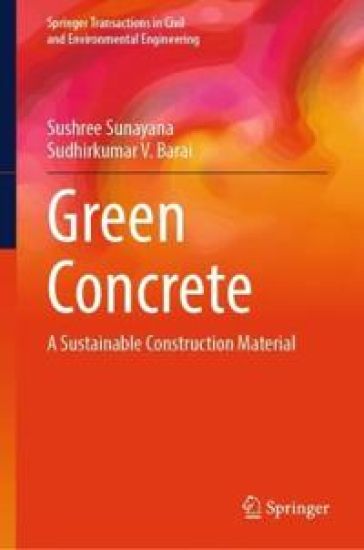
Green Concrete

Green Concrete

Sushree Sunayana; Sudhirkumar V. Barai

Springer Nature Switzerland AG
2025
sidottu
This book explores recycling and reusing construction wastes as alternative coarse aggregates and presents this as a possible solution for the major challenge of making sustainable concrete. It explores the reduction of cement use and the overcoming of some inferiorities in recycled coarse aggregate through the partial substitution of cement with supplementary cementitious materials (SCMs). The book evaluates the effect of low-volume SCMs (mainly fly ash) in 100% recycled coarse aggregate based concrete and comprehensively investigates this sustainable concrete for strength, safety, serviceability and sustainability. More specifically, this book discusses macro and microstructure properties, environmental impact assessment and performance of structural components. It explores the use of the particle packing mix design method (PPM) for concrete proportioning as it compensates lesser modulus of elasticity of RAC and is beneficial in lowering the environmental impact of concrete. Necessary modifications in mix design, mixing and design of concrete mixes are suggested to make this concrete safe for construction practice. It illustrates different mechanisms and results through figures, histograms, tables and experimental test pictures showing the failure pattern of structural elements and microstructure of concrete. Readers can get a clear understanding of the performance of this SCM incorporated RAC at various scales like micro, macro and structural components.
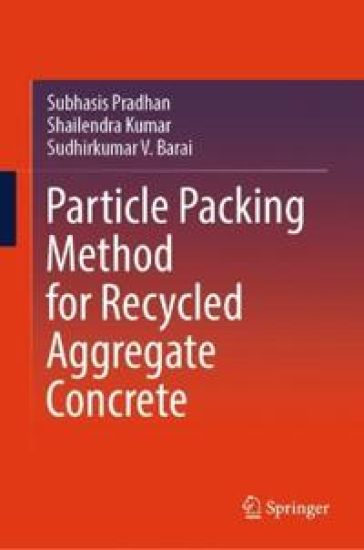
Particle Packing Method for Recycled Aggregate Concrete

Particle Packing Method for Recycled Aggregate Concrete

Subhasis Pradhan; Shailendra Kumar; Sudhirkumar V. Barai

SPRINGER VERLAG, SINGAPORE
2025
nidottu
This book highlights the use of commercially available recycled aggregate concrete (RAC) extracted from multiple construction and demolition sites, considering it as a viable alternative to conventional aggregate. It further describes the advanced techniques, such as, scanning electron microscopy, nanoindentation, thermogravimetric analysis and X-ray microtomography shedding light on the deep-rooted causes of inferior macro-mechanical performance of RAC and the advantages of particle packing method design approach in this regard. It then describes the improved properties of RAC with the help of macro-mechanical performance studies, microstructural characterization and fracture analysis. The systematic and in-depth presentation of the use of recycled coarse aggregate as an alternative to conventional aggregate for the preparation of structural concrete will guide researchers on subsequent research in RAC and provide assistance to structural engineers and concrete manufacturers for the usage of RAC.
Particle Packing Method for Recycled Aggregate Concrete

Particle Packing Method for Recycled Aggregate Concrete

Subhasis Pradhan; Shailendra Kumar; Sudhirkumar V. Barai

SPRINGER VERLAG, SINGAPORE
2024
sidottu
This book highlights the use of commercially available recycled aggregate concrete (RAC) extracted from multiple construction and demolition sites, considering it as a viable alternative to conventional aggregate. It further describes the advanced techniques, such as, scanning electron microscopy, nanoindentation, thermogravimetric analysis and X-ray microtomography shedding light on the deep-rooted causes of inferior macro-mechanical performance of RAC and the advantages of particle packing method design approach in this regard. It then describes the improved properties of RAC with the help of macro-mechanical performance studies, microstructural characterization and fracture analysis. The systematic and in-depth presentation of the use of recycled coarse aggregate as an alternative to conventional aggregate for the preparation of structural concrete will guide researchers on subsequent research in RAC and provide assistance to structural engineers and concrete manufacturers for the usage of RAC.
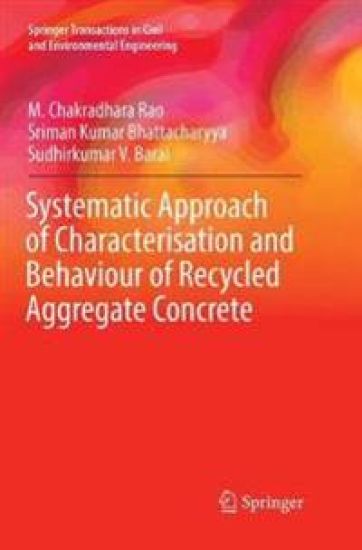
Systematic Approach of Characterisation and Behaviour of Recycled Aggregate Concrete

Systematic Approach of Characterisation and Behaviour of Recycled Aggregate Concrete

M. Chakradhara Rao; Sriman Kumar Bhattacharyya; Sudhirkumar V. Barai

Springer Verlag, Singapore
2018
nidottu
This book focuses on the utilisation of construction waste material as coarse aggregate in making concrete. It discusses in detail the behaviour of recycled aggregate under impact load along with other structural applications, and explains the various quality-improvement techniques for recycled aggregate and recycled aggregate concrete (RAC). The first chapter describes the importance of recycling construction and demolition waste and the status quo of global construction and demolition waste recycling. The second chapter examines the recycled aggregate production methodology. Subsequent chapters address the physical and mechanical characteristics and different research findings, as well as the engineering properties of recycled aggregate concrete. Further, the interrelationships among the mechanical properties of recycled aggregate concrete are discussed. The book also explores long-term properties like shrinkage and creep, durability properties, and microstructural characterisation. It will serve as a valuable resource for researchers and professionals alike.
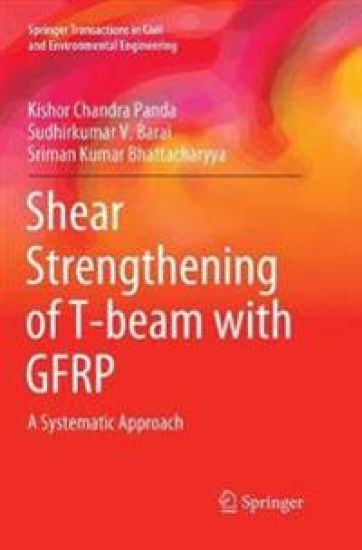
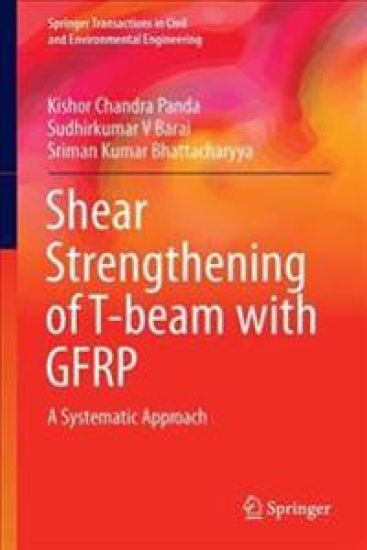
Shear Strengthening of T-beam with GFRP

Shear Strengthening of T-beam with GFRP

Kishor Chandra Panda; Sudhirkumar V. Barai; Sriman Kumar Bhattacharyya

Springer Verlag, Singapore
2018
nidottu
This book presents a systematic approach to the experimental, theoretical, and numerical investigation of reinforced concrete (RC) T-beams strengthened in shear with glass-fibre-reinforced polymers (GFRP) with variation in transverse steel reinforcements. It discusses experiments conducted on simply supported RC T-beams for control beams with and without transverse steel reinforcements and beams strengthened in shear with GFRP sheets and strips in different configurations, orientations, and variation of layers for each type of stirrup spacing. The book also includes a detailed numerical study using ANSYS performed in two stages. The first stage consists of selecting and testing relevant materials in the laboratory to establish the physical and mechanical properties of the materials. The second stage then involves testing beams for shear under two-point static loading systems. The test results demonstrate the advantage of using an externally applied, epoxy-bonded GFRP sheets and stripsto increase the shear capacity of the beams. The finite element method (FEM) analysis results verify the experimental results. The book will serve as a valuable resource for researchers and practicing civil engineers alike.
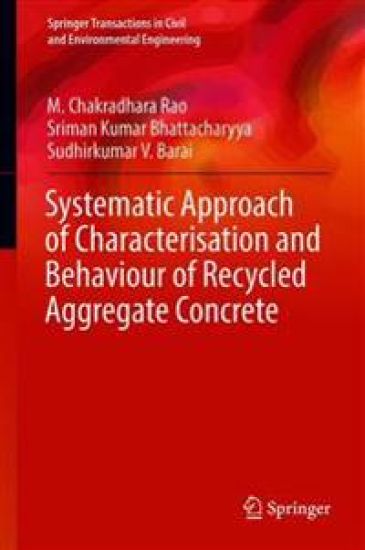
Systematic Approach of Characterisation and Behaviour of Recycled Aggregate Concrete

Systematic Approach of Characterisation and Behaviour of Recycled Aggregate Concrete

M. Chakradhara Rao; Sriman Kumar Bhattacharyya; Sudhirkumar V. Barai

Springer Verlag, Singapore
2018
sidottu
This book focuses on the utilisation of construction waste material as coarse aggregate in making concrete. It discusses in detail the behaviour of recycled aggregate under impact load along with other structural applications, and explains the various quality-improvement techniques for recycled aggregate and recycled aggregate concrete (RAC). The first chapter describes the importance of recycling construction and demolition waste and the status quo of global construction and demolition waste recycling. The second chapter examines the recycled aggregate production methodology. Subsequent chapters address the physical and mechanical characteristics and different research findings, as well as the engineering properties of recycled aggregate concrete. Further, the interrelationships among the mechanical properties of recycled aggregate concrete are discussed. The book also explores long-term properties like shrinkage and creep, durability properties, and microstructural characterisation. It will serve as a valuable resource for researchers and professionals alike.
Shear Strengthening of T-beam with GFRP

Shear Strengthening of T-beam with GFRP

Kishor Chandra Panda; Sudhirkumar V. Barai; Sriman Kumar Bhattacharyya

Springer Verlag, Singapore
2018
sidottu
This book presents a systematic approach to the experimental, theoretical, and numerical investigation of reinforced concrete (RC) T-beams strengthened in shear with glass-fibre-reinforced polymers (GFRP) with variation in transverse steel reinforcements. It discusses experiments conducted on simply supported RC T-beams for control beams with and without transverse steel reinforcements and beams strengthened in shear with GFRP sheets and strips in different configurations, orientations, and variation of layers for each type of stirrup spacing. The book also includes a detailed numerical study using ANSYS performed in two stages. The first stage consists of selecting and testing relevant materials in the laboratory to establish the physical and mechanical properties of the materials. The second stage then involves testing beams for shear under two-point static loading systems. The test results demonstrate the advantage of using an externally applied, epoxy-bonded GFRP sheets and stripsto increase the shear capacity of the beams. The finite element method (FEM) analysis results verify the experimental results. The book will serve as a valuable resource for researchers and practicing civil engineers alike.
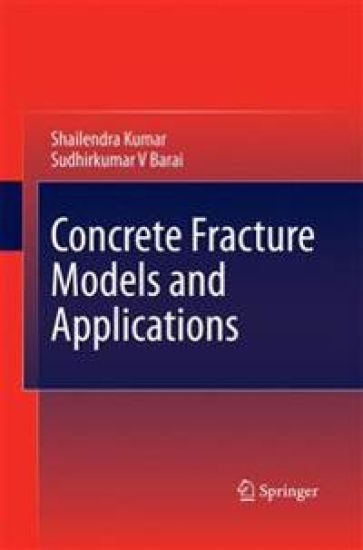
Concrete Fracture Models and Applications

Concrete Fracture Models and Applications

Shailendra Kumar; Sudhirkumar V Barai

Springer-Verlag Berlin and Heidelberg GmbH Co. K
2014
nidottu
Cementitious materials, rocks and fibre-reinforced composites commonly termed as quasibrittle, need a different fracture mechanics approach to model the crack propagation study because of the presence of significant size of fracture process zone ahead of the crack-tip. Recent studies show that concrete structures manifest three important stages in fracture process: crack initiation, stable crack propagation and unstable fracture or failure. Fracture Mechanics concept can better explain the above various stages including the concepts of ductility, size-effect, strain softening and post-cracking behavior of concrete and concrete structures. The book presents a basic introduction on the various nonlinear concrete fracture models considering the respective fracture parameters. To this end, a thorough state-of-the-art review on various aspects of the material behavior and development of different concrete fracture models is presented. The development of cohesive crack model for standard test geometries using commonly used softening functions is shown and extensive studies on the behavior of cohesive crack fracture parameters are also carried out. The subsequent chapter contains the extensive study on the double-K and double-G fracture parameters in which some recent developments on the related fracture parameters are illustrated including introduction of weight function method to Double-K Fracture Model and formulization of size-effect behavior of the double-K fracture parameters. The application of weight function approach for determining of theKR-curve associated with cohesive stress distribution in the fracture process zone is also presented. Available test data are used to validate the new approach. Further, effect of specimen geometry, loading condition, size-effect and softening function on various fracture parameters is investigated. Towards the end, a comparative study between different fracture parameters obtained from various models is presented.
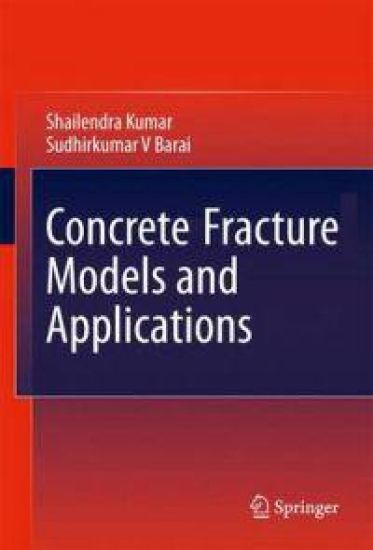
Concrete Fracture Models and Applications

Concrete Fracture Models and Applications

Shailendra Kumar; Sudhirkumar V Barai

Springer-Verlag Berlin and Heidelberg GmbH Co. K
2011
sidottu
Cementitious materials, rocks and fibre-reinforced composites commonly termed as quasibrittle, need a different fracture mechanics approach to model the crack propagation study because of the presence of significant size of fracture process zone ahead of the crack-tip. Recent studies show that concrete structures manifest three important stages in fracture process: crack initiation, stable crack propagation and unstable fracture or failure. Fracture Mechanics concept can better explain the above various stages including the concepts of ductility, size-effect, strain softening and post-cracking behavior of concrete and concrete structures. The book presents a basic introduction on the various nonlinear concrete fracture models considering the respective fracture parameters. To this end, a thorough state-of-the-art review on various aspects of the material behavior and development of different concrete fracture models is presented. The development of cohesive crack model for standard test geometries using commonly used softening functions is shown and extensive studies on the behavior of cohesive crack fracture parameters are also carried out. The subsequent chapter contains the extensive study on the double-K and double-G fracture parameters in which some recent developments on the related fracture parameters are illustrated including introduction of weight function method to Double-K Fracture Model and formulization of size-effect behavior of the double-K fracture parameters. The application of weight function approach for determining of theKR-curve associated with cohesive stress distribution in the fracture process zone is also presented. Available test data are used to validate the new approach. Further, effect of specimen geometry, loading condition, size-effect and softening function on various fracture parameters is investigated. Towards the end, a comparative study between different fracture parameters obtained from various models is presented.