

Kirjailija
Sue Farran
Kirjat ja teokset yhdessä paikassa: 11 kirjaa, julkaisuja vuosilta 2004–2025, suosituimpiin kuuluu Weaving Intellectual Property Policy in Small Island Developing States. Vertaile teosten hintoja ja tarkista saatavuus suomalaisista kirjakaupoista.
11 kirjaa
Kirjojen julkaisuvuodet: 2004–2025.


In considering diffusion from a global perspective, this book provides timely new insights into its application in a variety of fields and at many levels of both legal and non-legal orderings. This collection contributes to the wider theoretical debate concerning the movement of law and legal norms by engaging with concrete examples of legal diffusion, in jurisdictions as diverse as Albania, the Czech Republic, Poland and Kuwait. These examples, taken together, provide a comprehensive illustration of the theoretical debates concerning the diffusion of laws and norms in terms of both process and form. This international, multi-disciplinary and multi-methodological volume brings together scholars from law and social science with experience in mixed and hybrid jurisdictions, and advances the conversation about legal and normative diffusion across the academy. It represents a robust challenge to many preconceived ideas about legal movement and, as such, will be of interest to academics and students working in the fields of Law, Sociology, Anthropology, Political Science, Legal Education and comparative method.

A Study of Mixed Legal Systems: Endangered, Entrenched or Blended
Sue Farran; Esin Örücü
Routledge
2017
nidottu
A Study of Mixed Legal Systems: Endangered, Entrenched, or Blended takes the reader on a fascinating voyage of discovery. It includes case studies of a number of systems from across the globe: Cyprus, Guyana, Jersey, Mauritius, Philippines, Quebec, St Lucia, Scotland, and Seychelles. Each combines its legal legacies in novel ways. Large and small, in Europe and beyond, some are sovereign, some part of larger political units. Some are monolingual, some bilingual, some multilingual. Along with an analytical introduction and conclusion, the chapters explore the manner in which the elements of these mixed systems may be seen to be ’entrenched’, ’endangered’, or ’blended’. It explores how this process of legal change happens, questions whether some systems are at greater risk than others, and details the strategies that have been adopted to accelerate or counteract change. The studies involve consideration of the colourful histories of the jurisdictions, of their complex relationships to parent legal systems and traditions, and of language, legal education and legal actors. The volume also considers whether the experiences of these systems can tell us something about legal mixtures and movements generally. Indeed, the volume will be helpful both for scholars and students with a special interest in mixed legal systems as well as anyone interested in comparative law and legal history, in the diversity and dynamism of law.

Encompassing the legal systems of over a dozen independent countries, the authors of this book bring together a wealth of diverse sources to present a coherent picture of the law of property as it exists today, and offer some thoughts on the challenges and legal difficulties facing the region.
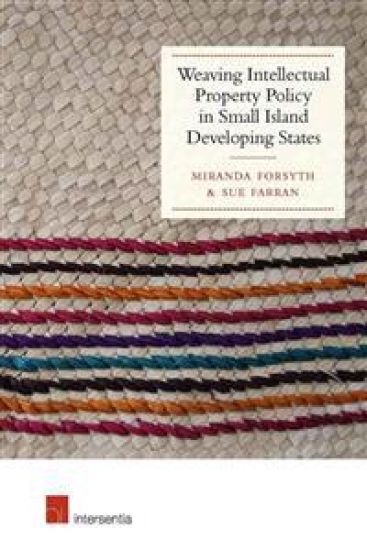
Weaving Intellectual Property Policy in Small Island Developing States
Miranda Forsyth; Sue Farran
Intersentia Ltd
2015
nidottu
There is considerable pressure on Small Island Developing States globally to introduce or to strengthen intellectual property regimes. This pressure comes in a number of forms, including bilateral and multilateral Free Trade Agreement negotiations and development assistance programmes such as those of the World Intellectual Property Organisation. The aim of this book is to offer a competing model of intellectual property policy using the Pacific Islands as a case study. This competing model is one based on local conceptions of culture and indigenous understandings about use, knowledge and transfer of intangible property. Adopting such a base as a starting point will enable the weaving together of multiple regulatory strategies to facilitate the transfer of knowledge, stimulate and reward innovation and creativity, and protect rights over traditional knowledge in ways that have meaning and resonance for local populations. Elements of western intellectual property frameworks can also form important strands in intellectual property policies. However, these elements should be incorporated, and possibly reinterpreted, within the local framework. The approach advocated in this book opens up a number of different roads for intellectual property policy. First, it encourages the exploration of non-state regulatory mechanisms, such as customary norms and institutions, community protocols, and also membership of international NGOs, in regulating the use of intellectual property. In most Pacific Island countries there is little state capacity to implement and police intellectual property laws and so creative use should be made of the possibilities offered by non-state structures. Second, it suggests centralising culture and the protection of traditional knowledge at the heart of intellectual property policy, rather than treating it as a secondary issue to be dealt with by sui generis legislation. Here, traditional knowledge forms the basis of culture and development and cannot and should not be separated from modern or scientific notions of creativity and innovation. A pragmatic incremental approach to intellectual property policy development is also advocated, requiring countries to thoroughly assess the advantages and disadvantages of any new intellectual property law within their local context, to consider how to adaptively implement this in a way suited to the local context, as well as to realistically assess the state's capacity for enforcement. Finally, the book challenges a number of claims made about intellectual property law and development, demonstrating that a far more fine-grained analysis of the nexus between the two is required than currently offered by the WIPO Development Agenda.

In considering diffusion from a global perspective, this book provides timely new insights into its application in a variety of fields and at many levels of both legal and non-legal orderings. This collection contributes to the wider theoretical debate concerning the movement of law and legal norms by engaging with concrete examples of legal diffusion, in jurisdictions as diverse as Albania, the Czech Republic, Poland and Kuwait. These examples, taken together, provide a comprehensive illustration of the theoretical debates concerning the diffusion of laws and norms in terms of both process and form. This international, multi-disciplinary and multi-methodological volume brings together scholars from law and social science with experience in mixed and hybrid jurisdictions, and advances the conversation about legal and normative diffusion across the academy. It represents a robust challenge to many preconceived ideas about legal movement and, as such, will be of interest to academics and students working in the fields of Law, Sociology, Anthropology, Political Science, Legal Education and comparative method.

A Study of Mixed Legal Systems: Endangered, Entrenched or Blended
Sue Farran; Esin Örücü
Routledge
2014
sidottu
A Study of Mixed Legal Systems: Endangered, Entrenched, or Blended takes the reader on a fascinating voyage of discovery. It includes case studies of a number of systems from across the globe: Cyprus, Guyana, Jersey, Mauritius, Philippines, Quebec, St Lucia, Scotland, and Seychelles. Each combines its legal legacies in novel ways. Large and small, in Europe and beyond, some are sovereign, some part of larger political units. Some are monolingual, some bilingual, some multilingual. Along with an analytical introduction and conclusion, the chapters explore the manner in which the elements of these mixed systems may be seen to be ’entrenched’, ’endangered’, or ’blended’. It explores how this process of legal change happens, questions whether some systems are at greater risk than others, and details the strategies that have been adopted to accelerate or counteract change. The studies involve consideration of the colourful histories of the jurisdictions, of their complex relationships to parent legal systems and traditions, and of language, legal education and legal actors. The volume also considers whether the experiences of these systems can tell us something about legal mixtures and movements generally. Indeed, the volume will be helpful both for scholars and students with a special interest in mixed legal systems as well as anyone interested in comparative law and legal history, in the diversity and dynamism of law.
This book looks at the challenges and contemporary issues raised by human rights in the island countries of the South West Pacific which have come under the influence of the common law - where the legal systems are complex and perceptions of rights varies widely. Drawing on a wide range of resources to present a contemporary and evolving picture of human rights in the island states of the South Pacific region, the book considers the human rights aspects of constitutions, legal institutions and structures, social organisation, culture and custom, tradition and change. The materials provide legal, historical, political, social and cultural insights into the lived experience of human rights in the region supported by illustrative material from case-law, media reports, and policy documents. The book also locates the human rights concerns of Pacific islanders firmly within the wider theoretical and international domain while at the same time maintaining focus on the importance of the unique identity of Pacific island nations and people. Human Rights in the South Pacific will appeal to anyone interested in the region or in human rights including international rights advocates, investors and developers, policy makers, representatives of government and civic society and those wishing to acquire a better understanding of what countries emerging from colonial rule face in developing but still retaining their identity.
This book looks at the challenges and contemporary issues raised by human rights in the island countries of the South West Pacific which have come under the influence of the common law – where the legal systems are complex and perceptions of rights varies widely. Drawing on a wide range of resources to present a contemporary and evolving picture of human rights in the island states of the South Pacific region, the book considers the human rights aspects of constitutions, legal institutions and structures, social organisation, culture and custom, tradition and change. The materials provide legal, historical, political, social and cultural insights into the lived experience of human rights in the region supported by illustrative material from case-law, media reports, and policy documents. The book also locates the human rights concerns of Pacific islanders firmly within the wider theoretical and international domain while at the same time maintaining focus on the importance of the unique identity of Pacific island nations and people. Human Rights in the South Pacific will appeal to anyone interested in the region or in human rights including international rights advocates, investors and developers, policy-makers, representatives of government and civic society and those wishing to acquire a better understanding of what countries emerging from colonial rule face in developing but still retaining their identity.

Encompassing the legal systems of over a dozen independent countries, the authors of this book bring together a wealth of diverse sources to present a coherent picture of the law of property as it exists today, and offer some thoughts on the challenges and legal difficulties facing the region.