Kirjojen hintavertailu – 12 903 725 kirjaa ja 27 kauppaa

Kirjailija

Sue Nichols

Kirjat ja teokset yhdessä paikassa: 6 kirjaa, julkaisuja vuosilta 2012–2024, suosituimpiin kuuluu Traversing Old and New Literacies. Vertaile teosten hintoja ja tarkista saatavuus suomalaisista kirjakaupoista.

6 kirjaa

Kirjojen julkaisuvuodet: 2012–2024.

Traversing Old and New Literacies

Traversing Old and New Literacies

Sue Nichols

SPRINGER VERLAG, SINGAPORE
2024
nidottu
This book re-examines the field of New Literacy Studies and promotes a shift away from binary constructions of literacies as 'old' or 'new' and to encourage critical reflection on the part of readers as to the uses of these constructs. First, the book examines the entanglement of pasts, presents and futures in contemporary literacy practices. Second, it considers representations of literacies as actors, having their own power and consequences. Third, it critically examines the place of 'new' and 'old' literacies in a marketplace in which social, economic and political power advantage is contested. The book demonstrates the use of assemblage theory drawing on semiotics, geo-semiotics and Actor Network Theory for analyzing literacies as assemblages. It provides readers with tools of analysis with which to interrogate claims made for the value of literacy, innovations and traditions alike. It also discusses implications for literacy policy, curriculum, teacher education and research.
Traversing Old and New Literacies

Traversing Old and New Literacies

Sue Nichols

SPRINGER VERLAG, SINGAPORE
2023
sidottu
This book re-examines the field of New Literacy Studies and promotes a shift away from binary constructions of literacies as 'old' or 'new' and to encourage critical reflection on the part of readers as to the uses of these constructs. First, the book examines the entanglement of pasts, presents and futures in contemporary literacy practices. Second, it considers representations of literacies as actors, having their own power and consequences. Third, it critically examines the place of 'new' and 'old' literacies in a marketplace in which social, economic and political power advantage is contested. The book demonstrates the use of assemblage theory drawing on semiotics, geo-semiotics and Actor Network Theory for analyzing literacies as assemblages. It provides readers with tools of analysis with which to interrogate claims made for the value of literacy, innovations and traditions alike. It also discusses implications for literacy policy, curriculum, teacher education and research.
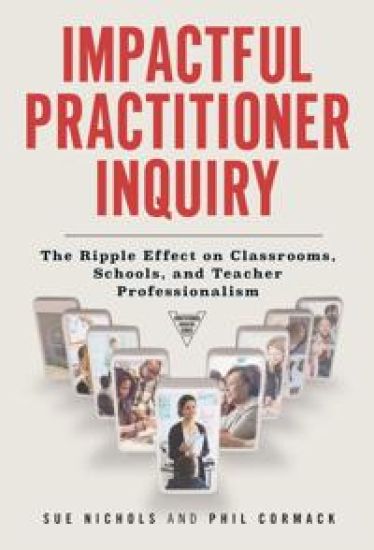
Impactful Practitioner Inquiry

Impactful Practitioner Inquiry

Sue Nichols; Phil Cormack

Teachers' College Press
2016
nidottu
How does practitioner inquiry impact education? Examining the experiences of practitioners who have participated in inquiry projects, the authors present ways in which this work has enabled educators to be positive change agents. They reveal the difference that practitioner inquiry has made in their professional practice, their understanding of student learning, their content area knowledge, and their career trajectories. Attesting to long-lasting changes in ways that these educators approach professional challenges, the authors identify the “ripple effect” of these changes through school communities and beyond. Impactful Practitioner Inquiry includes in-depth case studies as well as chapters specifically focused on the design and analysis aspects of inquiry. Book Features:An examination of how practitioner inquiry impacts professional practice, school culture, and career trajectoriesThe use of complexity and network theories to understand how practitioner inquiry is able to create its ripple effectTestimonies from educators with up to 10 years’ experience as inquirersPractices from early childhood and school settings, classroom and leadership roles, general education and specialist settings.
Resourcing Early Learners

Resourcing Early Learners

Sue Nichols; Jennifer Rowsell; Helen Nixon; Sophia Rainbird

Routledge
2014
nidottu
The landscape of early childhood education and care is changing. Governments world-wide are assuming increasing authority in relation to child-rearing in the years before school entry, beyond the traditional role in assisting parents to do the best they can by their children. As part of a social agenda aimed at forming citizens well prepared to play an active part in a globalised knowledge economy, the idea of ‘early learning’ expresses the necessity of engaging caregivers right from the start of children’s lives. Nichols, Rowsell, Rainbird, and Nixon investigate this trend over three years, in two countries, and three contrasting regions, by setting themselves the task of tracing every service and agent offering resources under the banner of early learning. Far from a dry catalogue, the study involves in-depth ethnographic research in fascinating spaces such as a church-run centre for African refugee women and children, a state-of-the-art community library and an Australian country town. Included is an unprecedented inventory of an entire suburban mall. Richly visually documented, the study employs emerging methods such as Google-mapping to trace the travels of actual parents as they search for particular resources. Each chapter features a context investigated in this large, international study: the library, the mall, the clinic, and the church. The author team unravels new spaces and new networks at work in early childhood literacy and development.
Resourcing Early Learners

Resourcing Early Learners

Sue Nichols; Jennifer Rowsell; Helen Nixon; Sophia Rainbird

Routledge
2012
sidottu
The landscape of early childhood education and care is changing. Governments world-wide are assuming increasing authority in relation to child-rearing in the years before school entry, beyond the traditional role in assisting parents to do the best they can by their children. As part of a social agenda aimed at forming citizens well prepared to play an active part in a globalised knowledge economy, the idea of ‘early learning’ expresses the necessity of engaging caregivers right from the start of children’s lives. Nichols, Rowsell, Rainbird, and Nixon investigate this trend over three years, in two countries, and three contrasting regions, by setting themselves the task of tracing every service and agent offering resources under the banner of early learning. Far from a dry catalogue, the study involves in-depth ethnographic research in fascinating spaces such as a church-run centre for African refugee women and children, a state-of-the-art community library and an Australian country town. Included is an unprecedented inventory of an entire suburban mall. Richly visually documented, the study employs emerging methods such as Google-mapping to trace the travels of actual parents as they search for particular resources. Each chapter features a context investigated in this large, international study: the library, the mall, the clinic, and the church. The author team unravels new spaces and new networks at work in early childhood literacy and development.