Kirjojen hintavertailu – 12 903 725 kirjaa ja 27 kauppaa

Kirjailija

Susan Moore Johnson

Kirjat ja teokset yhdessä paikassa: 4 kirjaa, julkaisuja vuosilta 1996–2019, suosituimpiin kuuluu Leading to Change. Vertaile teosten hintoja ja tarkista saatavuus suomalaisista kirjakaupoista.

4 kirjaa

Kirjojen julkaisuvuodet: 1996–2019.

Where Teachers Thrive

Where Teachers Thrive

Susan Moore Johnson

Harvard Educational Publishing Group
2019
nidottu

Halvin toimitettuna 44,20 €

In Where Teachers Thrive, Susan Moore Johnson outlines a powerful argument about the importance of the school as an organization in nurturing high-quality teaching. Based on case studies conducted in fourteen high-poverty, urban schools, the book examines why some schools failed to make progress, while others achieved remarkable results. It explores the challenges that administrators and teachers faced and describes what worked, what didn't work, and why. Johnson draws on vivid portraits of schools to highlight an array of school-based systems and practices that support teachers' professional growth and effectiveness. These include a rich and interactive hiring process; team-based curriculum planning and assessment; and informative feedback and ongoing professional learning. Critical to all of these is the role of the principal as an essential agent in a school's success. Although these elements may vary from school to school, Johnson argues that together these systems provide a comprehensive, mutually reinforcing set of well-orchestrated strategies that can help schools deliver results that exceed the sum of teachers' individual efforts. Since 2000, policy makers and education officials have diligently sought to improve schools by improving the quality of individual teachers. However, even if those teachers are skilled and committed, the schools where they work are all too often disjointed, dysfunctional organizations that serve no one well. Where Teachers Thrive explains clearly how educators within a school can join together to adopt systems of practice that ensure growth and success by all teachers and their students.
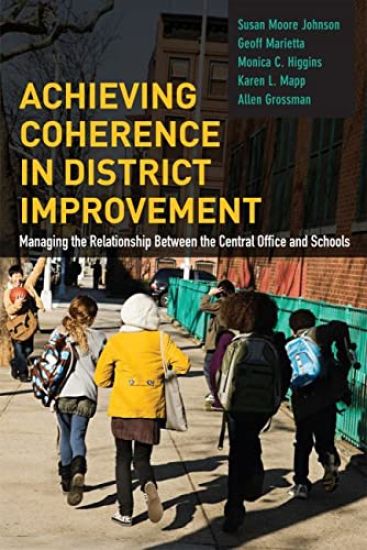
Achieving Coherence in District Improvement

Achieving Coherence in District Improvement

Susan Moore Johnson; Geoff Marietta; Monica C. Higgins; Karen L. Mapp; Allen Grossman

Harvard Educational Publishing Group
2014
nidottu
Achieving Coherence in District Improvement focuses on a problem of practice faced by educational leaders across the nation: how to effectively manage the relationship between the central office and schools. The book is based on a study of five large urban districts that have demonstrated improvement in student achievement. The authors—all members of Harvard University’s Public Education Leadership Project (PELP)—argue that there is no “one best way” to structure the central offi ce-school relationship. Instead, they say, what matters is whether district leaders eff ectively select and implement their strategy by achieving coherence among key elementsand actors—the district’s environment, resources, systems, structures, stakeholders, and culture. The authors examine the fi ve districts’ approaches in detail and point to a number of important findings. First, they emphasize that a clear, shared understanding of decision rights in key areas—academic programming, budgeting, and staffing—is essential to developing an eff ective central office-school relationship. Second, they stress the importance of building mutually supportive and trusting relationships between district leaders and principals. Third, they highlight the ways that culture and the external environment infl uence the relationship between the central office and schools. Each chapter also provides relevant “Lessons for Practice”—actionable takeaways—that educational leaders from any district can use to improve the central office-school relationship.
Achieving Coherence in District Improvement

Achieving Coherence in District Improvement

Susan Moore Johnson; Geoff Marietta; Monica C. Higgins; Karen L. Mapp; Allen Grossman

Harvard Educational Publishing Group
2014
sidottu
Achieving Coherence in District Improvement focuses on a problem of practice faced by educational leaders across the nation: how to effectively manage the relationship between the central office and schools. The book is based on a study of five large urban districts that have demonstrated improvement in student achievement. The authors—all members of Harvard University’s Public Education Leadership Project (PELP)—argue that there is no “one best way” to structure the central offi ce-school relationship. Instead, they say, what matters is whether district leaders eff ectively select and implement their strategy by achieving coherence among key elementsand actors—the district’s environment, resources, systems, structures, stakeholders, and culture. The authors examine the fi ve districts’ approaches in detail and point to a number of important findings. First, they emphasize that a clear, shared understanding of decision rights in key areas—academic programming, budgeting, and staffing—is essential to developing an eff ective central office-school relationship. Second, they stress the importance of building mutually supportive and trusting relationships between district leaders and principals. Third, they highlight the ways that culture and the external environment infl uence the relationship between the central office and schools. Each chapter also provides relevant “Lessons for Practice”—actionable takeaways—that educational leaders from any district can use to improve the central office-school relationship.
Leading to Change

Leading to Change

Susan Moore Johnson

Jossey-Bass Inc.,U.S.
1996
sidottu
"There are so few 'must read' books about superintAndents that I would recommAnd to policymakers, researchers, and novices. Add Leading to Change to the list. This insightful chapters on political and managerial leadership alone are worth the price of the book."-- Larry Cuban, professor of education, Stanford University