Kirjojen hintavertailu – 12 903 732 kirjaa ja 27 kauppaa

Kirjailija

Svetlozar T. Rachev

Kirjat ja teokset yhdessä paikassa: 19 kirjaa, julkaisuja vuosilta 1998–2023, suosituimpiin kuuluu RobustNon-Robust Models in Statistics. Vertaile teosten hintoja ja tarkista saatavuus suomalaisista kirjakaupoista.

Nimi esiintyy myös muodoissa: Svetlozar T Rachev

19 kirjaa

Kirjojen julkaisuvuodet: 1998–2023.

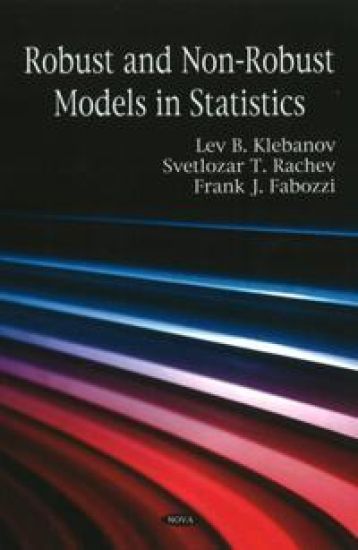
RobustNon-Robust Models in Statistics

RobustNon-Robust Models in Statistics

Lev B Klebanov; Svetlozar T Rachev; Frank J Fabozzi

Nova Science Publishers Inc
2010
sidottu
Considers the so-called ill-posed problems and stability in statistics. This book explains that ill-posed problems are not a mere curiosity in the field of contemporary probability. It aims to identify statistical problems of this type, find their stable variant, and propose alternative versions of numerous theorems in mathematical statistics.
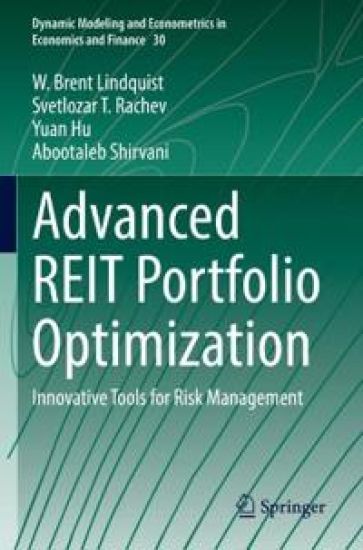
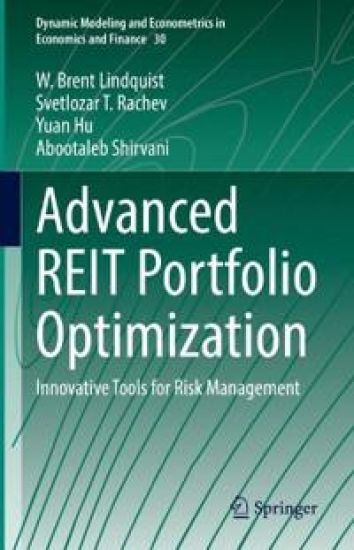
Advanced REIT Portfolio Optimization

Advanced REIT Portfolio Optimization

W. Brent Lindquist; Svetlozar T. Rachev; Yuan Hu; Abootaleb Shirvani

Springer International Publishing AG
2023
nidottu
This book provides an investor-friendly presentation of the premises and applications of the quantitative finance models governing investment in one asset class of publicly traded stocks, specifically real estate investment trusts (REITs). The models provide highly advanced analytics for REIT investment, including:portfolio optimization using both historic and predictive return estimation;model backtesting; a complete spectrum of risk assessment and management tools with an emphasis on early warning systems, risk budgeting, estimating tail risk, and factor analysis; derivative valuation;and incorporating ESG ratings into REIT investment. These quantitative finance models are presented in a unified framework consistent with dynamic asset pricing (rational finance). Given its scope and practical orientation, this book will appeal to investors interested in portfolio optimization and innovative tools for investment risk assessment.
Advanced REIT Portfolio Optimization

Advanced REIT Portfolio Optimization

W. Brent Lindquist; Svetlozar T. Rachev; Yuan Hu; Abootaleb Shirvani

Springer International Publishing AG
2022
sidottu
This book provides an investor-friendly presentation of the premises and applications of the quantitative finance models governing investment in one asset class of publicly traded stocks, specifically real estate investment trusts (REITs). The models provide highly advanced analytics for REIT investment, including:portfolio optimization using both historic and predictive return estimation;model backtesting; a complete spectrum of risk assessment and management tools with an emphasis on early warning systems, risk budgeting, estimating tail risk, and factor analysis; derivative valuation;and incorporating ESG ratings into REIT investment. These quantitative finance models are presented in a unified framework consistent with dynamic asset pricing (rational finance). Given its scope and practical orientation, this book will appeal to investors interested in portfolio optimization and innovative tools for investment risk assessment.
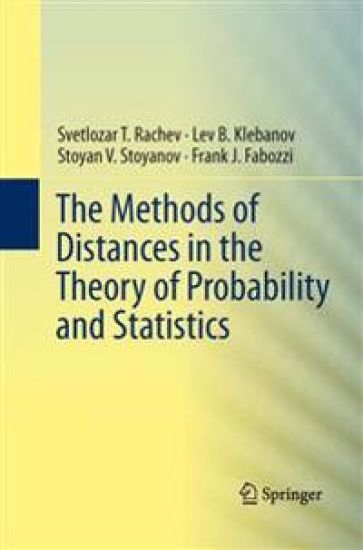
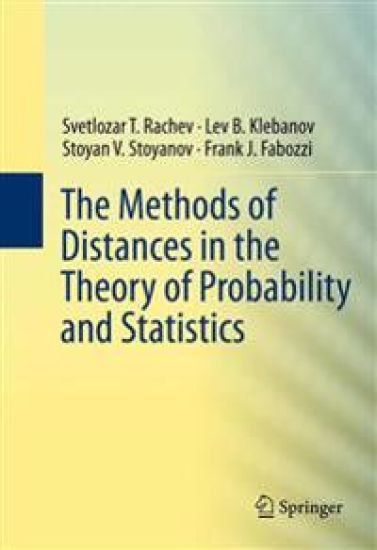
The Methods of Distances in the Theory of Probability and Statistics

The Methods of Distances in the Theory of Probability and Statistics

Svetlozar T. Rachev; Lev Klebanov; Stoyan V. Stoyanov; Frank Fabozzi

Springer-Verlag New York Inc.
2015
nidottu
This book covers the method of metric distances and its application in probability theory and other fields. The method is fundamental in the study of limit theorems and generally in assessing the quality of approximations to a given probabilistic model. The method of metric distances is developed to study stability problems and reduces to the selection of an ideal or the most appropriate metric for the problem under consideration and a comparison of probability metrics. After describing the basic structure of probability metrics and providing an analysis of the topologies in the space of probability measures generated by different types of probability metrics, the authors study stability problems by providing a characterization of the ideal metrics for a given problem and investigating the main relationships between different types of probability metrics. The presentation is provided in a general form, although specific cases are considered as they arise in the process of finding supplementary bounds or in applications to important special cases. Svetlozar T. Rachev is the Frey Family Foundation Chair of Quantitative Finance, Department of Applied Mathematics and Statistics, SUNY-Stony Brook and Chief Scientist of Finanlytica, USA. Lev B. Klebanov is a Professor in the Department of Probability and Mathematical Statistics, Charles University, Prague, Czech Republic. Stoyan V. Stoyanov is a Professor at EDHEC Business School and Head of Research, EDHEC-Risk Institute—Asia (Singapore). Frank J. Fabozzi is a Professor at EDHEC Business School. (USA)
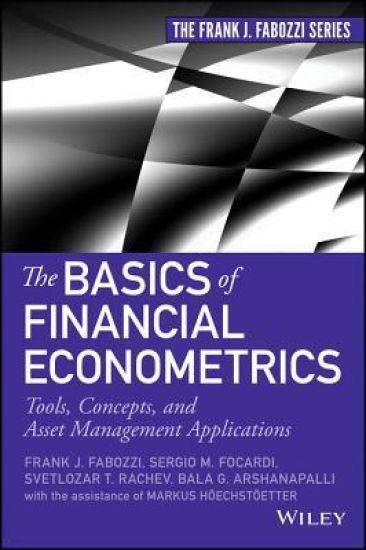
The Basics of Financial Econometrics

The Basics of Financial Econometrics

Frank J. Fabozzi; Sergio M. Focardi; Svetlozar T. Rachev; Bala G. Arshanapalli

John Wiley Sons Inc
2014
sidottu
An accessible guide to the growing field of financial econometrics As finance and financial products have become more complex, financial econometrics has emerged as a fast-growing field and necessary foundation for anyone involved in quantitative finance. The techniques of financial econometrics facilitate the development and management of new financial instruments by providing models for pricing and risk assessment. In short, financial econometrics is an indispensable component to modern finance. The Basics of Financial Econometrics covers the commonly used techniques in the field without using unnecessary mathematical/statistical analysis. It focuses on foundational ideas and how they are applied. Topics covered include: regression models, factor analysis, volatility estimations, and time series techniques. Covers the basics of financial econometrics—an important topic in quantitative financeContains several chapters on topics typically not covered even in basic books on econometrics such as model selection, model risk, and mitigating model risk Geared towards both practitioners and finance students who need to understand this dynamic discipline, but may not have advanced mathematical training, this book is a valuable resource on a topic of growing importance.
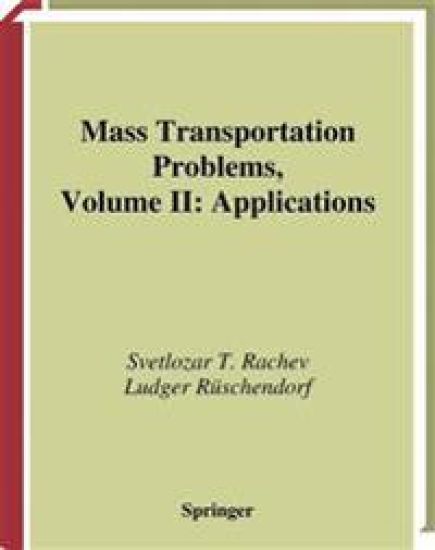
Mass Transportation Problems

Mass Transportation Problems

Svetlozar T. Rachev; Ludger Rüschendorf

Springer-Verlag New York Inc.
2013
nidottu
This is the first comprehensive account of the theory of mass transportation problems and its applications. In volume I, the authors systematically develop the theory of mass transportation with emphasis to the Monge-Kantorovich mass transportation and the Kantorovich-Rubinstein mass transshipment problems, and their various extensions. They discuss a variety of different approaches towards solutions of these problems and exploit the rich interrelations to several mathematical sciences--from functional analysis to probability theory and mathematical economics. The second volume is devoted to applications to the mass transportation and mass transshipment problems to topics in applied probability, theory of moments and distributions with given marginals, queucing theory, risk theory of probability metrics and its applications to various fields, amoung them general limit theorems for Gaussian and non-Gaussian limiting laws, stochastic differential equations, stochastic algorithms and rounding problems. The book will be useful to graduate students and researchers in the fields of theoretical and applied probabilitry, operations research, computer science, and mathematical economics. The prerequisites for this book are graduate level probability theory and real and functional analysis.
Mass Transportation Problems

Mass Transportation Problems

Svetlozar T. Rachev; Ludger Rüschendorf

Springer-Verlag New York Inc.
2013
nidottu
The first comprehensive account of the theory of mass transportation problems and its applications. In Volume I, the authors systematically develop the theory with emphasis on the Monge-Kantorovich mass transportation and the Kantorovich-Rubinstein mass transshipment problems. They then discuss a variety of different approaches towards solving these problems and exploit the rich interrelations to several mathematical sciences - from functional analysis to probability theory and mathematical economics. The second volume is devoted to applications of the above problems to topics in applied probability, theory of moments and distributions with given marginals, queuing theory, risk theory of probability metrics and its applications to various fields, among them general limit theorems for Gaussian and non-Gaussian limiting laws, stochastic differential equations and algorithms, and rounding problems. Useful to graduates and researchers in theoretical and applied probability, operations research, computer science, and mathematical economics, the prerequisites for this book are graduate level probability theory and real and functional analysis.
The Methods of Distances in the Theory of Probability and Statistics

The Methods of Distances in the Theory of Probability and Statistics

Svetlozar T. Rachev; Lev Klebanov; Stoyan V. Stoyanov; Frank Fabozzi

Springer-Verlag New York Inc.
2013
sidottu
This book covers the method of metric distances and its application in probability theory and other fields. The method is fundamental in the study of limit theorems and generally in assessing the quality of approximations to a given probabilistic model. The method of metric distances is developed to study stability problems and reduces to the selection of an ideal or the most appropriate metric for the problem under consideration and a comparison of probability metrics. After describing the basic structure of probability metrics and providing an analysis of the topologies in the space of probability measures generated by different types of probability metrics, the authors study stability problems by providing a characterization of the ideal metrics for a given problem and investigating the main relationships between different types of probability metrics. The presentation is provided in a general form, although specific cases are considered as they arise in the process of finding supplementary bounds or in applications to important special cases. Svetlozar T. Rachev is the Frey Family Foundation Chair of Quantitative Finance, Department of Applied Mathematics and Statistics, SUNY-Stony Brook and Chief Scientist of Finanlytica, USA. Lev B. Klebanov is a Professor in the Department of Probability and Mathematical Statistics, Charles University, Prague, Czech Republic. Stoyan V. Stoyanov is a Professor at EDHEC Business School and Head of Research, EDHEC-Risk Institute—Asia (Singapore). Frank J. Fabozzi is a Professor at EDHEC Business School. (USA)
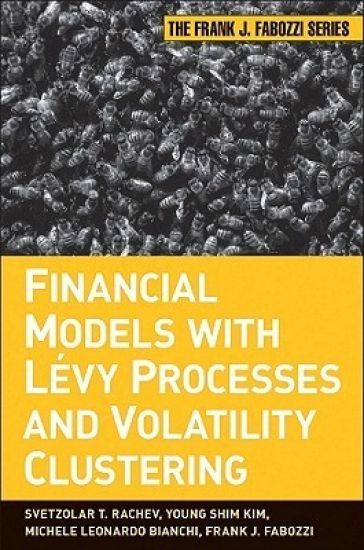
Financial Models with Levy Processes and Volatility Clustering

Financial Models with Levy Processes and Volatility Clustering

Svetlozar T. Rachev; Young Shin Kim; Michele L. Bianchi; Frank J. Fabozzi

John Wiley Sons Inc
2011
sidottu
An in-depth guide to understanding probability distributions and financial modeling for the purposes of investment management In Financial Models with Lévy Processes and Volatility Clustering, the expert author team provides a framework to model the behavior of stock returns in both a univariate and a multivariate setting, providing you with practical applications to option pricing and portfolio management. They also explain the reasons for working with non-normal distribution in financial modeling and the best methodologies for employing it. The book's framework includes the basics of probability distributions and explains the alpha-stable distribution and the tempered stable distribution. The authors also explore discrete time option pricing models, beginning with the classical normal model with volatility clustering to more recent models that consider both volatility clustering and heavy tails. Reviews the basics of probability distributionsAnalyzes a continuous time option pricing model (the so-called exponential Lévy model)Defines a discrete time model with volatility clustering and how to price options using Monte Carlo methodsStudies two multivariate settings that are suitable to explain joint extreme events Financial Models with Lévy Processes and Volatility Clustering is a thorough guide to classical probability distribution methods and brand new methodologies for financial modeling.
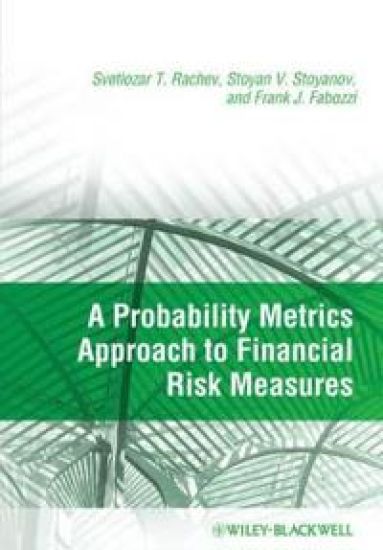
A Probability Metrics Approach to Financial Risk Measures

A Probability Metrics Approach to Financial Risk Measures

Svetlozar T. Rachev; Stoyan V. Stoyanov; Frank J. Fabozzi

Wiley-Blackwell (an imprint of John Wiley Sons Ltd)
2011
sidottu
A Probability Metrics Approach to Financial Risk Measures relates the field of probability metrics and risk measures to one another and applies them to finance for the first time. Helps to answer the question: which risk measure is best for a given problem? Finds new relations between existing classes of risk measuresDescribes applications in finance and extends them where possiblePresents the theory of probability metrics in a more accessible form which would be appropriate for non-specialists in the fieldApplications include optimal portfolio choice, risk theory, and numerical methods in financeTopics requiring more mathematical rigor and detail are included in technical appendices to chapters
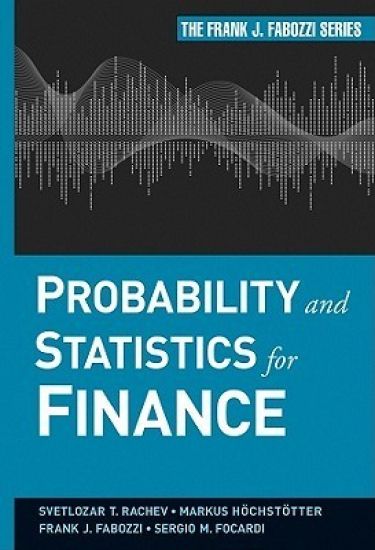
Probability and Statistics for Finance

Probability and Statistics for Finance

Svetlozar T. Rachev; Markus Hoechstoetter; Frank J. Fabozzi; Sergio M. Focardi

John Wiley Sons Inc
2010
sidottu
A comprehensive look at how probability and statistics is applied to the investment process Finance has become increasingly more quantitative, drawing on techniques in probability and statistics that many finance practitioners have not had exposure to before. In order to keep up, you need a firm understanding of this discipline. Probability and Statistics for Finance addresses this issue by showing you how to apply quantitative methods to portfolios, and in all matter of your practices, in a clear, concise manner. Informative and accessible, this guide starts off with the basics and builds to an intermediate level of mastery. • Outlines an array of topics in probability and statistics and how to apply them in the world of finance • Includes detailed discussions of descriptive statistics, basic probability theory, inductive statistics, and multivariate analysis • Offers real-world illustrations of the issues addressed throughout the text The authors cover a wide range of topics in this book, which can be used by all finance professionals as well as students aspiring to enter the field of finance.
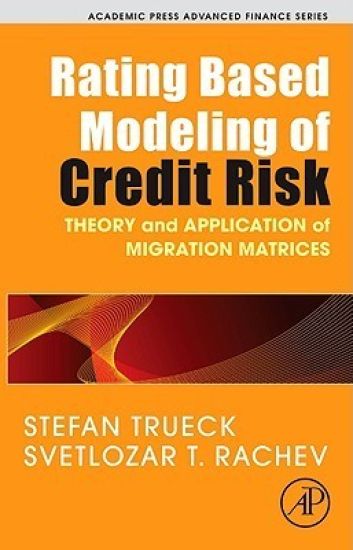
Rating Based Modeling of Credit Risk

Rating Based Modeling of Credit Risk

Stefan Trueck; Svetlozar T. Rachev

Academic Press Inc
2009
sidottu
In the last decade rating-based models have become very popular in credit risk management. These systems use the rating of a company as the decisive variable to evaluate the default risk of a bond or loan. The popularity is due to the straightforwardness of the approach, and to the upcoming new capital accord (Basel II), which allows banks to base their capital requirements on internal as well as external rating systems. Because of this, sophisticated credit risk models are being developed or demanded by banks to assess the risk of their credit portfolio better by recognizing the different underlying sources of risk. As a consequence, not only default probabilities for certain rating categories but also the probabilities of moving from one rating state to another are important issues in such models for risk management and pricing. It is widely accepted that rating migrations and default probabilities show significant variations through time due to macroeconomics conditions or the business cycle. These changes in migration behavior may have a substantial impact on the value-at-risk (VAR) of a credit portfolio or the prices of credit derivatives such as collateralized debt obligations (D+CDOs). In Rating Based Modeling of Credit Risk the authors develop a much more sophisticated analysis of migration behavior. Their contribution of more sophisticated techniques to measure and forecast changes in migration behavior as well as determining adequate estimators for transition matrices is a major contribution to rating based credit modeling.
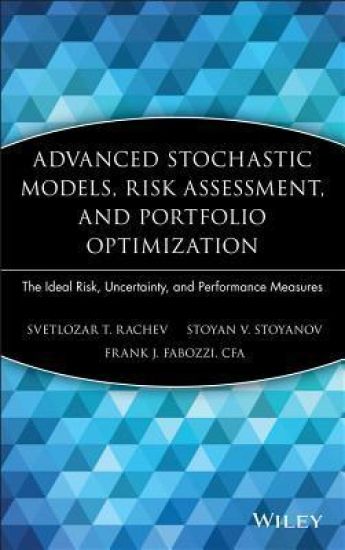
Advanced Stochastic Models, Risk Assessment, and Portfolio Optimization

Advanced Stochastic Models, Risk Assessment, and Portfolio Optimization

Svetlozar T. Rachev; Stoyan V. Stoyanov; Frank J. Fabozzi

John Wiley Sons Inc
2008
sidottu
This groundbreaking book extends traditional approaches of risk measurement and portfolio optimization by combining distributional models with risk or performance measures into one framework. Throughout these pages, the expert authors explain the fundamentals of probability metrics, outline new approaches to portfolio optimization, and discuss a variety of essential risk measures. Using numerous examples, they illustrate a range of applications to optimal portfolio choice and risk theory, as well as applications to the area of computational finance that may be useful to financial engineers.
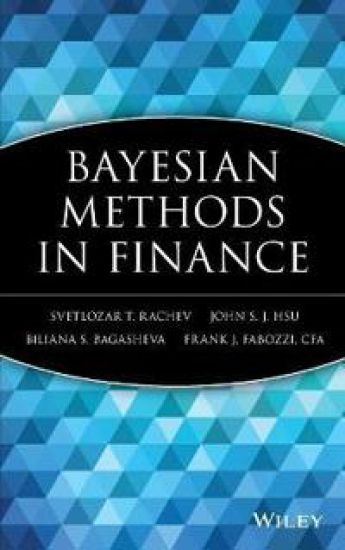
Bayesian Methods in Finance

Bayesian Methods in Finance

Svetlozar T. Rachev; John S. J. Hsu; Biliana S. Bagasheva; Frank J. Fabozzi

John Wiley Sons Inc
2008
sidottu
Bayesian Methods in Finance provides a detailed overview of the theory of Bayesian methods and explains their real-world applications to financial modeling. While the principles and concepts explained throughout the book can be used in financial modeling and decision making in general, the authors focus on portfolio management and market risk management—since these are the areas in finance where Bayesian methods have had the greatest penetration to date.
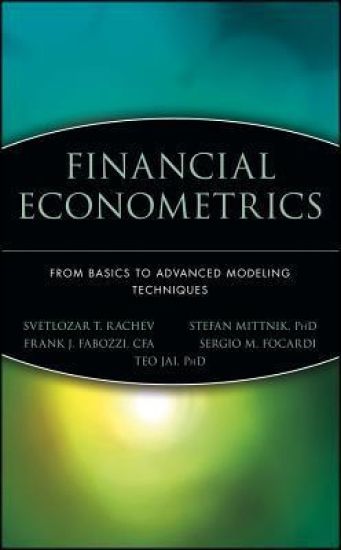
Financial Econometrics

Financial Econometrics

Svetlozar T. Rachev; Stefan Mittnik; Frank J. Fabozzi; Sergio M. Focardi; Teo Jašic

John Wiley Sons Inc
2007
sidottu
A comprehensive guide to financial econometrics Financial econometrics is a quest for models that describe financial time series such as prices, returns, interest rates, and exchange rates. In Financial Econometrics, readers will be introduced to this growing discipline and the concepts and theories associated with it, including background material on probability theory and statistics. The experienced author team uses real-world data where possible and brings in the results of published research provided by investment banking firms and journals. Financial Econometrics clearly explains the techniques presented and provides illustrative examples for the topics discussed. Svetlozar T. Rachev, PhD (Karlsruhe, Germany) is currently Chair-Professor at the University of Karlsruhe. Stefan Mittnik, PhD (Munich, Germany) is Professor of Financial Econometrics at the University of Munich. Frank J. Fabozzi, PhD, CFA, CFP (New Hope, PA) is an adjunct professor of Finance at Yale University’s School of Management. Sergio M. Focardi (Paris, France) is a founding partner of the Paris-based consulting firm The Intertek Group. Teo Jasic, PhD, (Frankfurt, Germany) is a senior manager with a leading international management consultancy firm in Frankfurt.
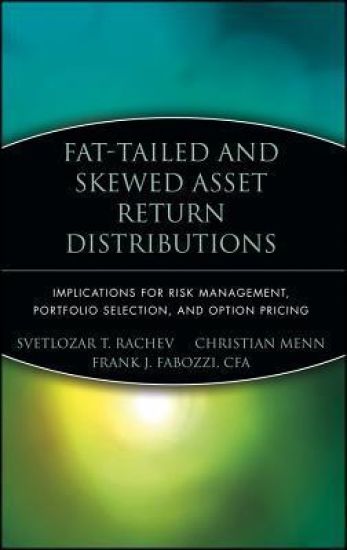
Fat-Tailed and Skewed Asset Return Distributions

Fat-Tailed and Skewed Asset Return Distributions

Svetlozar T. Rachev; Christian Menn; Frank J. Fabozzi

John Wiley Sons Inc
2005
sidottu
While mainstream financial theories and applications assume that asset returns are normally distributed, overwhelming empirical evidence shows otherwise. Yet many professionals don’t appreciate the highly statistical models that take this empirical evidence into consideration. Fat-Tailed and Skewed Asset Return Distributions examines this dilemma and offers readers a less technical look at how portfolio selection, risk management, and option pricing modeling should and can be undertaken when the assumption of a non-normal distribution for asset returns is violated. Topics covered in this comprehensive book include an extensive discussion of probability distributions, estimating probability distributions, portfolio selection, alternative risk measures, and much more. Fat-Tailed and Skewed Asset Return Distributions provides a bridge between the highly technical theory of statistical distributional analysis, stochastic processes, and econometrics of financial returns and real-world risk management and investments.
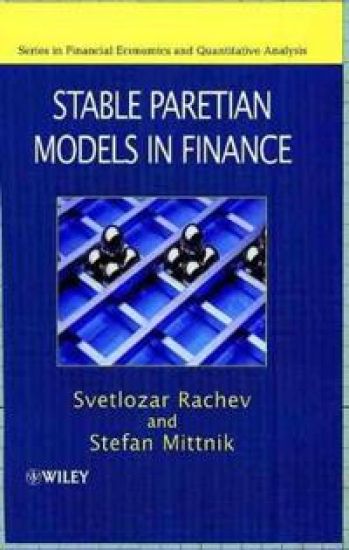
Stable Paretian Models in Finance

Stable Paretian Models in Finance

Svetlozar T. Rachev; Stefan Mittnik

John Wiley Sons Inc
2000
sidottu
"The adoption of stable modeling in finance and econometrics is undoubtedly one of the most interesting and promising ideas which has arisen in these fields. It is now widely accepted that classical models for the description of the dynamics of financial and economic variable suffer form major structural weaknesses, as they fail to explain important features of the empirical data. Therefore, the search for new more powerful models is a fundamental and fascinating topic of research. In this book, Rachev and Mittnik, two of the most prominent experts in so-called Stable Finance, present a wealth of convincing arguments to support the claim that stable models offer the right approach to the subject. Their monograph, which collects a large part of the authors' work in sable financial modeling, brings together innovative insights as well as new elegant explanations financial and economic phenomena..." "... The book explains in a lucid and understandable manner how to extend a wide range of financial paradigms to the stable case, presenting both new theoretical results and empirical applications. The material covered is truly impressive in its breadth and quality, and will be of great interest to researchers and advanced graduate students, as well as practitioners looking for state-of-the-art models with a better fit to real data." Eduardo S. Schwartz, Professor of Finance, Anderson School of Management, University of California
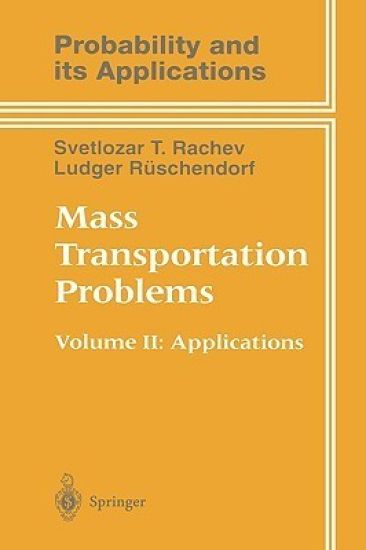
Mass Transportation Problems

Mass Transportation Problems

Svetlozar T. Rachev; Ludger Rüschendorf

Springer-Verlag New York Inc.
1998
sidottu
The first comprehensive account of the theory of mass transportation problems and its applications. In Volume I, the authors systematically develop the theory with emphasis on the Monge-Kantorovich mass transportation and the Kantorovich-Rubinstein mass transshipment problems. They then discuss a variety of different approaches towards solving these problems and exploit the rich interrelations to several mathematical sciences - from functional analysis to probability theory and mathematical economics. The second volume is devoted to applications of the above problems to topics in applied probability, theory of moments and distributions with given marginals, queuing theory, risk theory of probability metrics and its applications to various fields, among them general limit theorems for Gaussian and non-Gaussian limiting laws, stochastic differential equations and algorithms, and rounding problems. Useful to graduates and researchers in theoretical and applied probability, operations research, computer science, and mathematical economics, the prerequisites for this book are graduate level probability theory and real and functional analysis.
Mass Transportation Problems

Mass Transportation Problems

Svetlozar T. Rachev; Ludger Rüschendorf

Springer-Verlag New York Inc.
1998
sidottu
This is the first comprehensive account of the theory of mass transportation problems and its applications. In volume I, the authors systematically develop the theory of mass transportation with emphasis to the Monge-Kantorovich mass transportation and the Kantorovich-Rubinstein mass transshipment problems, and their various extensions. They discuss a variety of different approaches towards solutions of these problems and exploit the rich interrelations to several mathematical sciences--from functional analysis to probability theory and mathematical economics. The second volume is devoted to applications to the mass transportation and mass transshipment problems to topics in applied probability, theory of moments and distributions with given marginals, queucing theory, risk theory of probability metrics and its applications to various fields, amoung them general limit theorems for Gaussian and non-Gaussian limiting laws, stochastic differential equations, stochastic algorithms and rounding problems. The book will be useful to graduate students and researchers in the fields of theoretical and applied probabilitry, operations research, computer science, and mathematical economics. The prerequisites for this book are graduate level probability theory and real and functional analysis.