Kirjojen hintavertailu – 12 903 725 kirjaa ja 27 kauppaa

Kirjailija

Sylvère Lotringer

Kirjat ja teokset yhdessä paikassa: 9 kirjaa, julkaisuja vuosilta 1996–2025, suosituimpiin kuuluu Nancy Spero. Vertaile teosten hintoja ja tarkista saatavuus suomalaisista kirjakaupoista.

Nimi esiintyy myös muodoissa: Sylvere Lotringer

9 kirjaa

Kirjojen julkaisuvuodet: 1996–2025.

Nancy Spero

Nancy Spero

Jon Bird; Jo Anna Isaak; Sylvere Lotringer

Phaidon Press Ltd
1996
nidottu
American artist Nancy Spero (b.1929) concentrates on the depiction of women: mythological women, movie women, tortured women. Inspired by classical and modern sources, she collages and imprints her contemporary goddesses on to long, papyrus-like friezes that scroll around museum walls. Her subject matter, which has ranged from the writings of Artaud to the Vietnam War, mirrors her life. Working in Paris in the cultural ferment of the 1960s, she moved to New York in the 1970s to co-establish the feminist gallery A. I. R. and to join with artists and critics such as Leon Golub, Robert Morris and Lucy R Lippard in forming the Art Workers' Coalition. Since the 1980s she has attracted international acclaim, her exquisite works giving form to feminist issues and new critical discourses. The Survey by Jon Bird, cultural theorist and curator of the first British retrospective of Spero's work, discusses developments in her practice since the 1950s. Contemporary art scholar and critic Jo Anna Isaak talks with the artist about her life and work. Art historian Sylvere Lotringer, Edtior of Semiotext(e) and author of Overexposed, focuses on her 1993 installation at the Whitney Museum of American Art. In recognition of the impact Stanley Kubrick's Dr Strangelove made on her, Spero has chosen a scene from the screenplay; key excerpts from Gynesis: Configurations of Woman and Modernity by feminist theorist Alice Jardine on the place of women in a patriarchal culture complete the Artist's Choice section. Also included are a selection of Spero's own writings, many published here for the first time.

A Grammar of the Multitude

A Grammar of the Multitude

Paolo Virno; Sylvere Lotringer

Semiotext (E)
2025
nidottu

Halvin toimitettuna 20,30 €

Paolo Virno's on the rich concept of the "multitude" as crucial to understanding contemporary life. Paolo Virno's A Grammar of the Multitude became the Italian theorist's best-known work in English, influencing a generation of activists and performance artists, when it was first published by Semiotext(e) in 2004. Two decades later, this new edition proves Virno's conception of contemporary life--as a cartography of virtualities made possible by post-Fordism--to have been strikingly prescient. At the start of the twenty-first century, globalization forced a rethinking of some of the categories--such as "the people"--that had been traditionally associated with the now-eroding state. Virno argues that the category of "multitude," elaborated by Spinoza and for the most part left fallow since the seventeenth century, is a far better tool to analyze contemporary issues than the Hobbesian concept of "people" favored by classical political philosophy. Hobbes, who detested the notion of multitude, defined it as shunning political unity, resisting authority, and never entering into lasting agreements. "When they rebel against the state," Hobbes wrote, "the citizens are the multitude against the people." But the multitude isn't just a negative notion; it is a rich concept that allows us to examine anew plural experiences and forms of nonrepresentative democracy. Drawing from philosophy of language, political economics, and ethics, Virno shows that being foreign, "not-feeling-at-home-anywhere," is a condition that forces the multitude to place its trust in the intellect. In conclusion, Virno suggests that the metamorphosis of the social systems in the West during the 1980s and 1990s precipitated a paradoxical "Communism of the Capital."
I Was More American than the Americans - Sylvere Lotringer in Conversation with Donatien Grau

I Was More American than the Americans - Sylvere Lotringer in Conversation with Donatien Grau

Sylvere Lotringer; Donatien Grau; Peter Behrman De Sine

Diaphanes AG
2021
nidottu

Halvin toimitettuna 24,80 €

In the mid-1970s, Sylvère Lotringer created Semiotext(e), a philosophical group that became a magazine and then a publishing house. Since its creation, Semio-text(e) has been a place of stimulating dialogue between artists and philosophers, and for the past fifty years, much of American artistic and intellectual life has depended on it. The model of the journal and the publishing house revolves around the notion of the collective, and Lotringer has rarely shared his personal journey: his existence as a hidden child during World War II; the liberating and then traumatic experience of the collective in the kibbutz; his Parisian activism in the 1960s; his time of wandering, that took him, by way of Istanbul, to the United States; and then, of course, his American years, the way he mingled his nightlife with the formal experimentation he invented with Semiotext(e) and with his classes. Since the early 2010s, Donatien Grau has developed the habit of visiting Lotringer during his trips to Los Angeles; some of their dialogs were published or held in public. This book is an entry into Lotringer's life, his friendships, his choices, and his admiration for some of the leading thinkers of our times. The conversations between Lotringer and Grau show bursts of life, traces of a journey, through texts and existence itself, with an unusual intensity.
J'Étais Plus Américain Que Les Américains: Sylvère Lotringer En Conversation Avec Donatien Grau
Au milieu des ann es 1970, Sylv re Lotringer a cr Semiotext(e), un groupe philosophique devenu magazine puis maison d' dition. Depuis sa cr ation, Semiotext(e) est le lieu de rencontres libres: John Cage lisant Nietzsche, travers Deleuze; punk et philosophie; la possibilit de sexualit s et de politiques alternatives; le dialogue imm diat entre artistes et philosophes. La vie artistique et intellectuelle am ricaine des cinquante derni res ann es en est largement tributaire. Le mod le de la revue et de la maison d' dition tourne essentiellement autour de la notion de collectif, et leur cr ateur Sylv re Lotringer s'est rarement livr la continuit de son parcours personnel: son existence d'enfant cach pendant la Seconde Guerre mondiale; l'exp rience lib ratrice puis traumatisante du collectif dans le kibboutz; son activisme parisien dans les ann es 1960; son temps d'errance, qui le mena, par Istanbul, aux tats-Unis; et puis, bien s r, ses ann es am ricaines, la fa on dont il m lait sa vie nocturne l'exp rimentation formelle qu'il a invent e avec Semiotext(e) et avec ses cours. Depuis le d but des ann es 2010, Donatien Grau a pris l'habitude de rendre visite Sylv re Lotringer lors de ses voyages Los Angeles; certains de leurs dialogues ont t publi s ou tenus en public. Ceux-ci nous donnent acc s la vie de Sylv re Lotringer, ses amiti s, ses choix, son admiration pour certains des plus grands penseurs de notre temps. Les conversations montrent des clats de vie, des traces d'un voyage, travers les textes et l'existence elle-m me, avec une intensit rare.
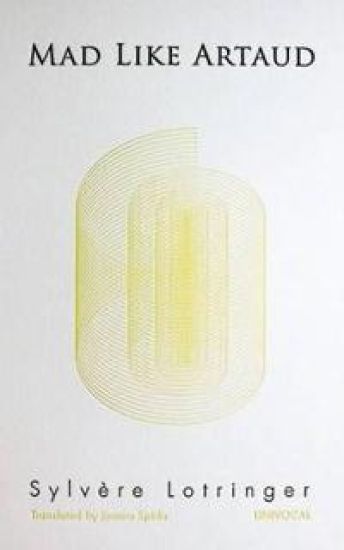
Mad Like Artaud

Mad Like Artaud

Sylvère Lotringer

Univocal Publishing LLC
2015
nidottu
Those who are mad like Antonin Artaud, are they just as mad as he was? Madness, like the plague, is contagious, and everyone, from his psychiatrists to his disciples, family, and critics, everyone who gets close to Artaud, seems to participate in his delirium. SylvÈre Lotringer explores various embodiments of this shared delirium through what Artaud called “mental dramas”-a series of confrontations with his witnesses or “persecutors” where we uncover the raw delirium at work, even in Lotringer himself. Mad Like Artaud does not intend to add one more layer of commentary to the bitter controversies that have been surrounding the cursed poet’s work since his death in 1948, nor does it take sides among the different camps who are still haggling over his corpse. This book speaks of the site where “madness” itself is simmering.
Pure War

Pure War

Paul Virilio; Sylvère Lotringer

MIT Press
2008
pokkari
Virilio and Lotringer revisit their prescient book on the invisible war waged by technology against humanity since World War II. In June 2007, Paul Virilio and Sylvere Lotringer met in La Rochelle, France to reconsider the premises they developed twenty-five years before in their frighteningly prescient classic, Pure War. Pure War described the invisible war waged by technology against humanity, and the lack of any real distinction since World War II between war and peace. Speaking with Lotringer in 1982, Virilio noted the "accidents" that inevitably arise with every technological development: from car crashes to nuclear spillage, to the extermination of space and the derealization of time wrought by instant communication. In this new and updated edition, Virilio and Lotringer consider how the omnipresent threat of the "accident"-both military and economic-has escalated. With the fall of the Soviet bloc, the balance of power between East and West based on nuclear deterrence has given way to a more diffuse multi-polar nuclear threat. Moreover, as the speed of communication has increased exponentially, "local" accidents-like the collapse of the Asian markets in the late 1980s-escalate, with the speed of contagion, into global events instantaneously. "Globalization," Virilio argues, is the planet's ultimate accident. Paul Virilio was born in Paris in 1932 to an immigrant Italian family. Trained as an urban planner, he became the director of the Ecole Speciale d'Architecture in the wake of the 1968 rebellion. He has published twenty-five books, including Pure War (1988) (his first in English) and The Accident of Art (2005), both with Sylvere Lotringer and published by Semiotext(e). Sylvere Lotringer, general editor of Semiotext(e), lives in New York and Baja California. He is the author of Overexposed: Perverting Perversions (Semiotext(e), 2007) and other books.
Overexposed

Overexposed

Sylvère Lotringer

Semiotext (E)
2007
pokkari
A report on the administration of deviant desire in specialized clinics that documents the way our postmodern society exposes sexuality to the point of overexposure. Do you ever get aroused by your patient's fantasies? Do you discover through them something about your own sexuality? –About my sexuality? You are exposed to a lot of fantasies. –Oh yes. Quite frankly, I think it has a satiation effect on me. I've been a sex researcher for ten years, and sometimes I get fed up with it, you know. I talk to people about sex all day long, and it does get to be a drag. –from Overexposed The most perverse perversions are not always those one would expect. Originally conceived as an American update to Foucault's History of Sexuality, Overexposed is even more outrageous and thought-provoking today than it was twenty years ago when first published by a commercial publisher. By a strange reversal, rather than being punished, deviant desire now is administrated in specialized clinics under medical supervision. Sexual excess is being turned into a "boredom therapy" claiming to rid patients of their own desires by forcing them to indulge them past the point of satiety. But are perversions still perverse when they are vindicated unconditionally? At once clinical, bewildering, and deeply poignant, Overexposed shows how science can pervert itself by identifying too closely with its object. This insider's exposition of controversial cognitive behavioral methods (carried out with instruments straight out of A Clockwork Orange–penile transducer? pupillometer?) is a hallucinatory document on the manner in which our postmodern society exposes sexuality to the point of overexposure–in order to exterminate it.
The Accident of Art

The Accident of Art

Sylvère Lotringer; Paul Virilio

Semiotext (E)
2005
pokkari
There is a catastrophe within contemporary art. What I call the "optically correct" is at stake. The vision machine and the motor have triggered it, but the visual arts haven't learned from it. Instead, they've masked this failure with commercial success. This "accident" is provoking a reversal of values. In my view, this is positive: the accident reveals something important we would not otherwise know how to perceive.-Paul Virilio, The Accident of ArtUrbanist and technological theorist Paul Virilio trained as a painter, studying under Henri Matisse, Georges Braque, Bazaine and de Stael. In The Accident of Art, his third extended conversation with Sylvere Lotringer, Virilio addresses the situation of art within technological society for the first time. This book completes a collaborative trilogy the two began in 1982 with Pure War and continued with Crepuscular Dawn, their 2002 work on architecture and biotechnology. In The Accident of Art, Virilio and Lotringer argue that a direct relation exists between war trauma and art. Why has art failed to reinvent itself in the face of technology, unlike performing art? Why has art simply retreated into painting, or surrendered to digital technology? Accidents, Virilio claims, can free us from speed's inertia. As technological catastrophes, accidents are inventions in their own right.
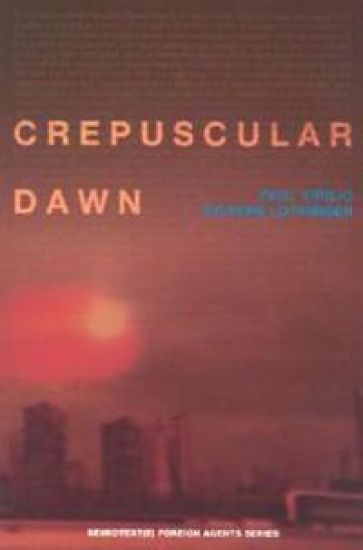
Crepuscular Dawn

Crepuscular Dawn

Paul Virilio; Sylvère Lotringer

Semiotext (E)
2002
pokkari
The "genetic bomb" marks a turn in the history of humanity. The accident is a new form of warfare. It is replacing revolution and war. Sarajevo triggered the First World War. New York is what Sarajevo was. September 11th opened Pandora's box. The first war of globalization will be the global accident, the total accident, including the accident of science. And it is on the way. In 1968, Virilio abandoned his work in oblique architecture, believing that time had replaced space as the most important point of reflection because of the dominance of speed. We were basically on the verge of converting space time into space speed... Speed facilitates the decoding of the human genome, and the possibility of another humanity: a humanity which is no longer extra-territorial, but extra-human. Crespuscular Dawn expands Virilio's vision of the implosion of physical time and space, onto the micro-level of bioengineering and biotechnology. In this cat-and-mouse dialogue between Sylvere Lotringer and Paul Virilio, Lotringer pushes Virilio to uncover the historical foundations of his biotech theories. Citing various medical experiments conducted during World War II, Lotringer asks whether biotechnology isn't the heir to eugenics and the "science for racial improvement" that the Nazis enthusiastically embraced. Will the endocolonizataion of the body come to replace the colonization of one's own population by the military? Both biographical and thematic, the book explores the development of Virilio's investigation of space (architecture, urbanism) and time (speed and simultanaeity) that would ultimately lay the foundation for his theories on biotechnology and his startling declaration that after the colonization of space begins the colonization of the body.