Kirjojen hintavertailu – 12 903 725 kirjaa ja 27 kauppaa

Kirjailija

T. W. Körner

Kirjat ja teokset yhdessä paikassa: 13 kirjaa, julkaisuja vuosilta 1993–2022, suosituimpiin kuuluu Zriny. Vertaile teosten hintoja ja tarkista saatavuus suomalaisista kirjakaupoista.

Nimi esiintyy myös muodoissa: T W Korner, T. W. Korner

13 kirjaa

Kirjojen julkaisuvuodet: 1993–2022.

Fourier Analysis

Fourier Analysis

T. W. Körner; Terence Tao

Cambridge University Press
2022
pokkari

Halvin toimitettuna 52,30 €

Fourier analysis is a subject that was born in physics but grew up in mathematics. Now it is part of the standard repertoire for mathematicians, physicists and engineers. This diversity of interest is often overlooked, but in this much-loved book, Tom Körner provides a shop window for some of the ideas, techniques and elegant results of Fourier analysis, and for their applications. These range from number theory, numerical analysis, control theory and statistics, to earth science, astronomy and electrical engineering. The prerequisites are few (a reader with knowledge of second- or third-year undergraduate mathematics should have no difficulty following the text), and the style is lively and entertaining. This edition of Körner's 1989 text includes a foreword written by Professor Terence Tao introducing it to a new generation of fans.
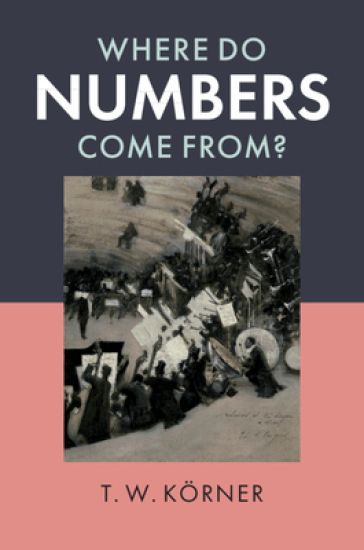
Where Do Numbers Come From?

Where Do Numbers Come From?

T. W. Körner

Cambridge University Press
2019
pokkari
Why do we need the real numbers? How should we construct them? These questions arose in the nineteenth century, along with the ideas and techniques needed to address them. Nowadays it is commonplace for apprentice mathematicians to hear 'we shall assume the standard properties of the real numbers' as part of their training. But exactly what are those properties? And why can we assume them? This book is clearly and entertainingly written for those students, with historical asides and exercises to foster understanding. Starting with the natural (counting) numbers and then looking at the rational numbers (fractions) and negative numbers, the author builds to a careful construction of the real numbers followed by the complex numbers, leaving the reader fully equipped with all the number systems required by modern mathematical analysis. Additional chapters on polynomials and quarternions provide further context for any reader wanting to delve deeper.
Where Do Numbers Come From?

Where Do Numbers Come From?

T. W. Körner

Cambridge University Press
2019
sidottu
Why do we need the real numbers? How should we construct them? These questions arose in the nineteenth century, along with the ideas and techniques needed to address them. Nowadays it is commonplace for apprentice mathematicians to hear 'we shall assume the standard properties of the real numbers' as part of their training. But exactly what are those properties? And why can we assume them? This book is clearly and entertainingly written for those students, with historical asides and exercises to foster understanding. Starting with the natural (counting) numbers and then looking at the rational numbers (fractions) and negative numbers, the author builds to a careful construction of the real numbers followed by the complex numbers, leaving the reader fully equipped with all the number systems required by modern mathematical analysis. Additional chapters on polynomials and quarternions provide further context for any reader wanting to delve deeper.
Calculus for the Ambitious

Calculus for the Ambitious

T. W. Körner

Cambridge University Press
2014
pokkari
From the author of The Pleasures of Counting and Naïve Decision Making comes a calculus book perfect for self-study. It will open up the ideas of the calculus for any 16- to 18-year-old, about to begin studies in mathematics, and will be useful for anyone who would like to see a different account of the calculus from that given in the standard texts. In a lively and easy-to-read style, Professor Körner uses approximation and estimates in a way that will easily merge into the standard development of analysis. By using Taylor's theorem with error bounds he is able to discuss topics that are rarely covered at this introductory level. This book describes important and interesting ideas in a way that will enthuse a new generation of mathematicians.
Calculus for the Ambitious

Calculus for the Ambitious

T. W. Körner

Cambridge University Press
2014
sidottu
From the author of The Pleasures of Counting and Naïve Decision Making comes a calculus book perfect for self-study. It will open up the ideas of the calculus for any 16- to 18-year-old, about to begin studies in mathematics, and will be useful for anyone who would like to see a different account of the calculus from that given in the standard texts. In a lively and easy-to-read style, Professor Körner uses approximation and estimates in a way that will easily merge into the standard development of analysis. By using Taylor's theorem with error bounds he is able to discuss topics that are rarely covered at this introductory level. This book describes important and interesting ideas in a way that will enthuse a new generation of mathematicians.
Vectors, Pure and Applied

Vectors, Pure and Applied

T. W. Körner

Cambridge University Press
2012
pokkari
Many books in linear algebra focus purely on getting students through exams, but this text explains both the how and the why of linear algebra and enables students to begin thinking like mathematicians. The author demonstrates how different topics (geometry, abstract algebra, numerical analysis, physics) make use of vectors in different ways and how these ways are connected, preparing students for further work in these areas. The book is packed with hundreds of exercises ranging from the routine to the challenging. Sketch solutions of the easier exercises are available online.
Vectors, Pure and Applied

Vectors, Pure and Applied

T. W. Körner

Cambridge University Press
2012
sidottu
Many books in linear algebra focus purely on getting students through exams, but this text explains both the how and the why of linear algebra and enables students to begin thinking like mathematicians. The author demonstrates how different topics (geometry, abstract algebra, numerical analysis, physics) make use of vectors in different ways and how these ways are connected, preparing students for further work in these areas. The book is packed with hundreds of exercises ranging from the routine to the challenging. Sketch solutions of the easier exercises are available online.
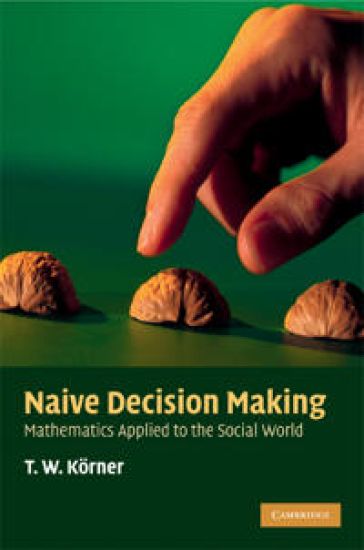
Naive Decision Making

Naive Decision Making

T. W. Körner

Cambridge University Press
2008
sidottu
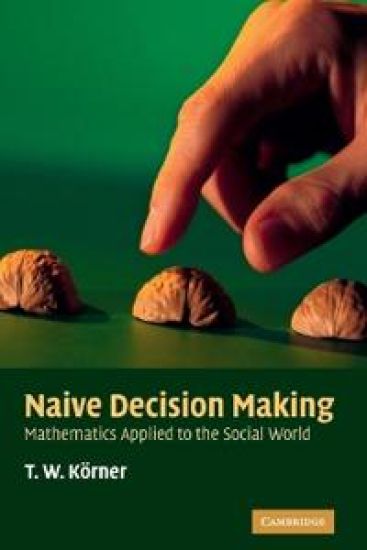
How should one choose the best restaurant to eat in? Can one really make money at gambling? Or predict the future? Naive Decision Making presents the mathematical basis for making decisions where the outcome may be uncertain or the interests of others have to taken into consideration. Professor Körner takes the reader on an enjoyable journey through many aspects of mathematical decision making, with pithy observations, anecdotes and quotations. Topics include probability, statistics, Arrow's theorem, Game Theory and Nash equilibrium. Readers will also gain a great deal of insight into mathematics in general and the role it can play within society. Intended for those with elementary calculus, this book is ideal as a supplementary text for undergraduate courses in probability, game theory and decision making. Engaging and intriguing, it will also appeal to all those of a mathematical mind. To aid understanding, many exercises are included, with solutions available online.
Naive Decision Making

Naive Decision Making

T. W. Körner

Cambridge University Press
2008
pokkari
How should one choose the best restaurant to eat in? Can one really make money at gambling? Or predict the future? Naive Decision Making presents the mathematical basis for making decisions where the outcome may be uncertain or the interests of others have to taken into consideration. Professor Körner takes the reader on an enjoyable journey through many aspects of mathematical decision making, with pithy observations, anecdotes and quotations. Topics include probability, statistics, Arrow's theorem, Game Theory and Nash equilibrium. Readers will also gain a great deal of insight into mathematics in general and the role it can play within society. Intended for those with elementary calculus, this book is ideal as a supplementary text for undergraduate courses in probability, game theory and decision making. Engaging and intriguing, it will also appeal to all those of a mathematical mind. To aid understanding, many exercises are included, with solutions available online.
A Companion to Analysis

A Companion to Analysis

T. W. Korner

Amer Mathematical Society
2004
sidottu
Many students acquire knowledge of a large number of theorems and methods of calculus without being able to say how they work together. This book provides those students with the coherent account that they need. "A Companion to Analysis" explains the problems that must be resolved in order to procure a rigorous development of the calculus and shows the student how to deal with those problems. Starting with the real line, the book moves on to finite-dimensional spaces and then to metric spaces. Readers who work through this text will be ready for courses such as measure theory, functional analysis, complex analysis, and differential geometry. Moreover, they will be well on the road that leads from mathematics student to mathematician. With this book, well-known author Thomas Korner provides able and hard-working students a great text for independent study or for an advanced undergraduate or first-level graduate course. It includes many stimulating exercises. An appendix contains a large number of accessible but non-routine problems that will help students advance their knowledge and improve their technique.
The Pleasures of Counting

The Pleasures of Counting

T. W. Körner

Cambridge University Press
1996
pokkari
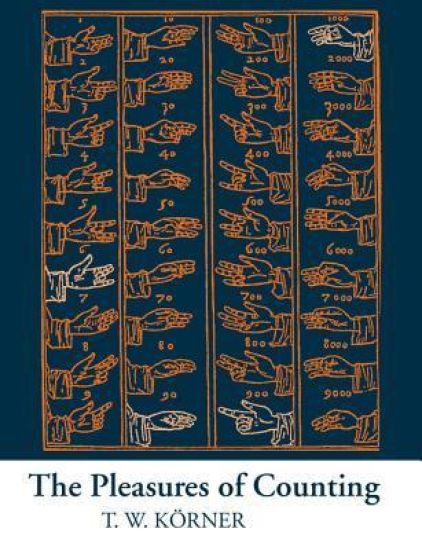
What is the connection between the outbreak of cholera in Victorian Soho, the Battle of the Atlantic, African Eve and the design of anchors? One answer is that they are all examples chosen by Dr Tom Körner to show how a little mathematics can shed light on the world around us, and deepen our understanding of it. Dr Körner, an experienced author, describes a variety of topics which continue to interest professional mathematicians, like him. He does this using relatively simple terms and ideas, yet confronting difficulties (which are often the starting point for new discoveries) and avoiding condescension. If you have ever wondered what it is that mathematicians do, and how they go about it, then read on. If you are a mathematician wanting to explain to others how you spend your working days (and nights), then seek inspiration here.
Exercises in Fourier Analysis

Exercises in Fourier Analysis

T. W. Körner

Cambridge University Press
1993
pokkari
For physicists, engineers and mathematicians, Fourier analysis constitutes a tool of great usefulness. A wide variety of the techniques and applications of the subject were discussed in Dr Körner’s highly popular book, Fourier Analysis. Now Dr Körner has compiled a collection of exercises on Fourier analysis that will thoroughly test the understanding of the reader. They are arranged chapter by chapter to correspond with Fourier Analysis, and for all who enjoyed that book, this companion volume will be an essential purchase.