Kirjojen hintavertailu – 12 903 725 kirjaa ja 27 kauppaa

Kirjailija

Taeku Lee

Kirjat ja teokset yhdessä paikassa: 7 kirjaa, julkaisuja vuosilta 2002–2027, suosituimpiin kuuluu Billionaire Backlash. Vertaile teosten hintoja ja tarkista saatavuus suomalaisista kirjakaupoista.

7 kirjaa

Kirjojen julkaisuvuodet: 2002–2027.

Billionaire Backlash

Billionaire Backlash

Pepper Culpepper; Taeku Lee

BLOOMSBURY PUBLISHING PLC
2027
nidottu
The surprising story of how corporate scandals - from Enron to the Facebook privacy scandal - change the way the world works for the better. Pepper Culpepper and Taeku Lee draw on a decade of research on policymaking and public opinion to show us how scandals can ignite a public with few political outlets for their discontent. Scandals don’t simply dominate news cycles: they can provoke us to demand better policy, spurring governments to adopt rules that protect us from massive corporations run amok. Today it is giant companies, not governments, who run the world. They launch rockets into space, control satellite communication and develop era-defining AI technologies. But around the globe, these corporate titans are facing increasing public hostility. Tech giants are seen as promoting misinformation, undermining democracy and violating our privacy. Big banks, reeling since the financial crisis of 2008, continue to be racked with major scandals. Drawing on real-life examples such as the VW scandal in Germany, the Goldman Sachs scandal in the United States and Samsung in South Korea - the authors show that these scandals are not just symptoms of a careless corporate elite, they are opportunities for real political change. Pepper Culpepper and Taeku Lee reveal how the shared anger of citizens can be channelled into a backlash that has the potential to reinvigorate our failing democracies. One corporate scandal at a time.
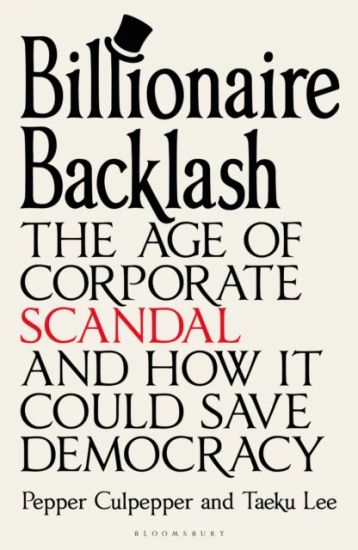
Billionaire Backlash

Billionaire Backlash

Pepper Culpepper; Taeku Lee

BLOOMSBURY PUBLISHING PLC
2026
sidottu

Halvin toimitettuna 24,40 €

The surprising story of how corporate scandals like the Lehman Shock and the Cambridge Analytica data scandal change the way the world works – for the better. Pepper Culpepper and Taeku Lee draw on a decade of research on policymaking and public opinion to show us how scandals can ignite a public with few political outlets for their discontent. Scandal no longer just dominates news cycles, they can inspire us to change policy, spur governments to action the rules that exist to protect us. Today it is giant companies, not governments, who run the world. They put rockets into space, control satellite communication and develop era-defining AI technologies. But around the globe, these corporate titans are facing increasing public hostility. Tech giants are accused of promoting misinformation, debasing democracy and violating our privacy. Big banks, reeling since the financial crisis of 2008, are racked with major scandals. Drawing on real-life examples such as the powdered milk scandal that rocked France, the VW scandal in Germany, Cambridge Analytica in Britain and Samsung in South Korea – the authors show that these terrible scandals are not just symptoms of a careless corporate elite, they are opportunities for real political change. Pepper Culpepper and Taeku Lee reveal how the anger of citizens can be channelled into a backlash that has the potential to reinvigorate our failing democracies. One corporate scandal at a time.

Race and Inequality in American Politics

Race and Inequality in American Politics

Zoltan L. Hajnal; Vincent L. Hutchings; Taeku Lee

Cambridge University Press
2024
sidottu
Authored by three of the USA's most well-known scholars on American politics, this undergraduate textbook argues that racial considerations are today-and have always been since the nation's founding-central to understanding America's political system writ large. Drawing on decades of teaching experience and compelling original research, Hajnal, Hutchings, and Lee present an up-to-date and comprehensive survey of race's role in American democracy, spanning topics as wide-ranging as public opinion, voting behavior, media representation, criminal justice, social policy, and protest movements. The reader will examine the perspectives of multiple racial groups, learn how to bring empirical analysis to bear on deeply divided viewpoints, and debate solutions to the many problems of governance in an America that is polarized by party, riven by race, and divided by inequality. Chapters open with a vignette to introduce the core issues and conclude with discussion questions and annotated suggested readings. Full color photos, figures, and boxed features elaborate on and reinforce important themes. Instructor resources are available online.
Race and Inequality in American Politics

Race and Inequality in American Politics

Zoltan L. Hajnal; Vincent L. Hutchings; Taeku Lee

Cambridge University Press
2024
pokkari
Authored by three of the USA's most well-known scholars on American politics, this undergraduate textbook argues that racial considerations are today-and have always been since the nation's founding-central to understanding America's political system writ large. Drawing on decades of teaching experience and compelling original research, Hajnal, Hutchings, and Lee present an up-to-date and comprehensive survey of race's role in American democracy, spanning topics as wide-ranging as public opinion, voting behavior, media representation, criminal justice, social policy, and protest movements. The reader will examine the perspectives of multiple racial groups, learn how to bring empirical analysis to bear on deeply divided viewpoints, and debate solutions to the many problems of governance in an America that is polarized by party, riven by race, and divided by inequality. Chapters open with a vignette to introduce the core issues and conclude with discussion questions and annotated suggested readings. Full color photos, figures, and boxed features elaborate on and reinforce important themes. Instructor resources are available online.
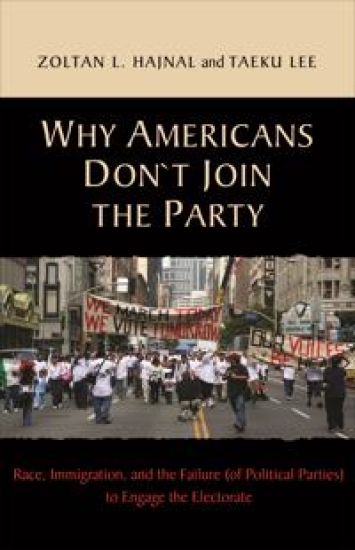
Why Americans Don't Join the Party

Why Americans Don't Join the Party

Zoltan Hajnal; Taeku Lee

Princeton University Press
2011
pokkari
Two trends are dramatically altering the American political landscape: growing immigration and the rising prominence of independent and nonpartisan voters. Examining partisan attachments across the four primary racial groups in the United States, this book offers the first sustained and systematic account of how race and immigration today influence the relationship that Americans have--or fail to have--with the Democratic and Republican parties. Zoltan Hajnal and Taeku Lee contend that partisanship is shaped by three factors--identity, ideology, and information--and they show that African Americans, Asian Americans, Latinos, and whites respond to these factors in distinct ways. The book explores why so many Americans--in particular, Latinos and Asians--fail to develop ties to either major party, why African Americans feel locked into a particular party, and why some white Americans are shut out by ideologically polarized party competition. Through extensive analysis, the authors demonstrate that when the Democratic and Republican parties fail to raise political awareness, to engage deeply held political convictions, or to affirm primary group attachments, nonpartisanship becomes a rationally adaptive response. By developing a model of partisanship that explicitly considers America's new racial diversity and evolving nonpartisanship, this book provides the Democratic and Republican parties and other political stakeholders with the means and motivation to more fully engage the diverse range of Americans who remain outside the partisan fray.
Mobilizing Public Opinion

Mobilizing Public Opinion

Taeku Lee

University of Chicago Press
2002
nidottu
What motivates us to change our opinions during times of political protest and social unrest? To investigate this question, Taeku Lee's smartly argued book looks to the critical struggle over the moral principles, group interests, and racial animosities that defined public support for racial policies during the civil rights movement, from the late 1940s to the mid-1960s. Challenging the conventional view that public opinion is shaped by elites, Lee crafts an alternate account of the geographic, institutional, historical, and issue-specific contexts that form our political views. He finds that grassroots organizations and local protests of ordinary people pushed demands for social change into the consciousness of the general public. From there, Lee argues, these demands entered the policy agendas of political elites. Evidence from multiple sources including survey data, media coverage, historical accounts, and presidential archives animates his argument. Ultimately, Mobilizing Public Opinion is a timely, cautionary tale about how we view public opinion and a compelling testament to the potential power of ordinary citizens.
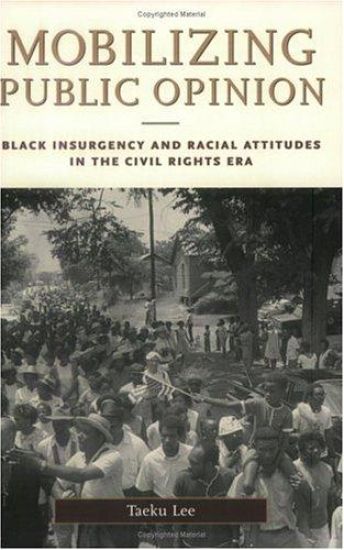
Mobilizing Public Opinion

Mobilizing Public Opinion

Taeku Lee

University of Chicago Press
2002
sidottu
What motivates us to change our opinions during times of political protest and social unrest? To investigate this question, Taeku Lee's smartly argued book looks to the critical struggle over the moral principles, group interests, and racial animosities that defined public support for racial policies during the civil rights movement, from the late 1940s to the mid-1960s. Challenging the conventional view that public opinion is shaped by elites, Lee crafts an alternate account of the geographic, institutional, historical, and issue-specific contexts that form our political views. He finds that grassroots organizations and local protests of ordinary people pushed demands for social change into the consciousness of the general public. From there, Lee argues, these demands entered the policy agendas of political elites. Evidence from multiple sources including survey data, media coverage, historical accounts, and presidential archives animates his argument. Ultimately, Mobilizing Public Opinion is a timely, cautionary tale about how we view public opinion and a compelling testament to the potential power of ordinary citizens.