Kirjojen hintavertailu – 12 903 725 kirjaa ja 27 kauppaa

Kirjailija

Tamás Terlaky

Kirjat ja teokset yhdessä paikassa: 5 kirjaa, julkaisuja vuosilta 2002–2017, suosituimpiin kuuluu Interior Point Methods for Linear Optimization. Vertaile teosten hintoja ja tarkista saatavuus suomalaisista kirjakaupoista.

Nimi esiintyy myös muodoissa: Tamas Terlaky

5 kirjaa

Kirjojen julkaisuvuodet: 2002–2017.

Interior Point Methods for Linear Optimization

Interior Point Methods for Linear Optimization

Cornelis Roos; Tamás Terlaky; J.-Ph. Vial

Springer-Verlag New York Inc.
2010
nidottu
Interior Point Methods for Linear Optimization is a comprehensive, thorough textbook on interior point methods (IPMs). The era of IPMs was initiated by N. Karmarkar’s 1984 paper, which triggered turbulent research and reshaped almost all areas of optimization theory and computational practice. This book gives a comprehensive review of the main results of more than a decade of IPM research. Numerous exercises are provided to aid in understanding the material.
Interior Point Methods for Linear Optimization

Interior Point Methods for Linear Optimization

Cornelis Roos; Tamás Terlaky; J.-Ph. Vial

Springer-Verlag New York Inc.
2005
sidottu
Interior Point Methods for Linear Optimization is a comprehensive, thorough textbook on interior point methods (IPMs). The era of IPMs was initiated by N. Karmarkar’s 1984 paper, which triggered turbulent research and reshaped almost all areas of optimization theory and computational practice. This book gives a comprehensive review of the main results of more than a decade of IPM research. Numerous exercises are provided to aid in understanding the material.
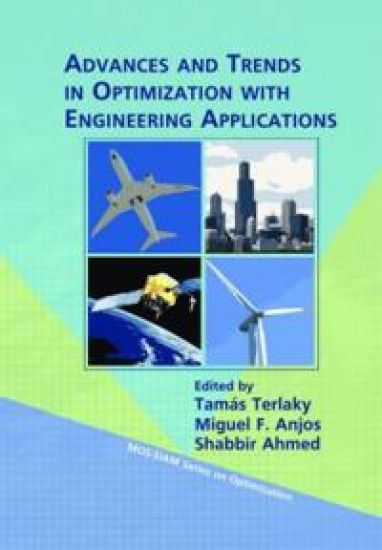
Advances and Trends in Optimization with Engineering Applications

Advances and Trends in Optimization with Engineering Applications

Tamas Terlaky; Miguel F. Anjos; Shabbir Ahmed

Society for Industrial Applied Mathematics,U.S.
2017
sidottu
Optimization is of critical importance in engineering. Engineers constantly strive for the best possible solutions, the most economical use of limited resources, and the greatest efficiency. As system complexity increases, these goals mandate the use of state-of-the-art optimization techniques. In recent years the theory and methodology of optimization have seen revolutionary improvements. Moreover, the exponential growth in computational power, along with the availability of multicore computing with virtually unlimited memory and storage capacity, has fundamentally changed what engineers can do to optimize their designs. This is a two-way process: engineers benefit from developments in optimization methodology, and challenging new classes of optimization problems arise from novel engineering applications. Advances and Trends in Optimization with Engineering Applications reviews 10 major areas of optimization and related engineering applications in a distinct part, providing a broad summary of state-of-the-art optimization techniques most important to engineering practice. Each part provides a clear overview of a specific area, followed by chapters detailing applications to a wide range of real-world problems. The book provides a solid foundation for engineers and mathematical optimizers alike who want to understand not only the importance of optimization methods to engineering but also the capabilities of current methods.
Nonlinear Optimization

Nonlinear Optimization

Immanuel M. Bomze; Vladimir F. Demyanov; Roger Fletcher; Tamás Terlaky

Springer-Verlag Berlin and Heidelberg GmbH Co. K
2010
nidottu
The Nonlinear Optimization problem of main concern here is the problem n of determining a vector of decision variables x ? R that minimizes (ma- n mizes) an objective function f(·): R ? R , usually described by a set of equality and - n n m equality constraints: F = {x ? R : h(x)=0,h(·): R ? 0, n p g(·): R ?
Self-Regularity

Self-Regularity

Jiming Peng; Cornelis Roos; Tamás Terlaky

Princeton University Press
2002
pokkari
Research on interior-point methods (IPMs) has dominated the field of mathematical programming for the last two decades. Two contrasting approaches in the analysis and implementation of IPMs are the so-called small-update and large-update methods, although, until now, there has been a notorious gap between the theory and practical performance of these two strategies. This book comes close to bridging that gap, presenting a new framework for the theory of primal-dual IPMs based on the notion of the self-regularity of a function. The authors deal with linear optimization, nonlinear complementarity problems, semidefinite optimization, and second-order conic optimization problems. The framework also covers large classes of linear complementarity problems and convex optimization. The algorithm considered can be interpreted as a path-following method or a potential reduction method. Starting from a primal-dual strictly feasible point, the algorithm chooses a search direction defined by some Newton-type system derived from the self-regular proximity. The iterate is then updated, with the iterates staying in a certain neighborhood of the central path until an approximate solution to the problem is found. By extensively exploring some intriguing properties of self-regular functions, the authors establish that the complexity of large-update IPMs can come arbitrarily close to the best known iteration bounds of IPMs. Researchers and postgraduate students in all areas of linear and nonlinear optimization will find this book an important and invaluable aid to their work.