Kirjojen hintavertailu – 12 903 725 kirjaa ja 27 kauppaa

Kirjailija

Tamra Stambaugh

Kirjat ja teokset yhdessä paikassa: 75 kirjaa, julkaisuja vuosilta 2005–2022, suosituimpiin kuuluu Comprehensive Curriculum for Gifted Learners. Vertaile teosten hintoja ja tarkista saatavuus suomalaisista kirjakaupoista.

75 kirjaa

Kirjojen julkaisuvuodet: 2005–2022.

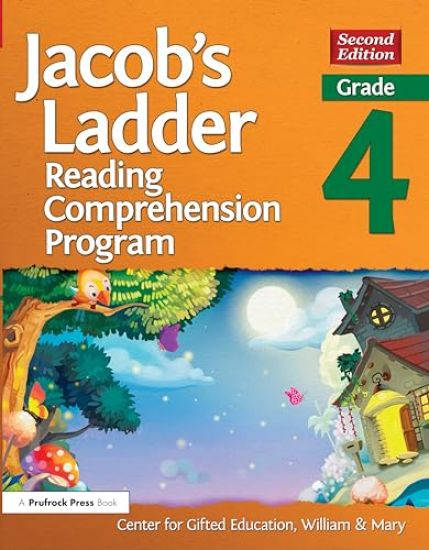
Jacob's Ladder Reading Comprehension Program

Jacob's Ladder Reading Comprehension Program

Joyce VanTassel-Baska; Tamra Stambaugh

TAYLOR FRANCIS INC
2017
muu
The Jacob’s Ladder Reading Comprehension Program:Targets reading comprehension skills in high-ability learners. Moves students through an inquiry process from basic understanding to critical analyses of texts. Uses a field-tested method developed by the Center for Gifted Education at William & Mary. Enables students in grades K–8 to comprehend and analyze any reading passage after completing the activities. Features optional student workbooks for each book and grade level. The second edition of the program features comprehensive teacher's guides and new readings and ladders for student use. Each complete set includes the teacher's guide and 5 copies of each companion student workbook.
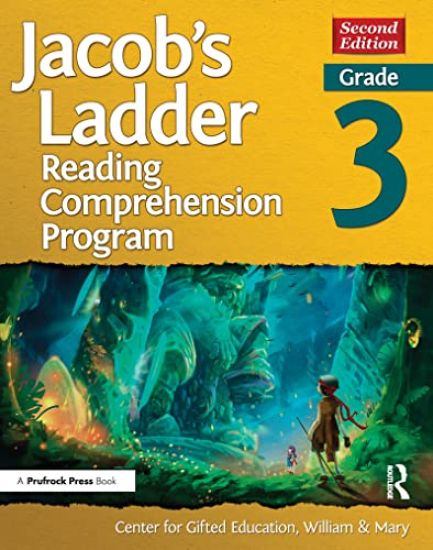
Jacob's Ladder Reading Comprehension Program

Jacob's Ladder Reading Comprehension Program

Joyce VanTassel-Baska; Tamra Stambaugh

TAYLOR FRANCIS INC
2017
muu
The Jacob’s Ladder Reading Comprehension Program:Targets reading comprehension skills in high-ability learners. Moves students through an inquiry process from basic understanding to critical analyses of texts. Uses a field-tested method developed by the Center for Gifted Education at William & Mary. Enables students in grades K–8 to comprehend and analyze any reading passage after completing the activities. Features optional student workbooks for each book and grade level. The second edition of the program features comprehensive teacher's guides and new readings and ladders for student use. Each complete set includes the teacher's guide and 5 copies of each companion student workbook.
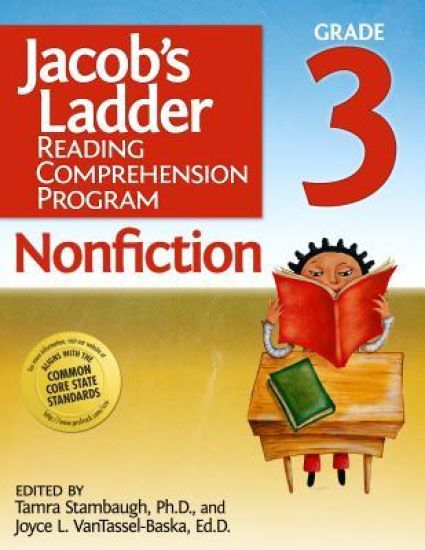
Jacob's Ladder Reading Comprehension Program

Jacob's Ladder Reading Comprehension Program

Joyce VanTassel-Baska; Tamra Stambaugh

Prufrock Press
2016
nidottu
The Jacob's Ladder Reading Comprehension Program: Nonfiction targets reading comprehension skills in high-ability learners by moving students through an inquiry process from basic understanding to critical analyses of texts using a field-tested method developed by the Center for Gifted Education at William & Mary. Students in grade 3 will be able to comprehend and analyze any nonfiction reading passage after completing the activities in this book. Using skill ladders connected to individual readings related to essays, articles, comparison documents, infographics, and other nonfiction texts, students move from lower order, concrete thinking skills to higher order, critical thinking skills. All of the books, geared to increasing grade levels, include high-interest readings, ladders to increase reading skill development, and easy-to-implement instructions. The ladders include multiple skills necessary for academic success, covering language arts standards such as sequencing, cause and effect, classification, making generalizations, inference, understanding emotion, using and thinking about words, and recognizing themes and concepts. Optional Student Workbook PacksIn addition to this teacher's guide, companion student workbooks are available for Science and Math, Social Studies, and Fiction/Nonfiction Comparisons. The student workbooks feature ample room for student responses and notes, make reviewing and providing feedback on student work easier than ever, provide students with an easy-to-use reference to use during discussions, and save time, as there is no need to reproduce student handouts. Grade 3
Jacob's Ladder Reading Comprehension Program

Jacob's Ladder Reading Comprehension Program

Joyce VanTassel-Baska; Tamra Stambaugh

Prufrock Press
2016
nidottu
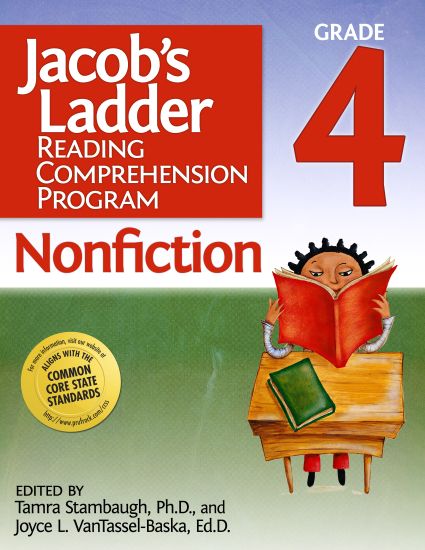
The Jacob's Ladder Reading Comprehension Program: Nonfiction targets reading comprehension skills in high-ability learners by moving students through an inquiry process from basic understanding to critical analyses of texts using a field-tested method developed by the Center for Gifted Education at William & Mary. Students in grade 4 will be able to comprehend and analyze any nonfiction reading passage after completing the activities in this book. Using skill ladders connected to individual readings related to essays, articles, comparison documents, infographics, and other nonfiction texts, students move from lower order, concrete thinking skills to higher order, critical thinking skills. All of the books, geared to increasing grade levels, include high-interest readings, ladders to increase reading skill development, and easy-to-implement instructions. The ladders include multiple skills necessary for academic success, covering language arts standards such as sequencing, cause and effect, classification, making generalizations, inference, understanding emotion, using and thinking about words, and recognizing themes and concepts. Optional Student Workbook PacksIn addition to this teacher's guide, companion student workbooks are available for Science and Math, Social Studies, and Fiction/Nonfiction Comparisons. The student workbooks feature ample room for student responses and notes, make reviewing and providing feedback on student work easier than ever, provide students with an easy-to-use reference to use during discussions, and save time, as there is no need to reproduce student handouts. Grade 4
Jacob's Ladder Reading Comprehension Program

Jacob's Ladder Reading Comprehension Program

Joyce VanTassel-Baska; Tamra Stambaugh

Prufrock Press
2016
nidottu
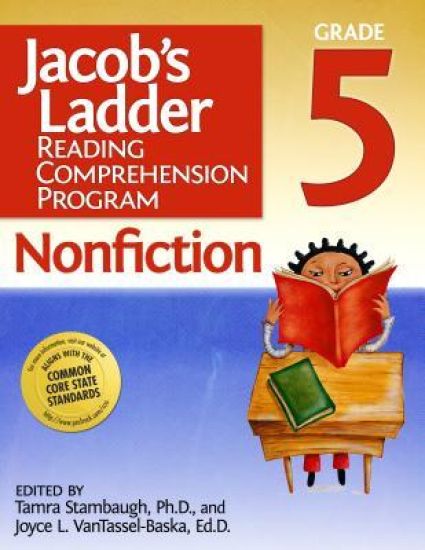
The Jacob's Ladder Reading Comprehension Program: Nonfiction targets reading comprehension skills in high-ability learners by moving students through an inquiry process from basic understanding to critical analyses of texts using a field-tested method developed by the Center for Gifted Education at William & Mary. Students in grade 5 will be able to comprehend and analyze any nonfiction reading passage after completing the activities in this book. Using skill ladders connected to individual readings related to essays, articles, comparison documents, infographics, and other nonfiction texts, students move from lower order, concrete thinking skills to higher order, critical thinking skills. All of the books, geared to increasing grade levels, include high-interest readings, ladders to increase reading skill development, and easy-to-implement instructions. The ladders include multiple skills necessary for academic success, covering language arts standards such as sequencing, cause and effect, classification, making generalizations, inference, understanding emotion, using and thinking about words, and recognizing themes and concepts. Optional Student Workbook PacksIn addition to this teacher's guide, companion student workbooks are available for Science and Math, Social Studies, and Fiction/Nonfiction Comparisons. The student workbooks feature ample room for student responses and notes, make reviewing and providing feedback on student work easier than ever, provide students with an easy-to-use reference to use during discussions, and save time, as there is no need to reproduce student handouts. Grade 5
In the Mind's Eye

In the Mind's Eye

Emily Mofield; Tamra Stambaugh

Prufrock Press
2016
nidottu
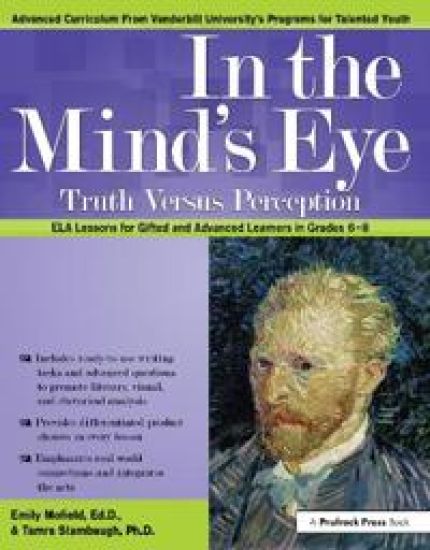
Winner of the 2012 NAGC Curriculum Studies AwardIn the Mind's Eye: Truth Versus Perception invites students on a philosophical exploration of the themes of truth and perception. Lessons include a major emphasis on rigorous evidence-based discourse through the study of common themes and content-rich, challenging informational and fictional texts. This unit, developed by Vanderbilt University's Programs for Talented Youth and aligned to the Common Core State Standards (CCSS), applies concepts from Plato's "Allegory of the Cave" to guide students to discover how reality is presented and interpreted in fiction, nonfiction, art, and media. Students engage in activities such as Socratic seminars, literary analyses, skits, and art projects, and creative writing to understand differing perceptions of reality. Lessons include close readings with text-dependent questions, choice-based differentiated products, rubrics, formative assessments, and ELA tasks that require students to analyze texts for rhetorical features, literary elements, and themes through argument, explanatory, and prose-constructed writing. Ideal for pre-AP and honors courses, the unit features art from M. C. Escher and Vincent Van Gogh, short stories from Guy de Maupassant and Shirley Jackson, longer texts by Daniel Keyes and Ray Bradbury, and informational texts related to sociology, Nazi propaganda, and Christopher Columbus. This unit encourages students to translate learning to real-life contexts and problems by exploring themes of disillusionment, social deception, and the power of perception. Grades 6-8
I, Me, You, We

I, Me, You, We

Emily Mofield; Tamra Stambaugh

Prufrock Press
2015
nidottu
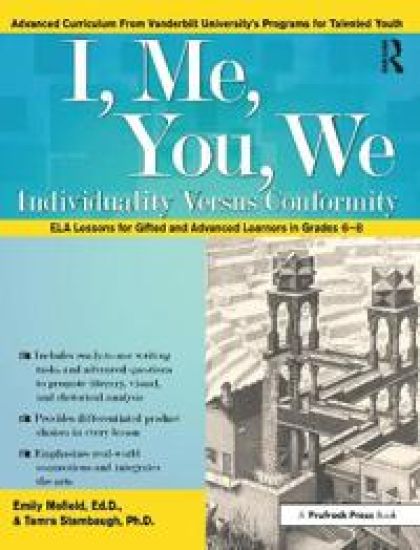
Winner of the 2016 NAGC Curriculum Studies AwardIn I, Me, You, We: Individuality Versus Conformity, students explore essential questions such as “How does our environment shape our identity? What are the consequences of conforming to a group? When does social conformity go too far?” This unit, developed by Vanderbilt University’s Programs for Talented Youth and aligned to the Common Core State Standards (CCSS), includes a major emphasis on rigorous evidence-based discourse through the study of common themes across rich, challenging nonfiction and fictional texts. The unit guides students to examine the fine line of individuality versus conformity through the related concepts of belongingness, community, civil disobedience, questioning the status quo, and self-reliance by engaging in creative activities, Socratic seminars, literary analyses, and debates. Lessons include close-readings with text-dependent questions, choice-based differentiated products, rubrics, formative assessments, and ELA tasks that require students to analyze texts for rhetorical features, literary elements, and themes through argument, explanatory, and prose-constructed writing. Ideal for pre-AP and honors courses, the unit features short stories from Kurt Vonnegut and Ray Bradbury, poetry from Emily Dickinson and Maya Angelou, art by M. C. Escher and Pablo Picasso, and primary source documents from Plato, Eleanor D. Roosevelt, William Bradford, Ralph Waldo Emerson, and Henry David Thoreau. Grades 6-8
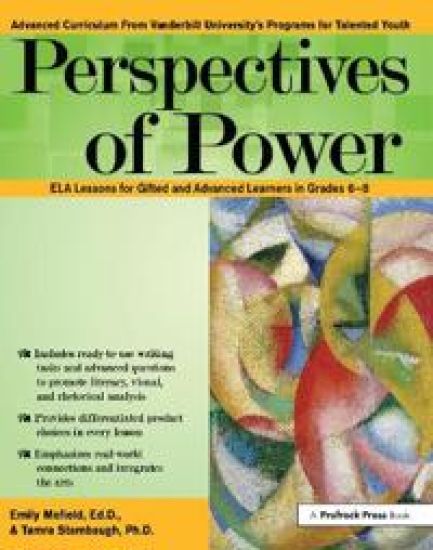
Perspectives of Power

Perspectives of Power

Emily Mofield; Tamra Stambaugh

Prufrock Press
2015
nidottu
Winner of the 2015 NAGC Curriculum Studies AwardPerspectives of Power explores the nature of power in literature, historical documents, poetry, and art. Lessons include a major focus on rigorous evidence-based discourse through the study of common themes and content-rich, challenging nonfiction and fictional texts. This unit, developed by Vanderbilt University's Programs for Talented Youth and aligned to the Common Core State Standards (CCSS), guides students to explore the power of oppression; the power of the past, present, and future; and the power of personal response by engaging in simulations, skits, creative projects, literary analyses, Socratic seminars, and debates. Texts illuminate content extensions that interest many high-ability students including bystander effect, social class structure, game theory, the use and abuse of technology, cultural conflict, the butterfly effect, women's suffrage, and surrealism as each relates to power. Lessons include close readings with text-dependent questions, choice-based differentiated products, rubrics, formative assessments, and ELA writing tasks that require students to analyze texts for rhetorical features, literary elements, and themes through argument, explanatory, and/or prose-constructed writing. Ideal for pre-AP and honors courses, the unit features texts from Emily Dickinson, William B. Yeats, and Charles Perrault; art from Moyo Okediji and Salvador Dali; and speeches by Elie Wiesel, Susan B. Anthony, and John F. Kennedy. As a result from the learning in the unit, students will be able to examine powerful influences in their own lives and identify their own power in personal responsibility. Grades 6-8
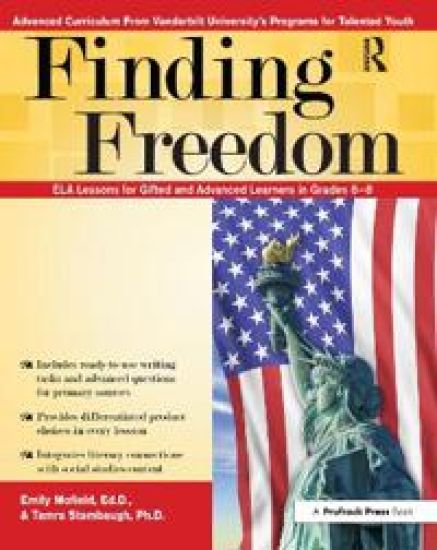
Finding Freedom

Finding Freedom

Emily Mofield; Tamra Stambaugh

Prufrock Press
2015
nidottu
Finding Freedom invites students to follow America's journey toward finding freedom by examining multiple perspectives, conflicts, ideas, and challenges through seminal historical texts. This unit, developed by Vanderbilt University's Programs for Talented Youth and aligned to the Common Core State Standards (CCSS), features close readings of some of the most famous American political speeches from notable Americans, presidents, and minority voices. To sharpen historical thinking, students analyze arguments for freedom, examine dissenting perspectives, and reason through multiple viewpoints of historical issues through debates and interactive activities. To develop advanced literacy skills, students evaluate effective rhetorical appeals, claims, supporting evidence, and techniques that advance arguments. Students synthesize their learning by comparing speeches to each other, relating texts to contemporary issues of today, and making interdisciplinary connections. Lessons include close readings with text-dependent questions, choice-based differentiated products, rubrics, formative assessments, social studies content connections, and ELA tasks that require argument and explanatory writing. Ideal for pre-AP and honors courses, the unit features speeches from Patrick Henry, Frederick Douglass, Carrie Chapman Catt, and Presidents Franklin D. Roosevelt, Lincoln, Kennedy, Johnson, George W. Bush, Obama, and others. Grades 6-8
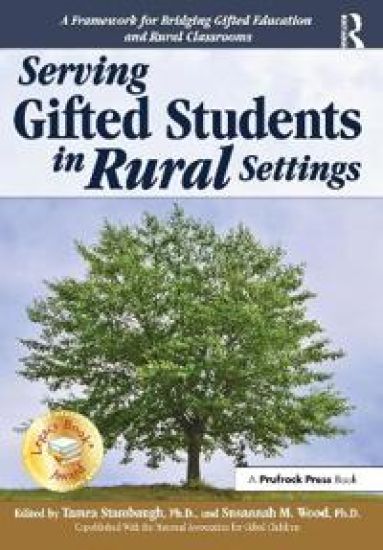
Serving Gifted Students in Rural Settings

Serving Gifted Students in Rural Settings

Tamra Stambaugh; Susannah M. Wood

Prufrock Press
2015
nidottu
A cooperative publication of the National Association for Gifted Children and Prufrock Press, Serving Gifted Students in Rural Settings provides a framework for educating the gifted in rural settings. The book outlines practical, theoretical, and evidence-supported approaches for understanding, teaching, and leading programs for this unique population. Case study vignettes and practical ideas for administrators and teachers are combined with theoretical applications. The first of three sections in the book outlines the various philosophies and current status of rural education. The second section focuses on practical strategies and evidence-supported approaches for identifying and serving rural gifted students based on their unique geography. Section three highlights support structures that are necessary for leading and supporting gifted education in rural schools. This book helps bridge the gap existing between rural education and accessible, effective gifted education.
Jacob's Ladder Reading Comprehension Program - Primary 2

Jacob's Ladder Reading Comprehension Program - Primary 2

Joyce VanTassel-Baska; Tamra Stambaugh

Prufrock Press
2012
nidottu
The Jacob's Ladder Reading Comprehension Program targets reading comprehension skills in learners by moving students through an inquiry process from basic understanding to critical analyses of texts using a field-tested method developed by the Center for Gifted Education at The College of William and Mary. Students in grades K-2 will learn to comprehend and analyze any reading passage after completing the activities in this series. The Primary 2 book, geared for students in grades 1-2, includes stories and ladder tasks carefully selected for young children to develop oral communication and listening skills in addition to the other ladder goals. This level provides stories focused on picture analysis, read alouds, classics, and original works. Grades 1-2
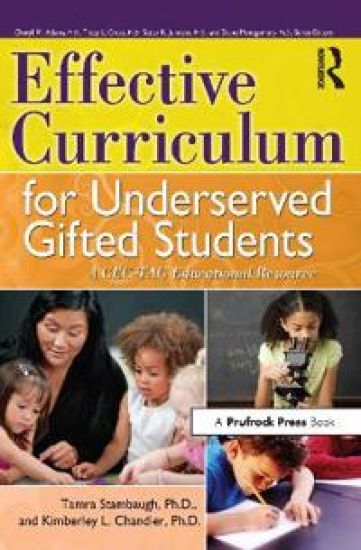
Effective Curriculum for Underserved Gifted Students

Effective Curriculum for Underserved Gifted Students

Tamra Stambaugh; Kimberley Chandler

TAYLOR FRANCIS INC
2011
nidottu
Effective Curriculum for Underserved Gifted Students explains the need for a differentiated curriculum for gifted students typically underrepresented in gifted programs, including children of poverty and those who are from culturally and linguistically diverse populations. Features of research-based curriculum found to be effective in enhancing the academic achievement of these populations are highlighted. In addition, practical, evidence-based strategies for curriculum development and instruction are shared.
Jacob's Ladder Reading Comprehension Program, Level 5: Grades 7-9

Jacob's Ladder Reading Comprehension Program, Level 5: Grades 7-9

Joyce Vantassel-Baska; Tamra Stambaugh

Prufrock Press
2011
nidottu
The Jacob's Ladder Reading Comprehension Program targets reading comprehension skills in high-ability learners by moving students through an inquiry process from basic understanding to critical analyses of texts using a field-tested method developed by the Center for Gifted Education at The College of William and Mary. Students in grades K-9 will be able to comprehend and analyze any reading passage after completing the activities in these books. Using skill ladders connected to individual readings in poetry, short stories, and nonfiction, students move from lower order, concrete thinking skills to higher order, critical thinking skills. All of the books, geared to increasing grade levels, include high-interest readings, ladders to increase reading skill development, and easy-to-implement instructions. The ladders include multiple skills necessary for academic success, covering language arts standards such as sequencing, cause and effect, classification, making generalizations, inference, and recognizing themes and concepts. The Jacob's Ladder guides provide teachers with an explanation of the nature and substance of supplementary tasks in reading comprehension that will help prepare students for their state assessment tests. At the same time, these tasks will move students from basic reading comprehension to more critical reading behaviors. Also included are an overview of the goals and objectives of Jacob's Ladder tasks and suggestions for implementation, giving every teacher of gifted learners the tools needed to create a successful reading classroom. Grades 7-9
Jacob's Ladder Reading Comprehension Program - Level 4

Jacob's Ladder Reading Comprehension Program - Level 4

Joyce VanTassel-Baska; Tamra Stambaugh

Prufrock Press
2011
nidottu
The Jacob's Ladder Reading Comprehension Program targets reading comprehension skills in high-ability learners by moving students through an inquiry process from basic understanding to critical analyses of texts using a field-tested method developed by the Center for Gifted Education at The College of William and Mary. Students in grades K-9 will be able to comprehend and analyze any reading passage after completing the activities in these books. Using skill ladders connected to individual readings in poetry, short stories, and nonfiction, students move from lower order, concrete thinking skills to higher order, critical thinking skills. All of the books, geared to increasing grade levels, include high-interest readings, ladders to increase reading skill development, and easy-to-implement instructions. The ladders include multiple skills necessary for academic success, covering language arts standards such as sequencing, cause and effect, classification, making generalizations, inference, and recognizing themes and concepts. The Jacob's Ladder guides provide teachers with an explanation of the nature and substance of supplementary tasks in reading comprehension that will help prepare students for their state assessment tests. At the same time, these tasks will move students from basic reading comprehension to more critical reading behaviors. Also included are an overview of the goals and objectives of Jacob's Ladder tasks and suggestions for implementation, giving every teacher of gifted learners the tools needed to create a successful reading classroom. Grades 7-9
Comprehensive Curriculum for Gifted Learners

Comprehensive Curriculum for Gifted Learners

Joyce VanTassel-Baska; Tamra Stambaugh

Pearson
2005
sidottu
Comprehensive Curriculum for Gifted Learners provides a theoretical, research-based framework and practical ideas for writing, implementing, and adapting curriculum for gifted learners in a standards-based era. Readers are first introduced to various curriculum theories, the Integrated Curriculum Model, curriculum reform, and a process for curriculum design and development, culminating in examples of key curriculum products. Specific core subject areas and non-core subject areas (including thinking skills, creativity, leadership, and the arts) are addressed with practical examples and connections to standards with adaptations for gifted learners. At-risk populations, connections to technology, interdisciplinary approaches, assessment options, and instructional and classroom management strategies are also emphasized and discussed in detail. Finally, leadership and programming options, as well as new directions in curriculum for gifted learners, provide the reader with an overall examination of a comprehensive approach for teaching, adapting, and leading best-practice initiatives in curriculum for gifted learners.