Kirjojen hintavertailu – 12 903 725 kirjaa ja 27 kauppaa

Kirjailija

Tapan Kumar Pal

Kirjat ja teokset yhdessä paikassa: 4 kirjaa, julkaisuja vuosilta 2009–2021, suosituimpiin kuuluu Fuzzy Preference Ordering of Interval Numbers in Decision Problems. Vertaile teosten hintoja ja tarkista saatavuus suomalaisista kirjakaupoista.

4 kirjaa

Kirjojen julkaisuvuodet: 2009–2021.

Bioequivalence study of Drug

Bioequivalence study of Drug

Bhaswati Pal; Shubhasis Dan; Tapan Kumar Pal

PharmaMed Press
2021
sidottu
This book has been designed to illustrate the concept and practice of Bioavailability and Bioequivalence Studies and will definitely beneficial to them who are interested to proceed further in this field. India is the largest provider of generic drugs globally. Availability of the generic products in the market has been gained serious public consideration in respect of their safety and efficacy with the innovator products. Bioequivalence (BE) studies with a view to demonstrate therapeutic equivalence between two drug products (test and reference or innovator) can able to answer this public concern internationally. The aspect of bioequivalence study is not included in the syllabus of pharmacy or MBBS, this will be definitely helpful to the pharmacist, doctors and the pharma industries to have a thorough knowledge regarding this subject as well as it will guide them to establish a Contract Research Organizations (CRO) for conducting BA/BE study. Moreover it is obvious that the technology transfer from existing CROs for conducting BA/BE study is not possible due to commercial reason. In our book attempts were made to elaborate the CPU and the bioanalytical labs with specimen layout plan, list of essential instruments, and list of SOPs for conducting BA/BE studies etc. Prior to any study the approval of ethics committee is mandatory. Procedure of getting the approval along with the composition of ethics committee has been highlighted. The contents of protocol to conduct BA/BE study including ICF, CRF, PIS, IB, IU and preclinical study of volunteers along with procedure for reporting SAE have been discussed in details.

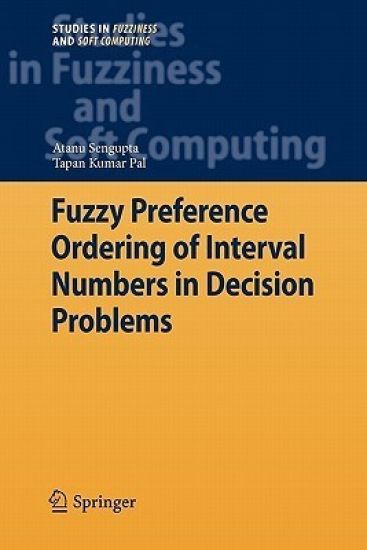
Fuzzy Preference Ordering of Interval Numbers in Decision Problems

Fuzzy Preference Ordering of Interval Numbers in Decision Problems

Atanu Sengupta; Tapan Kumar Pal

Springer-Verlag Berlin and Heidelberg GmbH Co. K
2010
nidottu
In conventional mathematical programming, coefficients of problems are usually determined by the experts as crisp values in terms of classical mathematical reasoning. But in reality, in an imprecise and uncertain environment, it will be utmost unrealistic to assume that the knowledge and representation of an expert can come in a precise way. The wider objective of the book is to study different real decision situations where problems are defined in inexact environment. Inexactness are mainly generated in two ways – (1) due to imprecise perception and knowledge of the human expert followed by vague representation of knowledge as a DM; (2) due to huge-ness and complexity of relations and data structure in the definition of the problem situation. We use interval numbers to specify inexact or imprecise or uncertain data. Consequently, the study of a decision problem requires answering the following initial questions: How should we compare and define preference ordering between two intervals?, interpret and deal inequality relations involving interval coefficients?, interpret and make way towards the goal of the decision problem? The present research work consists of two closely related fields: approaches towards defining a generalized preference ordering scheme for interval attributes and approaches to deal with some issues having application potential in many areas of decision making.
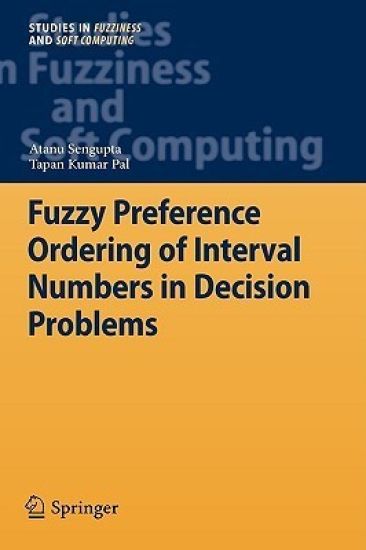
Fuzzy Preference Ordering of Interval Numbers in Decision Problems

Fuzzy Preference Ordering of Interval Numbers in Decision Problems

Atanu Sengupta; Tapan Kumar Pal

Springer-Verlag Berlin and Heidelberg GmbH Co. K
2009
sidottu
In conventional mathematical programming, coefficients of problems are usually determined by the experts as crisp values in terms of classical mathematical reasoning. But in reality, in an imprecise and uncertain environment, it will be utmost unrealistic to assume that the knowledge and representation of an expert can come in a precise way. The wider objective of the book is to study different real decision situations where problems are defined in inexact environment. Inexactness are mainly generated in two ways – (1) due to imprecise perception and knowledge of the human expert followed by vague representation of knowledge as a DM; (2) due to huge-ness and complexity of relations and data structure in the definition of the problem situation. We use interval numbers to specify inexact or imprecise or uncertain data. Consequently, the study of a decision problem requires answering the following initial questions: How should we compare and define preference ordering between two intervals?, interpret and deal inequality relations involving interval coefficients?, interpret and make way towards the goal of the decision problem? The present research work consists of two closely related fields: approaches towards defining a generalized preference ordering scheme for interval attributes and approaches to deal with some issues having application potential in many areas of decision making.