
Kirjojen hintavertailu – 12 859 829 kirjaa ja 27 kauppaa

Kirjailija

Tatjana Gric

Kirjat ja teokset yhdessä paikassa: 4 kirjaa, julkaisuja vuosilta 2018–2026, suosituimpiin kuuluu Anisotropy of Metamaterials. Vertaile teosten hintoja ja tarkista saatavuus suomalaisista kirjakaupoista.

4 kirjaa

Kirjojen julkaisuvuodet: 2018–2026.

Anisotropy of Metamaterials

Anisotropy of Metamaterials

Vladimir Mityushev; Tatjana Gric; Radoslaw Kycia; Natalia Rylko

Taylor & Francis
2026
Nidottu
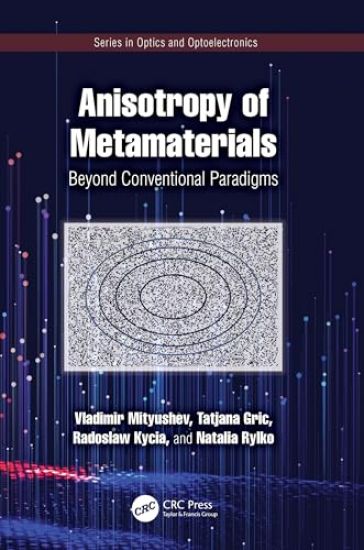
Anisotropy of Metamaterials: Beyond Conventional Paradigms provides a comprehensive introduction to the mathematical modeling of metamaterials based on the macroscopic complex-valued permittivity tensor of dispersed random composites. Key topics include physical and mathematical theory, computer simulations, constructive homogenization, classification of dispersed random composites and their applications in cancer recognition. Image processing and machine learning algorithms are used. The book also discusses the precision of various effective medium approximations, including Bruggeman and Maxwell-Garnett formulas. New analytical, approximate and exact formulas and bounds for the macroscopic permittivity and piezoelectric constants of composites are derived. This book is a valuable tool for academics and professionals in photonics, presenting sustainable materials for sensing, health diagnostics and cancer detection methodologies. Key features: Offers key insights into the current trends and techniques in the study of the macroscopic properties of metamaterials, aiming at stimulating new avenues of research Presents examples of image analysis, the primary tool for non-destructive metamaterials analysis Discusses the applications of Machine Learning to image processing, illustrated using specific code in Python programming language
Anisotropy of Metamaterials

Anisotropy of Metamaterials

Vladimir Mityushev; Tatjana Gric; Radoslaw Kycia; Natalia Rylko

TAYLOR FRANCIS LTD
2025
sidottu
Anisotropy of Metamaterials: Beyond Conventional Paradigms provides a comprehensive introduction to the mathematical modeling of metamaterials based on the macroscopic complex-valued permittivity tensor of dispersed random composites. Key topics include physical and mathematical theory, computer simulations, constructive homogenization, classification of dispersed random composites and their applications in cancer recognition. Image processing and machine learning algorithms are used. The book also discusses the precision of various effective medium approximations, including Bruggeman and Maxwell-Garnett formulas. New analytical, approximate and exact formulas and bounds for the macroscopic permittivity and piezoelectric constants of composites are derived. This book is a valuable tool for academics and professionals in photonics, presenting sustainable materials for sensing, health diagnostics and cancer detection methodologies. Key features:Offers key insights into the current trends and techniques in the study of the macroscopic properties of metamaterials, aiming at stimulating new avenues of researchPresents examples of image analysis, the primary tool for non-destructive metamaterials analysisDiscusses the applications of Machine Learning to image processing, illustrated using specific code in Python programming language
Spoof Plasmons

Spoof Plasmons

Tatjana Gric

Springer International Publishing AG
2020
nidottu
The fundamental optical excitations that are confined to a metal/dielectric interface are the surface plasmon polaritons (SPPs), as described by Ritchie. SPPs can be referred to as electromagnetic excitations existing at an interface between two media, of which at least one is conducting. Investigating spoof plasmons in a semiconductor is becoming an increasingly active area of research. The field of plasmonics deals with the application of surface and interface plasmons. It is an area in which surface plasmon-based circuits merge the fields of photonics and electronics at the nanoscale. Recently, an idea of engineering surface plasmons at lower frequencies was suggested. It was concluded in that the existence of holes in the structure can lower the frequency of existing surface plasmons. Thus, by cutting holes or grooves in metal surfaces, it is possible to take concepts such as highly localized waveguiding and superfocusing to lower frequencies, particularly to the THz regime, whereplasmonics could enable near-field imaging and biosensing with unprecedented sensitivity. It is the main reason to use the terminology "spoof surface plasmons" for the bound surface waves propagating along the perforated structures. The book's title Spoof Plasmons demonstrates that it is devoted to exhibiting the current state of the art of the dynamic and vibrant field of photonic metamaterials reaching across various disciplines, suggesting exciting applications in chemistry, material science, biology, medicine, and engineering.
Phenomena of Optical Metamaterials

Phenomena of Optical Metamaterials

Ortwin Hess; Tatjana Gric

Elsevier Science Publishing Co Inc
2018
nidottu
Phenomena of Optical Metamaterials provides an overview of phenomena enabled by artificial and designed metamaterials and their application for photonic devices. The book explores the study of active metamaterials with tunable and switchable properties and novel functionalities, such as the control of spontaneous emission and enhancement. Topics addressed cover theory, modelling and design, applications in practical devices, fabrication, characterization, and measurement, thus helping readers understand and develop new artificial, functional materials.