Kirjojen hintavertailu – 12 903 724 kirjaa ja 27 kauppaa

Kirjailija

Tejbal Singh

Kirjat ja teokset yhdessä paikassa: 13 kirjaa, julkaisuja vuodelta 2021, suosituimpiin kuuluu Wirkung unterschiedlicher Pflanztermine auf Wachstum und Ertrag von Reis. Vertaile teosten hintoja ja tarkista saatavuus suomalaisista kirjakaupoista.

13 kirjaa

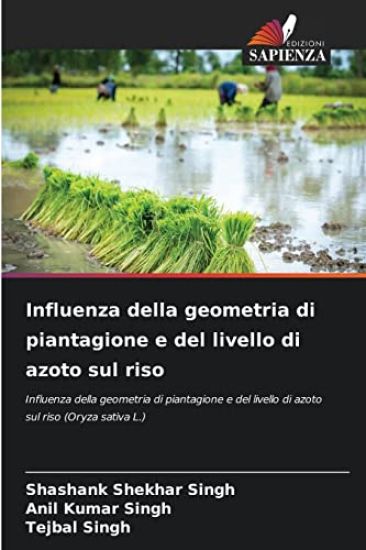
Influenza della geometria di piantagione e del livello di azoto sul riso

Influenza della geometria di piantagione e del livello di azoto sul riso

Shashank Shekhar Singh; Anil Kumar Singh; Tejbal Singh

Edizioni Sapienza
2021
pokkari
Un esperimento di campo stato condotto sul tema intitolato "Influenza della geometria di impianto e del livello di azoto sul riso (Oryza sativa L.)" durante due stagioni consecutive di kharif del 2017 e del 2018 presso l'Agronomy Research Farm, Narendra Deva University of Agriculture and Technology, Narendra Nagar (Kumarganj), Ayodhya (U. P.) L'esperimento era composto da sedici combinazioni di trattamento, vale a dire quattro geometrie di impianto e quattro livelli di azoto nel disegno split plot. Quattro geometrie di impianto cio 15x10 cm, 15x15 cm, 20x10 cm e 20x15 cm sono stati tenuti in trame principali e quattro livelli di azoto cio 0 kg N/ha, 60 kg/N ha, 120 kg N/ha e 180 kg/N ha sono stati tenuti in sottotrame. L'esperimento stato replicato tre volte. Secondo il requisito di piantine, semi NDR-359 variet di riso stato utilizzato come per il trattamento della geometria di impianto Il raccolto stato uniformemente fertilizzato con 60 kg P2O5, 40 kg K2O e azoto come da trattamenti. I risultati rivelano che la geometria di piantagione di 20 10cm stata trovata adatta per gli attributi pi alti del rendimento e la resa del riso. L'applicazione di 120 kg di azoto/ha stata trovata adatta per una maggiore produzione di riso. L'effetto di interazione tra la geometria di piantagione e il livello di azoto stato trovato significativo su grano e paglia yi
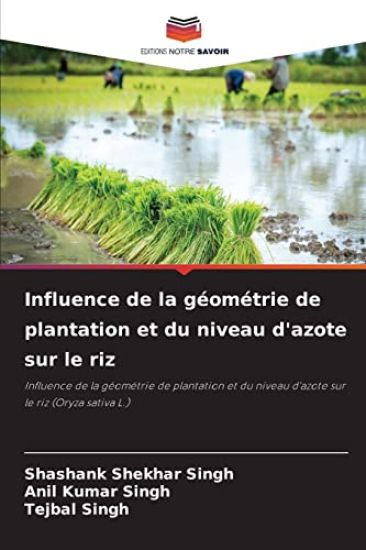
Influence de la géométrie de plantation et du niveau d'azote sur le riz

Influence de la géométrie de plantation et du niveau d'azote sur le riz

Shashank Shekhar Singh; Anil Kumar Singh; Tejbal Singh

Editions Notre Savoir
2021
pokkari
Une exp rience de terrain a t men e sur le sujet intitul "Influence de la g om trie de plantation et du niveau d'azote sur le riz (Oryza sativa L.)" pendant deux saisons kharif cons cutives de 2017 et 2018 la ferme de recherche agronomique, Narendra Deva University of Agriculture and Technology, Narendra Nagar (Kumarganj), Ayodhya (U. P.) L'exp rience tait compos e de seize combinaisons de traitement, savoir quatre g om tries de plantation et quatre niveaux d'azote dans un plan de parcelles divis es. Quatre g om tries de plantation, savoir 15x10 cm, 15x15 cm, 20x10 cm et 20x15 cm, ont t conserv es dans les parcelles principales et quatre niveaux d'azote, savoir 0 kg N/ha, 60 kg/N ha, 120 kg N/ha et 180 kg/N ha, dans les parcelles secondaires. L'exp rience a t r p t e trois fois. Selon les besoins des semis, les graines de la vari t de riz NDR-359 ont t utilis es selon le traitement de la g om trie de plantation. La culture a t uniform ment fertilis e avec 60 kg P2O5, 40 kg K2O et de l'azote selon les traitements. Les r sultats r v lent que la g om trie de plantation de 20 10cm a t jug e appropri e pour des attributs de rendement plus lev s et le rendement du riz. L'application de 120 kg d'azote/ha a t jug e appropri e pour une production plus lev e de riz. L'effet d'interaction entre la g om trie de plantation et le niveau d'azote a t trouv significatif sur le grain et la paille.
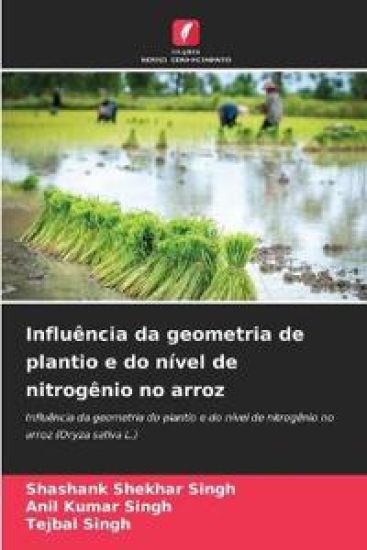
Influência da geometria de plantio e do nível de nitrogênio no arroz

Influência da geometria de plantio e do nível de nitrogênio no arroz

Shashank Shekhar Singh; Anil Kumar Singh; Tejbal Singh

Edicoes Nosso Conhecimento
2021
pokkari
Um experimento de campo foi conduzido sobre o tema "Influ ncia da geometria de plantio e n vel de nitrog nio no arroz (Oryza sativa L.)" durante duas esta es kharif consecutivas de 2017 e 2018 na Fazenda de Pesquisa Agron mica, Universidade de Agricultura e Tecnologia Narendra Deva, Narendra Nagar (Kumarganj), Ayodhya (U. P.) O experimento foi composto de dezesseis combina es de tratamento, ou seja, quatro geometrias de plantio e quatro n veis de nitrog nio no desenho de parcelas divididas. Quatro geometrias de plantio i.e. 15x10 cm, 15x15 cm, 20x10 cm e 20x15 cm foram mantidos em parcelas principais e quatro n veis de nitrog nio i.e. 0 kg N/ha, 60 kg/N ha, 120 kg N/ha e 180 kg/N ha foram mantidos em sub-parcelas. A experi ncia foi replicada tr s vezes. Como por exig ncia de pl ntulas, as sementes NDR-359 variedade de arroz foram usadas como por tratamento de geometria de plantio. A cultura foi uniformemente fertilizada com 60 kg P2O5, 40 kg K2O e nitrog nio como por tratamento. Os resultados revelam que a geometria de plantio de 20 10cm foi encontrada adequada para maiores atributos de rendimento e produ o de arroz. A aplica o de 120 kg de nitrog nio/ha foi considerada adequada para uma maior produ o de arroz. O efeito de intera o entre a geometria do plantio e o n vel de nitrog nio foi significativo nos gr os e na palha yi
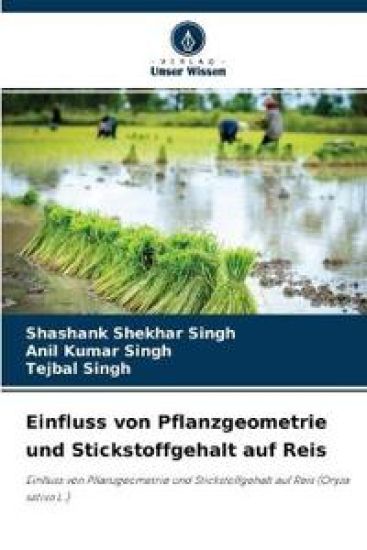
Einfluss von Pflanzgeometrie und Stickstoffgehalt auf Reis

Einfluss von Pflanzgeometrie und Stickstoffgehalt auf Reis

Shashank Shekhar Singh; Anil Kumar Singh; Tejbal Singh

Verlag Unser Wissen
2021
pokkari
Ein Feldversuch mit dem Titel "Einfluss der Pflanzgeometrie und des Stickstoffgehalts auf Reis (Oryza sativa L.)" wurde in zwei aufeinanderfolgenden Erntesaisons 2017 und 2018 auf der Agronomy Research Farm, Narendra Deva University of Agriculture and Technology, Narendra Nagar (Kumarganj), Ayodhya (U. P.) durchgef hrt. Der Versuch umfasste sechzehn Behandlungskombinationen, n mlich vier Pflanzgeometrien und vier Stickstoffgehalte in einem Split-Plot-Design. Vier Pflanzgeometrien, d.h. 15x10 cm, 15x15 cm, 20x10 cm und 20x15 cm, wurden in den Hauptparzellen und vier Stickstoffgehalte, d.h. 0 kg N/ha, 60 kg/N ha, 120 kg N/ha und 180 kg/N ha, in den Unterparzellen verwendet. Der Versuch wurde dreimal wiederholt. Je nach Bedarf an Setzlingen wurde Saatgut der Reissorte NDR-359 je nach Behandlung der Pflanzgeometrie verwendet. Die Ernte wurde gleichm ig mit 60 kg P2O5, 40 kg K2O und Stickstoff je nach Behandlung ged ngt. Die Ergebnisse zeigen, dass eine Pflanzgeometrie von 20 10 cm f r h here Ertragsattribute und Ertr ge von Reis geeignet war. Die Ausbringung von 120 kg Stickstoff/ha erwies sich als geeignet f r eine h here Produktion von Reis. Der Interaktionseffekt zwischen der Pflanzgeometrie und dem Stickstoffgehalt erwies sich als signifikant f r den Korn- und Strohertrag.
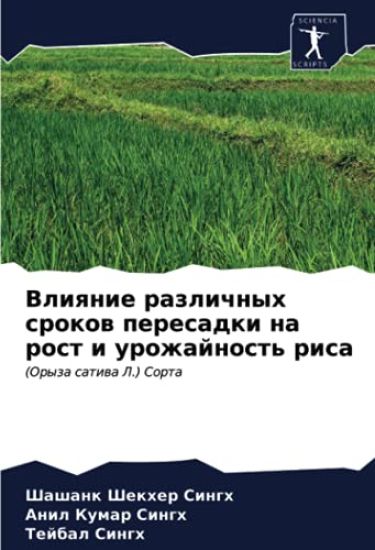
Effect of Different Date of Transplanting on Growth and Yield of Rice

Effect of Different Date of Transplanting on Growth and Yield of Rice

Shashank Shekher Singh; Anil Kumar Singh; Tejbal Singh

Lap Lambert Academic Publishing
2021
pokkari
The field experiment entitled "Effect of different date of transplanting on growth and yield of rice (Oryza sativa L.) varieties" was conducted at Agronomy Research Farm of Narendra Deva University of Agriculture & Technology, Narendra Nagar (Kumarganj), Faizabad, Uttar Pradesh during Kharif season of 2015 with an objective to find out suitable date of transplanting of rice, the treatment consisted of three transplanting date (15 July, 25 July and 5 August) and three varieties (Sarju-52, NDR-359 and Swarna) there were 9 treatment combinations. The values of growth contributing characters viz. plant height (cm), number of tillers, dry matter accumulation, leaf area index and yield attributes like number of panicles m-2, length of panicle (cm), number of panicle-1, grain weight panicle-1, grain and straw yield (q ha-1) were increasing significantly with 15 July date of transplanting followed by 25 July date of transplanting and significantly superior with 5 August date of transplanting.
Influence of planting geometry and nitrogen level on rice

Influence of planting geometry and nitrogen level on rice

Shashank Shekhar Singh; Anil Kumar Singh; Tejbal Singh

Lap Lambert Academic Publishing
2021
pokkari
A field experiment was conducted on the topic entitled "Influence of planting geometry and nitrogen level on rice (Oryza sativa L.)" during two consecutive kharif seasons of 2017 and 2018 at Agronomy Research Farm, Narendra Deva University of Agriculture and Technology, Narendra Nagar (Kumarganj), Ayodhya (U. P.) Experiment was comprised with sixteen treatment combinations viz. four planting geometry and four nitrogen levels in split plot design. Four planting geometry i.e. 15x10 cm, 15x15 cm, 20x10 cm and 20x15 cm were kept in main plots and four nitrogen levels i.e. 0 kg N/ha, 60 kg/N ha, 120 kg N/ha and 180 kg/N ha were kept in sub plots. The experiment was replicated three times. As per requirement of seedlings, seeds NDR-359 variety of rice was used as per treatment of planting geometry Crop was uniformly fertilized with 60 kg P2O5, 40 kg K2O and nitrogen as per treatments. Results reveal that planting geometry of 20 10cm was found suitable for higher yield attributes and yield of rice. Application of 120 kg nitrogen/ha was found suitable for higher production of rice.