Kirjojen hintavertailu – 12 859 826 kirjaa ja 27 kauppaa

Kirjailija

Terry A. Osborn

Kirjat ja teokset yhdessä paikassa: 14 kirjaa, julkaisuja vuosilta 2000–2025, suosituimpiin kuuluu Teaching World Languages in Middle and Secondary Schools. Vertaile teosten hintoja ja tarkista saatavuus suomalaisista kirjakaupoista.

Nimi esiintyy myös muodoissa: Terry a Osborn

14 kirjaa

Kirjojen julkaisuvuodet: 2000–2025.

Teaching World Languages in Middle and Secondary Schools

Teaching World Languages in Middle and Secondary Schools

Timothy Reagan; Terry A. Osborn

Emerald Publishing Limited
2025
sidottu
Teaching World Languages in Middle and Secondary Schools: A Critical Introduction is an introductory textbook for teacher education candidates, at either the undergraduate or graduate levels, who are seeking certification to teach a world/foreign language. It might also be used as a methods textbook in programs preparing teachers to work with English Language Learners (ELLs) in public school contexts. There is a growing shortage of world language teachers in the United States, and the market for such educators is likely to increase dramatically in the years ahead. Currently, only about 20% of US students study a language other than English, although this may change if more individuals are prepared to teach world languages. This book stands out from most world language education methodology books by combining ideas, concepts, and practices from two traditions in the world language education literature that rarely overlap: the technical skills and knowledge needed to be an effective and competent classroom teacher, and the growing literature on critical pedagogy in the specific context of world language education.
Teaching World Languages in Middle and Secondary Schools

Teaching World Languages in Middle and Secondary Schools

Timothy Reagan; Terry A. Osborn

Emerald Publishing Limited
2025
nidottu
Teaching World Languages in Middle and Secondary Schools: A Critical Introduction is an introductory textbook for teacher education candidates, at either the undergraduate or graduate levels, who are seeking certification to teach a world/foreign language. It might also be used as a methods textbook in programs preparing teachers to work with English Language Learners (ELLs) in public school contexts. There is a growing shortage of world language teachers in the United States, and the market for such educators is likely to increase dramatically in the years ahead. Currently, only about 20% of US students study a language other than English, although this may change if more individuals are prepared to teach world languages. This book stands out from most world language education methodology books by combining ideas, concepts, and practices from two traditions in the world language education literature that rarely overlap: the technical skills and knowledge needed to be an effective and competent classroom teacher, and the growing literature on critical pedagogy in the specific context of world language education.

Moving Forward

Moving Forward

Joy Bird Osborn; Terry a Osborn

Lulu.com
2025
pokkari
Moving Forward: A Christian Study for Survivors of Suicide Loss Second Edition is written with deep compassion for those who have lost a loved one to suicide. Its authors are Christians who have personal experiences and insights as loss survivors. This book offers the unique perspective of a Christian worldview on suicide and hope in the midst of grief following the trauma of losing a loved one in this way, and has been updated with new insights gleaned from years of working with suicide loss survivors.
Questions Christians have about Suicide

Questions Christians have about Suicide

Joy Bird Osborn; Terry a Osborn

Lulu.com
2023
pokkari
Questions Christians have about Suicide is a concise and compassionate book that addresses the numerous questions Christians may have after experiencing the loss of a loved one to suicide. From understanding the reasons behind the tragic choice to the spiritual and emotional struggles that follow, this guide offers clear answers and practical advice from a Christian perspective. It covers a wide range of topics, including dealing with grief, handling the practicalities of funeral arrangements, explaining suicide to children, and finding support within the church community. It also includes a section with guidance for clergy. With sensitivity and biblical perspective, this guide serves as a valuable resource for those seeking comfort and understanding during their own journey of healing and recovery as well as for those who support them. This work is a publication of Christian Association for Survivors of Suicide Loss, Inc., a 501(c)3 charity supporting those whose loved one who died by suicide. For more information, visit www.suicideloss.org.
The Art and Science of Teaching

The Art and Science of Teaching

Timothy J Reagan; Terry A Osborn

Kendall/Hunt Publishing Co ,U.S.
2021
nidottu
The Art and Science of Teaching provides students with a broad introduction to teaching and education in contemporary U. S. society. The book includes chapters that address such issues as:The Purposes of Public SchoolingThe Legal and Organizational Foundations of Public SchoolingThe Epistemology of Education and Learning TheoriesSchooling, Education, and the Educated PersonCurriculum and InstructionPhilosophy of Education and Reflective PracticeCulture, Cultural Diversity, and SchoolingRace and Racism in SchoolingReligion and Religious Diversity in U. S. SocietyThe Ideals of Democratic EducationThis book, written by two experienced teachers and teacher educators, will be of value for both students who intend to become teachers themselves and for anyone who will be a future parent or citizen and wishes to better understand the American educational system.
World Language Education as Critical Pedagogy

World Language Education as Critical Pedagogy

Timothy G. Reagan; Terry A. Osborn

Routledge
2020
nidottu
Accessible and cutting-edge, this text is a pivotal update to the field and offers a much-needed critical perspective on world language education. Building off their classic 2002 book, The Foreign Language Educator in Society, Timothy G. Reagan and Terry A. Osborn address major issues facing the world language educator today, including language myths, advocacy, the perceived and real benefits of language learning, linguistic human rights, constructivism, learning theories, language standards, monolingualism, bilingualism and multiculturalism. Organized into three parts – "Knowing Language," "Learning Language," and "Teaching Language" – this book applies a critical take on conventional wisdom on language education, evaluates social and political realities, assumptions, and controversies in the field. Each chapter includes questions for reflection and discussion to support students and educators in developing their own perspectives on teaching and learning languages. With a critical pedagogy and social justice lens, this book is ideal for scholars and students in foreign/world language education, social justice education, and language teaching methodology courses, as well as pre- and in-service teachers.
World Language Education as Critical Pedagogy

World Language Education as Critical Pedagogy

Timothy G. Reagan; Terry A. Osborn

Routledge
2020
sidottu
Accessible and cutting-edge, this text is a pivotal update to the field and offers a much-needed critical perspective on world language education. Building off their classic 2002 book, The Foreign Language Educator in Society, Timothy G. Reagan and Terry A. Osborn address major issues facing the world language educator today, including language myths, advocacy, the perceived and real benefits of language learning, linguistic human rights, constructivism, learning theories, language standards, monolingualism, bilingualism and multiculturalism. Organized into three parts – "Knowing Language," "Learning Language," and "Teaching Language" – this book applies a critical take on conventional wisdom on language education, evaluates social and political realities, assumptions, and controversies in the field. Each chapter includes questions for reflection and discussion to support students and educators in developing their own perspectives on teaching and learning languages. With a critical pedagogy and social justice lens, this book is ideal for scholars and students in foreign/world language education, social justice education, and language teaching methodology courses, as well as pre- and in-service teachers.
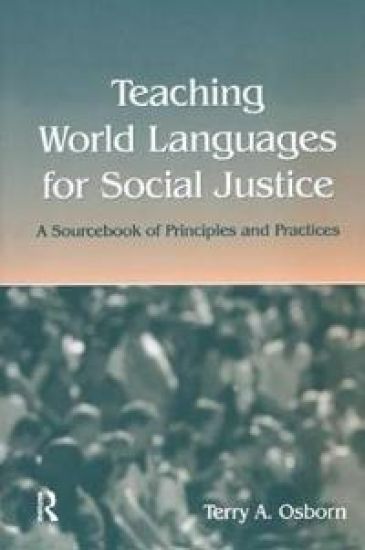
Teaching World Languages for Social Justice
Teaching World Languages for Social Justice: A Sourcebook of Principles and Practices offers principles based on theory, and innovative concepts, approaches, and practices illustrated through concrete examples, for promoting social justice and developing a critical praxis in foreign language classrooms in the U. S. and in wider world language communities. For educators seeking to translate these ideals into classroom practice in an environment dominated by the current standards movement and accountability measures, the critical insights on language education offered in this text will be widely welcomed. The text is designed as a sourcebook for translating theory into practice. Each chapter includes the theoretical base, guidelines for practice, discussion of the relationship to existing practices in the world language classroom, suggestions for activity development (which can be integrated into a professional portfolio), illustrative examples, questions for reflection, and additional suggested readings. Teaching World Languages for Social Justice is a primary or supplementary text for second and foreign language teaching methods courses and is equally appropriate for graduate courses in language education or educational studies.
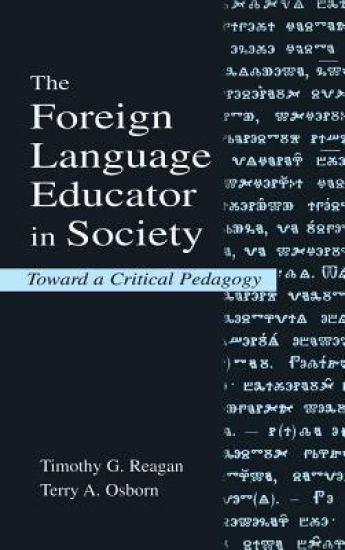
The Foreign Language Educator in Society

The Foreign Language Educator in Society

Timothy G. Reagan; Terry A. Osborn

Routledge
2016
sidottu
This text brings together two significant domains of educational practice: foreign language education and critical pedagogy--linking them in a way that can help foreign language educators develop a critical awareness of the nature, purposes, and challenges facing foreign language pedagogy. Unique among texts in the field, this is the first to deal explicitly with the social, political, ideological, and economic aspects of language, language learning, and language teaching in our society and to connect the practice of foreign language education with these critical, and crucial, aspects of language and language use. The Foreign Language Educator in Society: Toward A Critical Pedagogy: *emphasizes what teachers and future teachers of foreign languages in this country ought to know and understand about language-- language attitudes, practices, rights, and policy-- and related issues; *focuses on helping students to move beyond pragmatic pedagogical concerns to the social and political concerns relevant to their teaching; and *provides students with the opportunity to develop critical perspectives on the central facets of the language education process. Intended for foreign language education programs at both basic and advanced levels, as well as courses in critical pedagogy, critical language awareness, sociolinguistics, and social and cultural foundations of education, the text provides helpful pedagogical features to direct the reader in applying the content of each chapter to his or her own context.
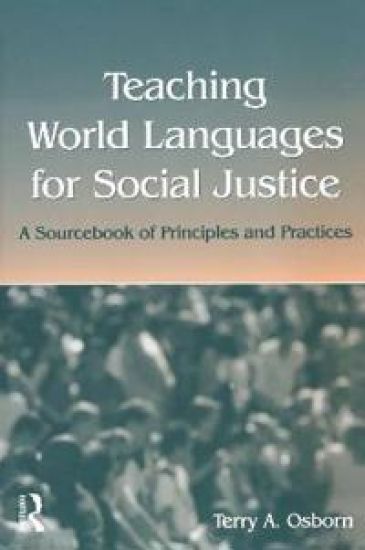
Teaching World Languages for Social Justice

Teaching World Languages for Social Justice

Terry A. Osborn

Routledge Member of the Taylor and Francis Group
2005
nidottu
Teaching World Languages for Social Justice: A Sourcebook of Principles and Practices offers principles based on theory, and innovative concepts, approaches, and practices illustrated through concrete examples, for promoting social justice and developing a critical praxis in foreign language classrooms in the U. S. and in wider world language communities. For educators seeking to translate these ideals into classroom practice in an environment dominated by the current standards movement and accountability measures, the critical insights on language education offered in this text will be widely welcomed. The text is designed as a sourcebook for translating theory into practice. Each chapter includes the theoretical base, guidelines for practice, discussion of the relationship to existing practices in the world language classroom, suggestions for activity development (which can be integrated into a professional portfolio), illustrative examples, questions for reflection, and additional suggested readings. Teaching World Languages for Social Justice is a primary or supplementary text for second and foreign language teaching methods courses and is equally appropriate for graduate courses in language education or educational studies.
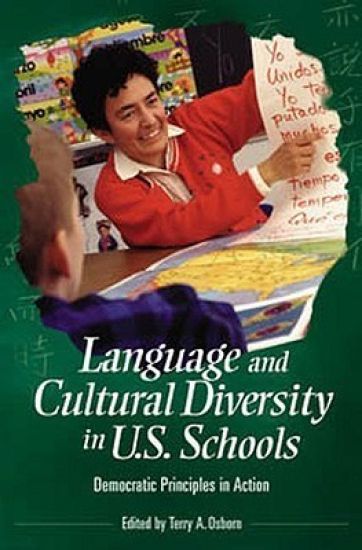
Language and Cultural Diversity in U.S. Schools

Language and Cultural Diversity in U.S. Schools

Terry A. Osborn

Praeger Publishers Inc
2005
sidottu
Diversity is at the heart of today's education debates. Often, school policies and programs designed to encourage and embrace diversity are met with public ire and a deep misunderstanding of how diversity serves learning. This work explains how diversity is an essential element in classroom settings. As children from around the world continue to pour into U. S. classrooms, an understanding of cultural and linguistic diversity in its broadest sense moves to the foreground. In a post 9/11 world, the benefits of understanding diversity take on urgent meaning. The introdutory chapter, Participating in Democracy Means Participating in Schools, sets the tone for the discussion to follow. As the geographic backgrounds of immigrants becomes increasingly diverse, religion must be added to previous discussions of race, ethnicity, and language. Thus, the need for the public to understand how shifts in population affect schools, makes this work a vital resource for anyone concerned with education today.
The Future of Foreign Language Education in the United States
At the dawning of the 21st century, foreign language education in the United States is experiencing a period marked by exciting possibilities. Theorists and practitioners embrace a move from a perceived position of teaching only the elite to a nationally initiated cross-disciplinary and cross-cultural orientation embodied in the latest standards. Given the presence of non-English languages in all parts of the United States, a growing number of scholars are beginning to examine the sociological context in which this educational endeavor is carried out, noting that the figure of professional practice is inextricably linked to issues of cultural and academic context. Theory-informed practice in the coming years, therefore, will include the challenge of examining a broad range of topics related to curricular and instructional principles and procedures. The text is intended to provide a collection of perspectives related to issues of pluralism and reform as they will influence theory-informed practice of foreign language education in the coming century. Drawing from a variety of contributors from both inside and outside of foreign/second language education, this text brings the voices of scholars together focused on issues of contemporary consequence. The chapters center around a focusing theme in the form of the following question: How does the changing social and academic context of language education in the United States impact the future of our discipline?
The Foreign Language Educator in Society

The Foreign Language Educator in Society

Timothy G. Reagan; Terry A. Osborn

Routledge Member of the Taylor and Francis Group
2001
nidottu
This text brings together two significant domains of educational practice: foreign language education and critical pedagogy--linking them in a way that can help foreign language educators develop a critical awareness of the nature, purposes, and challenges facing foreign language pedagogy. Unique among texts in the field, this is the first to deal explicitly with the social, political, ideological, and economic aspects of language, language learning, and language teaching in our society and to connect the practice of foreign language education with these critical, and crucial, aspects of language and language use. The Foreign Language Educator in Society: Toward A Critical Pedagogy: *emphasizes what teachers and future teachers of foreign languages in this country ought to know and understand about language-- language attitudes, practices, rights, and policy-- and related issues; *focuses on helping students to move beyond pragmatic pedagogical concerns to the social and political concerns relevant to their teaching; and *provides students with the opportunity to develop critical perspectives on the central facets of the language education process. Intended for foreign language education programs at both basic and advanced levels, as well as courses in critical pedagogy, critical language awareness, sociolinguistics, and social and cultural foundations of education, the text provides helpful pedagogical features to direct the reader in applying the content of each chapter to his or her own context.
Critical Reflection and the Foreign Language Classroom

Critical Reflection and the Foreign Language Classroom

Terry A. Osborn

Praeger Publishers Inc
2000
sidottu
This book introduces pre-service and in-service foreign language teachers to the basic concepts of critical educational study as applied to the sociological position occupied by foreign language education in the United States. Although contemporary foreign language teachers typically know about second language acquisition and instructional methodology, they are not prepared to understand issues of power in relation to, for example, language variety, language status, and education. The author addresses issues such as the supposed failure of foreign language education, the educational filter role played by language classes, the concept of foreignness as seen in national standards, language curricula and textbooks, and the implications of these issues in terms of power relationships and cultural mediation both in and out of the classroom. The reader is encouraged to analyze the forms of cultural struggle which can be found within the foreign language classrooms of the United States including the likely impact those struggles have on members of the dominant and subordinate cultures. Teachers are led through the development of skills in critical reflection and pedagogical application geared to social justice.