

Kirjailija
Terry Thomas
Kirjat ja teokset yhdessä paikassa: 25 kirjaa, julkaisuja vuosilta 1995–2026, suosituimpiin kuuluu The Science of Marking. Vertaile teosten hintoja ja tarkista saatavuus suomalaisista kirjakaupoista.
25 kirjaa
Kirjojen julkaisuvuodet: 1995–2026.


The Sex Offender Register examines the origins, history, structure and legalities of the UK sex offender register, and explores how political and public opinion has influenced the direction the policy of registration has taken. Delving into the origins of the UK sex offender register and how the registration policy has evolved, this book provides an understanding of the register and its contribution to public protection while attempting to see the register as a policy that has grown and developed and as having an organic life of its own. The sex offender register is designed as a form of public protection rather than a punishment, requiring offenders to notify the police of their circumstances and to accept a degree of offender management from the police. The book: • puts the development of the register in its political, social and ethical context • considers the position of children and young people as offenders• outlines the movement of registered offenders across international borders• analyses how offenders can be removed from the register• explores how other countries in the UK manage sex offenders through registers • asks questions about the efficacy of the register and what contribution it makes to public protection• looks at specific aspects of registration including the management of information • delves into the experience of life on the register• examines the influence of public opinion • discusses the role of the police as custodians of the register and as offender managers. Exploring the different pressures brought to bear on the register, this book provides an authoritative starting point for police officers, social workers, probation officers, magistrates, students of Criminology, Criminal Justice and Policing, and the general reader wanting to understand where the UK sex offender register originated from and how it operates today.

The Sex Offender Register examines the origins, history, structure and legalities of the UK sex offender register, and explores how political and public opinion has influenced the direction the policy of registration has taken. Delving into the origins of the UK sex offender register and how the registration policy has evolved, this book provides an understanding of the register and its contribution to public protection while attempting to see the register as a policy that has grown and developed and as having an organic life of its own. The sex offender register is designed as a form of public protection rather than a punishment, requiring offenders to notify the police of their circumstances and to accept a degree of offender management from the police. The book: • puts the development of the register in its political, social and ethical context • considers the position of children and young people as offenders• outlines the movement of registered offenders across international borders• analyses how offenders can be removed from the register• explores how other countries in the UK manage sex offenders through registers • asks questions about the efficacy of the register and what contribution it makes to public protection• looks at specific aspects of registration including the management of information • delves into the experience of life on the register• examines the influence of public opinion • discusses the role of the police as custodians of the register and as offender managers. Exploring the different pressures brought to bear on the register, this book provides an authoritative starting point for police officers, social workers, probation officers, magistrates, students of Criminology, Criminal Justice and Policing, and the general reader wanting to understand where the UK sex offender register originated from and how it operates today.



Terry returned from Saudi Arabia in the May of 1978 after a year in the Kingdom, with a spring in his step and over flowing with enthusiasm, feeling that he could secure a job using the experience he had gained during his time in operations engineering in the Eastern Province of Saudi. Having cut his teeth in a demanding environment and coming out the other end full of ambition to move on in the Petroleum industry and how soon he was to discover it was not to be as easy as he first thought. Experiencing an educational system of the 50's and the inadequacies of that system made Terry realise at an early age that things don't come simple and if you really want something then you had better be prepared to work hard to get it. Coming back from Saudi Arabia after soaking up so much experience in the petroleum industry he expected to walk into employment without any problems. When that was not the case, it was like another wakeup call and reasserted what Terry had previously experienced, that nothing comes without an inner drive from yourself to make it happen. Originally his wife and himself had agreed that he would work in Saudi Arabia for two years but at the end of the first year and in the fifth week of his six weeks leave period after which Terry was supposed to return, they realised that neither relished the idea of being apart from each other and Terry being away from his family for another year. He was only too willing to agree that he needed to seek work nearer home and so the search began in July 1978. After many interviews and rejected contracts he finally found his dream job in the North Sea Petroleum industry and his career takes off with an engineering construction company he remained with for over thirty years. The book tells of the projects and people he was engaged with including many adventures and events that transpired over the span of his career.

Terry returned from Saudi Arabia in the May of 1978 after a year in the Kingdom, with a spring in his step and over flowing with enthusiasm, feeling that he could secure a job using the experience he had gained during his time in operations engineering in the Eastern Province of Saudi. Having cut his teeth in a demanding environment and coming out the other end full of ambition to move on in the Petroleum industry and how soon he was to discover it was not to be as easy as he first thought. Experiencing an educational system of the 50's and the inadequacies of that system made Terry realise at an early age that things don't come simple and if you really want something then you had better be prepared to work hard to get it. Coming back from Saudi Arabia after soaking up so much experience in the petroleum industry he expected to walk into employment without any problems. When that was not the case, it was like another wakeup call and reasserted what Terry had previously experienced, that nothing comes without an inner drive from yourself to make it happen. Originally his wife and himself had agreed that he would work in Saudi Arabia for two years but at the end of the first year and in the fifth week of his six weeks leave period after which Terry was supposed to return, they realised that neither relished the idea of being apart from each other and Terry being away from his family for another year. He was only too willing to agree that he needed to seek work nearer home and so the search began in July 1978. After many interviews and rejected contracts he finally found his dream job in the North Sea Petroleum industry and his career takes off with an engineering construction company he remained with for over thirty years. The book tells of the projects and people he was engaged with including many adventures and events that transpired over the span of his career.
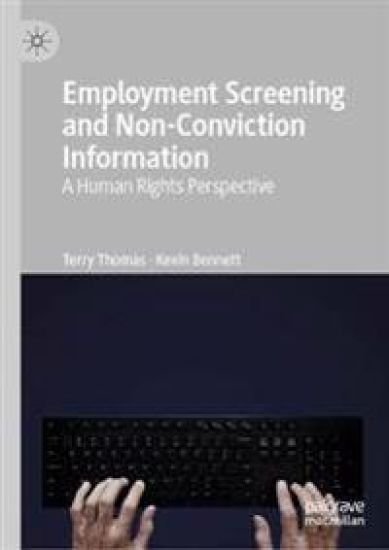
Employment Screening and Non-Conviction Information
Terry Thomas; Kevin Bennett
Springer Nature Switzerland AG
2019
sidottu
This book provides a critical overview of the policy frameworks underpinning the contemporary practices of non-conviction information disclosure during pre-employment ‘screening’. It questions how a man can walk free from a criminal court as an innocent person only to have all the court details of his acquittal passed to any potential employer. Despite several million ‘enhanced’ criminal background checks being performed each year, there has been little discussion of these issues within academic literature. Non-conviction information, also known as 'police intelligence', is a less well-known check provided alongside the criminal record check. This book seeks to define what is meant by non-conviction information and to provide a clear and simple explanation of how this decision making process of police disclosure to employers is made. It also considers the extent to which these practices have been subjected to legal challenges within the UK and explores how public protection is balancedagainst individual rights.


Circles of Support and Accountability is a voluntary initiative that assists people with convictions for sexual offences to resettle in the community. People leaving prison with such convictions often have difficulties in resettling. They carry the burden of the conviction itself, which may be both stigmatising and isolating, and they are the subject of sex offender register requirements, parole and other supervisory conditions. Circles of Support and Accountability in the UK started over ten years ago and have slowly spread across the country. They work closely with the police and probation services but rely entirely on volunteers prepared to give up their time to work with people often otherwise shunned by communities. Circles offer support to the person concerned but also hold them accountable for their future behaviour. They aim to ensure there are ‘no more victims’. This book is based on original research and provides a close-up picture of how these Circles of Support and Accountability work in practice. It brings together for the first time the voices of all the participants, from the offenders and the volunteers through to the Coordinators who link the volunteers to the professionals in the form of the police and probation services. The research was commissioned by Circles UK and funded by the Wates Foundation and the University of Leeds, School of Law.

Like many other young married couples in the 1970s who were struggling to make a better future for their family Life in the Sandpit outlines my personal tale to improve my familys lifestyle. My wife Jean and I had to make some hard decisions if we were to achieve our goal. Having secured a job in the petroleum industry working in The Kingdom of Saudi Arabia my adventure began. I, as well as my wife, were both apprehensive and yet excited at the same time, of the prospect of my living and working in another country. The downside being I would be going alone leaving my wife, my eight years old daughter Nicola and my six years old son David behind. The trials and tribulations of educating myself, not only in the technical aspects of my role, but also in adapting to a totally different culture was a big challenge. I was to meet many people on my journey and experience many, at times frightening, events, but all adding to my lifes tapestry. At the age of 31 years and going to work in a developing country, I was to witness many changes as the oil wealth was being used to improve the infrastructure of Saudi Arabia. During the period of my time in the Kingdom of Saudi between May 1977 and May 1978 there were major projects just starting and I in my tale I reflect on the part I played in the early stages of development. But for me it was the engagement with the people I met and worked with that produced the main adventure. The year I spent in Saudi was to shape my life in a most wonderful way.

Like many other young married couples in the 1970s who were struggling to make a better future for their family Life in the Sandpit outlines my personal tale to improve my familys lifestyle. My wife Jean and I had to make some hard decisions if we were to achieve our goal. Having secured a job in the petroleum industry working in The Kingdom of Saudi Arabia my adventure began. I, as well as my wife, were both apprehensive and yet excited at the same time, of the prospect of my living and working in another country. The downside being I would be going alone leaving my wife, my eight years old daughter Nicola and my six years old son David behind. The trials and tribulations of educating myself, not only in the technical aspects of my role, but also in adapting to a totally different culture was a big challenge. I was to meet many people on my journey and experience many, at times frightening, events, but all adding to my lifes tapestry. At the age of 31 years and going to work in a developing country, I was to witness many changes as the oil wealth was being used to improve the infrastructure of Saudi Arabia. During the period of my time in the Kingdom of Saudi between May 1977 and May 1978 there were major projects just starting and I in my tale I reflect on the part I played in the early stages of development. But for me it was the engagement with the people I met and worked with that produced the main adventure. The year I spent in Saudi was to shape my life in a most wonderful way.

Privacy and Criminal Justice
Daniel Marshall; Terry Thomas
Springer International Publishing AG
2018
nidottu
This book offers a comparison of the differences between the ‘public’ and ‘private’ spheres, and questions the need for law enforcement to intrude upon both. Beginning with the origins of the concept of privacy, before addressing more current thinking, the authors examine the notion of privacy and policing, using both direct (e.g. 'stop and search' methods) and technological interventions (e.g. telephone interceptions and Automatic Number Plate Recognition cameras), privacy in the space of the court, looking at what restrictions are placed on press reporting, as well as considering whether the open court ensures fair trials. Particular forms of offending and privacy are also considered: anonymity for sexual offence defendants, for example, or weighing the terrorist’s right to privacy against the safety and security of the general public. A timely discussion into the right to privacy in prison and during community sentences is also included, and Marshall and Thomas offer convin cing analysis on the importance of rehabilitation, giving consideration to police registers and the storage and maintenance of criminal records by the police and their possible future use. A diverse investigation into the many facets of privacy, this volume will hold broad appeal for scholars and students of terrorism, security, and human rights.

Privacy and Criminal Justice
Terry Thomas; Daniel Marshall
Springer International Publishing AG
2017
sidottu
This book offers a comparison of the differences between the ‘public’ and ‘private’ spheres, and questions the need for law enforcement to intrude upon both. Beginning with the origins of the concept of privacy, before addressing more current thinking, the authors examine the notion of privacy and policing, using both direct (e.g. 'stop and search' methods) and technological interventions (e.g. telephone interceptions and Automatic Number Plate Recognition cameras), privacy in the space of the court, looking at what restrictions are placed on press reporting, as well as considering whether the open court ensures fair trials. Particular forms of offending and privacy are also considered: anonymity for sexual offence defendants, for example, or weighing the terrorist’s right to privacy against the safety and security of the general public. A timely discussion into the right to privacy in prison and during community sentences is also included, and Marshall and Thomas offer convin cing analysis on the importance of rehabilitation, giving consideration to police registers and the storage and maintenance of criminal records by the police and their possible future use. A diverse investigation into the many facets of privacy, this volume will hold broad appeal for scholars and students of terrorism, security, and human rights.
Circles of Support and Accountability is a voluntary initiative that assists people with convictions for sexual offences to resettle in the community. People leaving prison with such convictions often have difficulties in resettling. They carry the burden of the conviction itself, which may be both stigmatising and isolating, and they are the subject of sex offender register requirements, parole and other supervisory conditions. Circles of Support and Accountability in the UK started over ten years ago and have slowly spread across the country. They work closely with the police and probation services but rely entirely on volunteers prepared to give up their time to work with people often otherwise shunned by communities. Circles offer support to the person concerned but also hold them accountable for their future behaviour. They aim to ensure there are ‘no more victims’. This book is based on original research and provides a close-up picture of how these Circles of Support and Accountability work in practice. It brings together for the first time the voices of all the participants, from the offenders and the volunteers through to the Coordinators who link the volunteers to the professionals in the form of the police and probation services. The research was commissioned by Circles UK and funded by the Wates Foundation and the University of Leeds, School of Law.

The "How-to" Guide on Becoming a Certified Nursing Assistant: Find a School, Pay for Training, Prepare for the Exam, Get a Job, Jump-start Your Career
Terry Thomas; Sheilah Mara
Cloud City Creative Publishing
2016
nidottu
If you have ever thought about a career in healthcare, and specifically as a Certified Nursing Assistant, then this book is what you will need to set you on the path to realizing your career goals. The "How-to" Guide on Becoming a Certified Nursing Assistant gives detailed answers to a wide range of questions. It is ideal for those who -Are interested in a career as a certified nursing assistant -Are inexperienced in the field of healthcare -Want affordable training -Want to know about employment opportunities -Want an easy step-by-step process to follow Almost everyone who wants to enter this profession could use some assistance along the way to becoming a CNA, and The "How-to" Guide on Becoming a Certified Nursing Assistant will provide exactly that, along with: -Understanding what a CNA does -Appreciating how jobs for CNAs differ from similar occupations in the healthcare sector -Determining if your personality traits align with other CNAs -How to select the training program appropriate for your needs -What to expect from training -Eligibility requirements -Ways to pay for training (and even get it free) -An insight into the competency exam process and tips on how to prepare -Tips on getting a job and how to keep it. The "How-to" Guide on Becoming a Certified Nursing Assistant is the last word in the pursuit of a CNA certification, and with handy links to state resources, you can use it as a reference long after you have passed the exam and have landed your first job. Read the book and gain the confidence you need to jump start your CNA career today.
Sexual offending has become a mainstay item of reporting in our daily newspapers, and television news bulletins. This book offers an account of the policing of sexual offences and the difficulties that confront the police in the investigation of these intrusive crimes. It surveys the breath of sexual offences and examines the reporting of sexual crime and the attrition level that follows. It proceeds by critically assessing the efforts the police are making to overcome these difficulties and the degree to which they are making progress. The book outlines the relatively new police role of policing the convicted sex offenders themselves, who are living in the community and are subject to risk 'management' by the police and the requirements of the sex offender register held by the police. Written by a leading expert, this timely book will be of great interest to scholars of sexual offending and criminal justice.

Sex Crime, Third edition offers a comprehensive and integrative introduction to sex crime, written by an expert in the field. The third edition has been fully expanded and updated to include further coverage of a range of critical topics, including child sexual exploitation, child pornography, female sex offenders, treatment approaches such as the ‘Good Lives Model’ and the European Convention on Human Rights. Delving into and beyond the news headlines about sexual crimes that seem to appear on our screens and in our newspapers almost every day, this third edition draws on a range of high profile case studies, such as Vanessa George, Stuart Hall, Jimmy Savile and Operation Yewtree and also offers a review of all relevant legislation. This new edition also includes an analysis of possible causes of sex offending, as well as public and professional responses to sex crime. Including an examination of the policing of sexual crime; the prosecution of the accused; the sentencing and punishment of sexual offenders; and ‘public protection’ measures, this new edition covers all of the key aspects of sex crime and how it is dealt with. Wide-ranging and authoritative, Sex Crime, Third edition presents a complex area in a straightforward and understandable manner. Thomas guides the reader through the range of policies and law which have accumulated over the years, making this essential reading for academics and students engaged in the study of sex crime, sexual violence and the treatment of sex offenders. It will also be of great interest to criminal justice practitioners.