Kirjailija
Thaddeus Metz
Kirjat ja teokset yhdessä paikassa: 11 kirjaa, julkaisuja vuosilta 2013–2026, suosituimpiin kuuluu A Relational Theory of Justice. Vertaile teosten hintoja ja tarkista saatavuus suomalaisista kirjakaupoista.
11 kirjaa
Kirjojen julkaisuvuodet: 2013–2026.
A Relational Theory of Justice argues that normative economic, political, and legal philosophy should be grounded on people's relational features, in particular their ability to commune with others and be communed with by them. Usually, philosophers of justice in the West have based their views on people's intrinsic features, ones that make no essential reference to others, such as their well-being, autonomy, or self-ownership. In addition, critics of basing institutional choice on justice--whether in the African, feminist, Marxian, or Confucian traditions--have often appealed to non-intrinsic values. In contrast, this book articulates and defends accounts of justice based on the dignity of people's relational nature. A proper valuation of people's capacity to be party to communal relationships does not transcend categories of justice, but instead calls for sorts that differ in plausible ways from those grounded on intrinsic properties. Applications are discussed in the contexts of distributive, compensatory, criminal, transitional, and global justice. Together, they are intended to constitute a big picture of communal governance that rivals the grand comprehensive philosophies of, for example, utilitarianism, Rawlsianism, Lockean natural rights theory, and the capabilities approach.
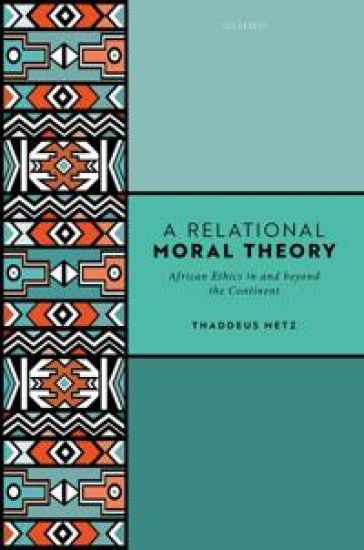
A Relational Moral Theory
Thaddeus Metz
Oxford University Press
2025
nidottu
Halvin toimitettuna 46,90 €
A Relational Moral Theory draws on neglected resources from the Global South and especially the African philosophical tradition to provide a new answer to a perennial philosophical question: what do all morally right actions have in common as distinct from wrong ones? Thaddeus Metz points out that the principles of utility and of respect for autonomy, the two rivals that have dominated Western moral theory for the last two centuries, share an individualist premise. Once that common assumption is replaced by a relational perspective given prominence in African ethical thought, a different comprehensive principle, one focused on harmony or friendliness, emerges. Metz argues that this principle corrects the blind spots of the Western moral principles, and has implications for a wide array of controversies in applied ethics that an international audience of moral philosophers, professional ethicists, and similar thinkers will find compelling.
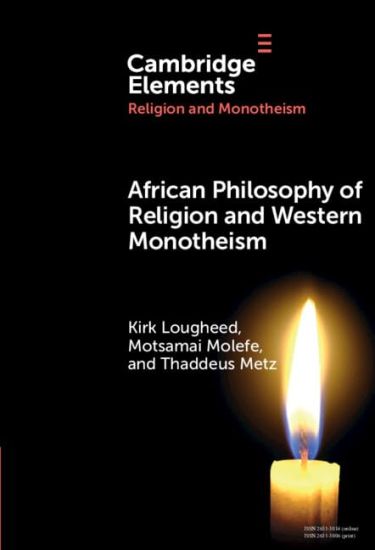
African Philosophy of Religion and Western Monotheism
Kirk Lougheed; Motsamai Molefe; Thaddeus Metz
Cambridge University Press
2024
sidottu
The Abrahamic faiths of Christianity, Judaism, and Islam are typically recognized as the world's major monotheistic religions. However, African Traditional Religion is, despite often including lesser spirits and gods, a monotheistic religion with numerous adherents in sub-Saharan Africa; it includes the idea of a single most powerful God responsible for the creation and sustenance of everything else. This Element focuses on drawing attention to this major world religion that has been much neglected by scholars around the globe, particularly those working in the West or Northern Hemisphere. It accomplishes this primarily by bringing it into conversation with topics in the Anglo-American philosophy of religion.
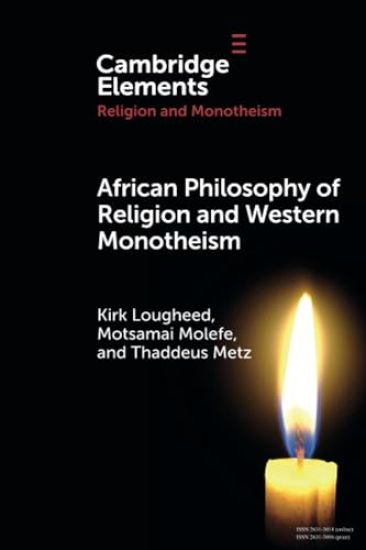
African Philosophy of Religion and Western Monotheism
Kirk Lougheed; Motsamai Molefe; Thaddeus Metz
Cambridge University Press
2024
pokkari
The Abrahamic faiths of Christianity, Judaism, and Islam are typically recognized as the world's major monotheistic religions. However, African Traditional Religion is, despite often including lesser spirits and gods, a monotheistic religion with numerous adherents in sub-Saharan Africa; it includes the idea of a single most powerful God responsible for the creation and sustenance of everything else. This Element focuses on drawing attention to this major world religion that has been much neglected by scholars around the globe, particularly those working in the West or Northern Hemisphere. It accomplishes this primarily by bringing it into conversation with topics in the Anglo-American philosophy of religion.
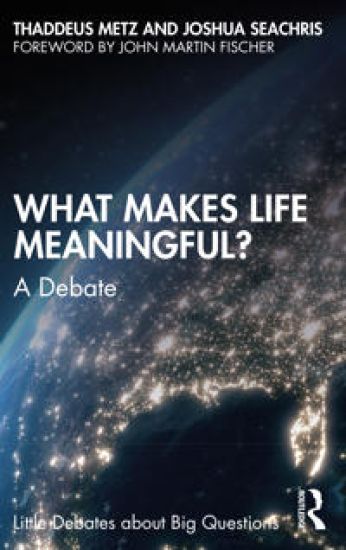
Can human life be meaningful? What does talk about life’s meaning even mean? What is God’s role, if any, in a meaningful life? These three questions frame this one-of-a-kind debate between two philosophers who have spent most of their professional lives thinking and writing about the topic of life’s meaning. In this wide-ranging scholarly conversation, Professors Thaddeus Metz and Joshua W. Seachris develop and defend their own unique answers to these questions, while responding to each other’s objections in a lively dialog format. Seachris argues that the concept of life’s meaning largely revolves around three interconnected ideas—mattering, purpose, and sense-making; that a meaningful human life involves sufficiently manifesting all three; and that God would importantly enhance the meaningfulness of life on each of these three fronts. Metz instead holds that talk of life’s meaning is about a variety of properties such as meriting pride, transcending one’s animal self, making a contribution, and authoring a life-story. For him, many lives are meaningful insofar as they exercise intelligence in positive, robust, and developmental ways. Finally, Metz argues that God is unnecessary for an objective meaning that suits human nature. Metz and Seachris develop and defend their own unique answers to these three questions, while responding to each other’s objections in a dialog format that is accessible to students though—given their new contributions—will be of great interest to scholars as well. Key Features Offers an up-to-date scholarly conversation on life’s meaning by two researchers at the forefront of research on the topic. Provides a wide-ranging, yet orderly discussion of the most important issues. Accessible for the student investigating the topic for the first time yet also valuable to the scholar working on life’s meaning. Includes helpful pedagogical features, like:- Chapter outlines and introductions;- Annotated reading lists for both students and research-level readers;- A glossary; and- Clear examples, thought experiments, narratives, and cultural references, which enhance the book’s role in thinking about life’s meaning and related topics.
A Relational Moral Theory draws on neglected resources from the Global South and especially the African philosophical tradition to provide a new answer to a perennial philosophical question: what do all morally right actions have in common as distinct from wrong ones? Metz points out that the principles of utility and of respect for autonomy, the two rivals that have dominated western moral theory for the last two centuries, share an individualist premise. Once that common assumption is replaced by a relational perspective given prominence in African ethical thought, a different comprehensive principle, one focused on harmony or friendliness, emerges. Metz argues that this principle corrects the blind spots of the western moral principles, and has implications for a wide array of controversies in applied ethics that an international audience of moral philosophers, professional ethicists, and similar thinkers will find compelling.
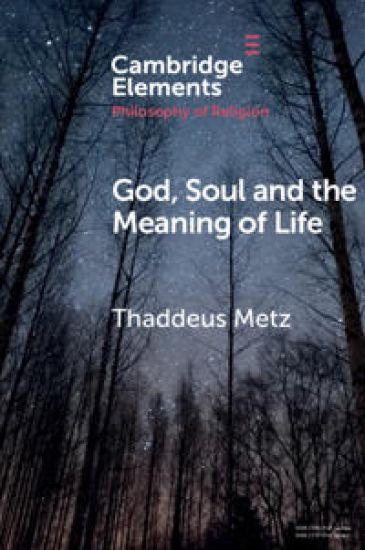
This Element critically explores the potential relevance of God or a soul for life's meaning as discussed in recent Anglo-American philosophical literature. There have been four broad views: God or a soul is necessary for meaning in our lives; neither is necessary for it; one or both would greatly enhance the meaning in our lives; one or both would substantially detract from it. This Element familiarizes readers with all four positions, paying particular attention to the latter two, and also presents prima facie objections to them, points out gaps in research agendas and suggests argumentative strategies that merit development.
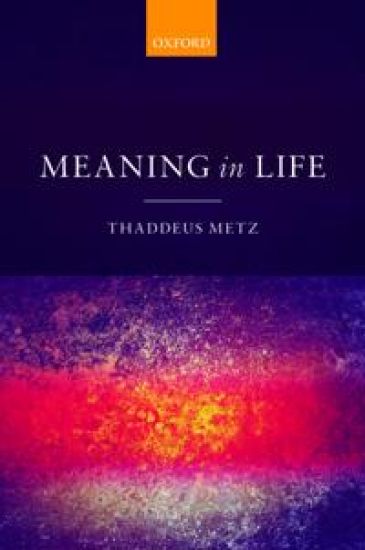
What makes a person's life meaningful? Thaddeus Metz offers a new answer to an ancient question which has recently returned to the philosophical agenda. He proceeds by examining what, if anything, all the conditions that make a life meaningful have in common. The outcome of this process is a philosophical theory of meaning in life. He starts by evaluating existing theories in terms of the classic triad of the good, the true, and the beautiful. He considers whether meaning in life might be about such principles as fulfilling God's purpose, obtaining reward in an afterlife for having been virtuous, being attracted to what merits attraction, leaving the world a better place, connecting to organic unity, or transcending oneself by connecting to what is extensive. He argues that no extant principle satisfactorily accounts for the three-fold significance of morality, enquiry, and creativity, and that the most promising theory is a fresh one according to which meaning in life is a matter of intelligence contoured toward fundamental conditions of human existence.
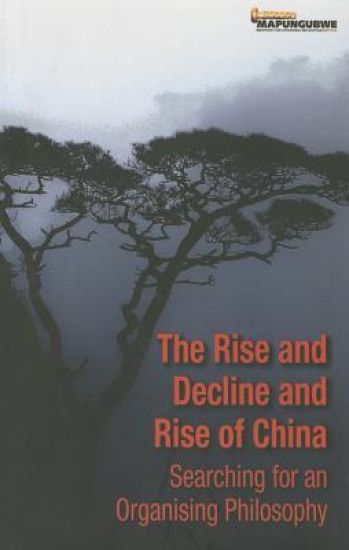
The Rise and Decline and Rise of China
Ross Anthony; Kevin Bloom; Daouda Cissé; Martyn Davies; Hester du Plessis; Maxime Lauzon-Lacroix; Garth le Pere; Thaddeus Metz; Richard Poplak; Gauhar Raza
Real African Publishers Pty Ltd
2015
nidottu
Running like a red thread through this book are the manifestations of Sino-African relations dating back many centuries. In this way, The Rise and Decline and Rise of China: Searching for an Organising Philosophy takes forward the work MISTRA conducted on the Mapungubwe society, one of the advanced states that existed in southern Africa some 800 years ago, and which enjoyed trade relations with China and other centres in the East. Mapungubwe rose and fell, long before European colonial incursions. Other states emerged in the vicinity, but they also suffered the same fate. When do southern Africa and Africa at large rise again? Are there lessons that the continent can draw from the experience of the Chinese people? If – beyond material considerations – religion, culture and ideology do play a role in the rise, decline and resurgence of a civilization, what are the similarities and contrasts between these regions? Of course, such research cannot ignore the fundamental questions: whence does the current system of social, economic and political relations in China draw its resilience, how adaptable is it, and is it sustainable? As the outcome contained in this book demonstrates, a research exercise of this kind can only be exploratory. It serves merely as a genesis to work that should find new legs. What makes this research report unique, though, is that the treatment of these issues has been undertaken primarily from an African perspective.
What makes a person's life meaningful? Thaddeus Metz offers a new answer to an ancient question which has recently returned to the philosophical agenda. He proceeds by examining what, if anything, all the conditions that make a life meaningful have in common. The outcome of this process is a philosophical theory of meaning in life. He starts by evaluating existing theories in terms of the classic triad of the good, the true, and the beautiful. He considers whether meaning in life might be about such principles as fulfilling God's purpose, obtaining reward in an afterlife for having been virtuous, being attracted to what merits attraction, leaving the world a better place, connecting to organic unity, or transcending oneself by connecting to what is extensive. He argues that no extant principle satisfactorily accounts for the three-fold significance of morality, enquiry, and creativity, and that the most promising theory is a fresh one according to which meaning in life is a matter of intelligence contoured toward fundamental conditions of human existence.