

Kirjailija
Thomas Benjamin
Kirjat ja teokset yhdessä paikassa: 17 kirjaa, julkaisuja vuosilta 1996–2026, suosituimpiin kuuluu Loi de Murphy Principes de Vie Pour Les Enfants. Vertaile teosten hintoja ja tarkista saatavuus suomalaisista kirjakaupoista.
17 kirjaa
Kirjojen julkaisuvuodet: 1996–2026.

Loi de Murphy Principes de Vie Pour Les Enfants
Thomas Benjamin
Independently Published
2026
Nidottu


La Legge Di Murphy Principi Di Vita Per Bambini
Thomas Benjamin
Independently Published
2026
Nidottu


Libro de Chistes de la Ley de Murphy Para Niños de 8 a 12 Años
Thomas Benjamin
Independently Published
2026
Nidottu


Music for Analysis: Examples from the Common Practice Period and the Twenty-First Century
Thomas Benjamin; Michael Horvit; Timothy Koozin
Oxford University Press
2025
nidottu
Offering over 475 pieces of music from the Baroque period to the present, Music for Analysis, Ninth Edition, is the most comprehensive anthology of its kind. The book is organized by music theory concept, so it can easily be linked to any introductory theory course. The authors do not prescribe any system of analysis, allowing individual instructors to follow their own preferences with their students. Ample room for student work eliminates the need for a separate workbook or to purchase score paper.
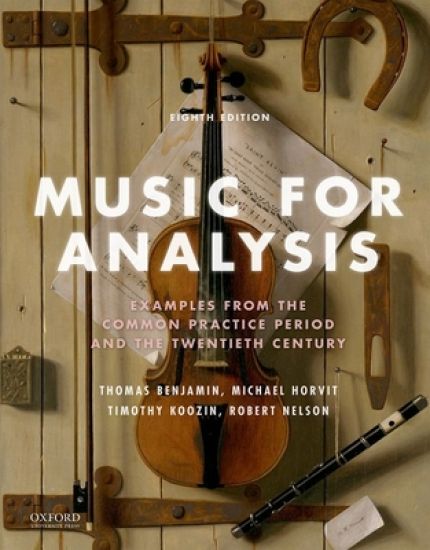
Music for Analysis: Examples from the Common Practice Period and the Twentieth Century
Thomas Benjamin; Michael Horvit; Timothy Koozin
Oxford University Press
2018
kierre
Offering 477 pieces of music from the Baroque period to the present, Music for Analysis, Eighth Edition, is the most comprehensive anthology of its kind. The book is organized by music theory concept, so it can easily be linked to any introductory theory course. The authors do not prescribe any system of analysis, allowing individual instructors to follow their own preferences with their students. Ample room for student work eliminates the need for a separate workbook or to purchase score paper.
First Published in 2003. The Craft of Tonal Counterpoint is an introductory text to the analysis and composition of tonal counterpoint. Using examples from the music of J. S. Bach - the master of this style - the author takes students through a series of carefully graded, cumulative exercises that stress both analysis and writing. Benjamin covers chromaticism and fugal writing in exceptional detail. The exercises cover a wide range of formats, including error detection, linear pitch reduction, analysis and composition. The book also incorporates a 100-page anthology of scores, effective for analysis, in-class performance, and compositional models.
Techniques and Materials of Music
Thomas Benjamin; Michael Horvit; Robert Nelson; Timothy Koozin
Schirmer Books,U.S.
2014
muu
TECHNIQUES AND MATERIALS OF MUSIC, 7th Enhanced Edition covers all the basics of composition--including harmony, melody, and musical form. The authors present essential materials of common-practice music and an overview of 20th century techniques. Numerous hands-on exercises promote readers' memorization and retention of key concepts. Included with every new copy of the print book is access to the new Premium interactive learning website, which delivers a wealth of practical material that will help users better understand musical theory and improve their musical technique.

From 1400 to 1900 the Atlantic Ocean served as a major highway, allowing people and goods to move easily between Europe, Africa, and the Americas. These interactions and exchanges transformed European, African, and American societies and led to the creation of new peoples, cultures, economies, and ideas throughout the Atlantic arena. The Atlantic World provides a comprehensive and lucid history of one of the most important and impactful cross-cultural encounters in human history. Empires, economies, and trade in the Atlantic world thrived due to the European drive to expand as well as the creative ways in which the peoples living along the Atlantic's borders adapted to that drive. This comprehensive, cohesively written textbook offers a balanced view of the activity in the Atlantic world. The 40 maps, 60 illustrations, and multiple excerpts from primary documents bring the history to life. Each chapter offers a reading list for those interested in a more in-depth look at the period.

"The Craft of Modal Counterpoint" is the companion book to Benjamin's "The Craft of Tonal Counterpoint," recently republished in a second edition by Routledge. Modal counterpoint is the style of composition that was employed until the "tonal" revolution pioneered by Bach; it is the basis for most Early Music. Benjamin, a composer and pedagogue, offers a complete analysis of this important musical style. He begins by covering general aspects of the style, then covers in detail two, three, and four-part counterpoint. The Motet, an important form of vocal composition in this period, is studied separately. The book concludes with a brief anthology of key scores, 15 in all, for the student to study further. Also includes 132 musical examples.
"The Craft of Modal Counterpoint" is the companion book to Benjamin's "The Craft of Tonal Counterpoint," recently republished in a second edition by Routledge. Modal counterpoint is the style of composition that was employed until the "tonal" revolution pioneered by Bach; it is the basis for most Early Music. Benjamin, a composer and pedagogue, offers a complete analysis of this important musical style. He begins by covering general aspects of the style, then covers in detail two, three, and four-part counterpoint. The Motet, an important form of vocal composition in this period, is studied separately. The book concludes with a brief anthology of key scores, 15 in all, for the student to study further. Also includes 132 musical examples.
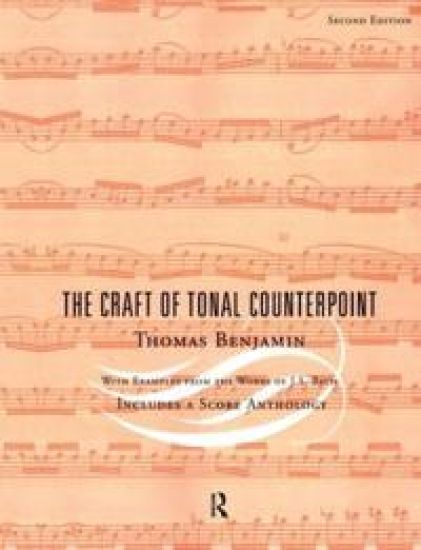
First Published in 2003. The Craft of Tonal Counterpoint is an introductory text to the analysis and composition of tonal counterpoint. Using examples from the music of J. S. Bach - the master of this style - the author takes students through a series of carefully graded, cumulative exercises that stress both analysis and writing. Benjamin covers chromaticism and fugal writing in exceptional detail. The exercises cover a wide range of formats, including error detection, linear pitch reduction, analysis and composition. The book also incorporates a 100-page anthology of scores, effective for analysis, in-class performance, and compositional models.

The 1910 Revolution is still tangibly present in Mexico in the festivals that celebrate its victories, on the monuments to its heroes, and, most important, in the stories and memories of the Mexican people. Yet there has never been general agreement on what the revolution meant, what its objectives were, and whether they have been accomplished. This pathfinding book shows how Mexicans from 1910 through the 1950s interpreted the revolution, tried to make sense of it, and, through collective memory, myth-making, and history writing, invented an idea called "la Revolución." In part one, Thomas Benjamin follows the historical development of different and often opposing revolutionary traditions and the state's efforts to forge them into one unified and unifying narrative. In part two, he examines ways of remembering the past and making it relevant to the present through fiestas, monuments, and official history. This research clarifies how the revolution has served to authorize and legitimize political factions and particular regimes to the present day. Beyond the Mexican case, it demonstrates how history is used to serve the needs of the present.

Chiapas, a state in southern Mexico, burst into international news in January 1994. Several thousand insurgents, given a voice in the communiques of Subcomandante Marcos, took control of the capital and other key towns and held the Mexican army and government at bay for weeks. Proclaiming themselves the Zapatista Army of National Liberation, they captured both land and headlines. Worldwide, people wanted to know the answer to one question: why had revolutionaries taken over a Mexican state? No other study of Chiapas answers that question as thoroughly as does this book. The uprising and government's armed occupation of the state are but the latest violent episodes in a region that is now and has always been a rich land worked by poor people. By studying the impoverishment of the laboring class in Chiapas, Benjamin addresses how the Chiapan elite survived the Revolution of 1910 and remain in control of the state's development and destiny. More clearly than anyone else, Benjamin shows in his new final chapter that the contemporary agrarian uprising is the legacy of Chiapan underdevelopment.