Kirjojen hintavertailu – 12 903 725 kirjaa ja 27 kauppaa

Kirjailija

Thomas Byrne Edsall

Kirjat ja teokset yhdessä paikassa: 8 kirjaa, julkaisuja vuosilta 1985–2026, suosituimpiin kuuluu The Point of No Return. Vertaile teosten hintoja ja tarkista saatavuus suomalaisista kirjakaupoista.

8 kirjaa

Kirjojen julkaisuvuodet: 1985–2026.

The Point of No Return

The Point of No Return

Thomas Byrne Edsall

PRINCETON UNIVERSITY PRESS
2026
pokkari
How Donald Trump laid waste to American politics, culture, and social order After Donald Trump’s rise to power, after the 2020 presidential election, after January 6, is American politics past the point of no return? New York Times columnist and political reporter Thomas Byrne Edsall fears that the country may be headed over a cliff, arguing that the election of Donald Trump was the most serious threat to the American political system since the Civil War. In this compelling and illuminating book, Edsall documents how the Trump years ravaged the nation’s politics, culture, and social order. He explains the demographic shifts that helped make Trump’s election possible, and describes the racial and ethnic conflict, culture wars, rural/urban divide, diverging economies of red and blue states, and the transformation of both the Republican and Democratic parties that have left our politics in a state of permanent hostility. The Point of No Return brings together a series of Edsall’s columns, bookended by a new introduction and conclusion, which show how we got to this dangerous point. These dispatches from our new political landscape chronicle the emergence of what Edsall calls “the not-so-silent white majority” and show how Trump deployed fears about race and immigration to appeal to voters. Edsall examines Trump’s construction of an alternate reality, discusses why we don’t always vote according to our own self-interest, and explores the Democrats’ calibrated response. Considering the 2020 election and its violent aftermath, Edsall looks at the Capitol insurrection and warns that American democracy is under siege. The forces behind Trump’s election, and the “stop the steal” true believers, have pushed the nation to the brink.
The Point of No Return

The Point of No Return

Thomas Byrne Edsall

PRINCETON UNIVERSITY PRESS
2023
sidottu
How Donald Trump laid waste to American politics, culture, and social orderAfter Donald Trump’s rise to power, after the 2020 presidential election, after January 6, is American politics past the point of no return? New York Times columnist and political reporter Thomas Byrne Edsall fears that the country may be headed over a cliff, arguing that the election of Donald Trump was the most serious threat to the American political system since the Civil War. In this compelling and illuminating book, Edsall documents how the Trump years ravaged the nation’s politics, culture, and social order. He explains the demographic shifts that helped make Trump’s election possible, and describes the racial and ethnic conflict, culture wars, rural/urban divide, diverging economies of red and blue states, and the transformation of both the Republican and Democratic parties that have left our politics in a state of permanent hostility. The Point of No Return brings together a series of Edsall’s columns, bookended by a new introduction and conclusion, which show how we got to this dangerous point. These dispatches from our new political landscape chronicle the emergence of what Edsall calls “the not-so-silent white Majority” and show how Trump deployed fears about race and immigration to appeal to voters. Edsall examines Trump’s construction of an alternate reality, discusses why we don’t always vote according to our own self-interest, and explores the Democrats’ calibrated response. Considering the 2020 election and its violent aftermath, Edsall looks at the Capitol insurrection and warns that American democracy is under siege. The forces behind Trump’s election, and the “stop the steal” true believers, have pushed the nation to the brink.
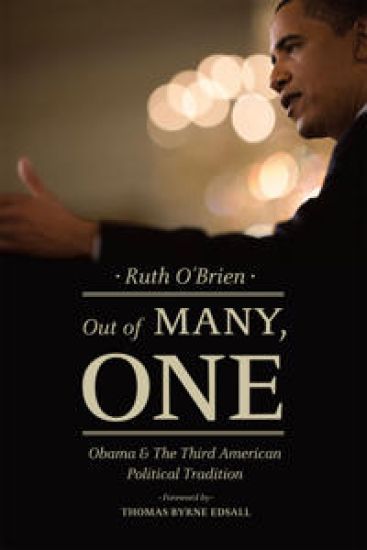
Out of Many, One

Out of Many, One

Ruth O'Brien; Thomas Byrne Edsall

University of Chicago Press
2013
sidottu
Feared by conservatives and embraced by liberals when he entered the White House, Barack Obama has since been battered by criticism from both sides. In "Out of Many, One", Ruth O'Brien explains why. We are accustomed to seeing politicians supporting either a minimalist state characterized by unfettered capitalism and individual rights or a relatively strong welfare state and regulatory capitalism. Obama, O'Brien argues, represents the values of a lesser-known third tradition in American political thought that defies the usual left-right categorization. Bearing traces of Baruch Spinoza, John Dewey, and Saul Alinsky, Obama's progressivism embraces the ideas of mutual reliance and collective responsibility and adopts an interconnected view of the individual and the state. So, while Obama might emphasize difference, he rejects identity politics, which can create permanent minorities and diminish individual agency. Analyzing Obama's major legislative victories - financial regulation, health care, and the stimulus package - O'Brien shows how they reflect a stakeholder society that neither regulates in the manner of the New Deal nor deregulates. Instead, Obama focuses on negotiated rule making and allows executive branch agencies to fill in the details when dealing with a deadlocked Congress. Similarly, his commitment to difference and his resistance to universal mandates underlies his reluctance to advocate for human rights as much as many on the Democratic left had hoped. By establishing Obama within the context of a much longer and broader political tradition, this book sheds critical light on both the political and philosophical underpinnings of his presidency and a fundamental shift in American political thought.
Out of Many, One

Out of Many, One

Ruth O'Brien; Thomas Byrne Edsall

University of Chicago Press
2013
nidottu
Feared by conservatives and embraced by liberals when he entered the White House, Barack Obama has since been battered by criticism from both sides. In "Out of Many, One", Ruth O'Brien explains why. We are accustomed to seeing politicians supporting either a minimalist state characterized by unfettered capitalism and individual rights or a relatively strong welfare state and regulatory capitalism. Obama, O'Brien argues, represents the values of a lesser-known third tradition in American political thought that defies the usual left-right categorization. Bearing traces of Baruch Spinoza, John Dewey, and Saul Alinsky, Obama's progressivism embraces the ideas of mutual reliance and collective responsibility and adopts an interconnected view of the individual and the state. So, while Obama might emphasize difference, he rejects identity politics, which can create permanent minorities and diminish individual agency. Analyzing Obama's major legislative victories - financial regulation, health care, and the stimulus package - O'Brien shows how they reflect a stakeholder society that neither regulates in the manner of the New Deal nor deregulates. Instead, Obama focuses on negotiated rule making and allows executive branch agencies to fill in the details when dealing with a deadlocked Congress. Similarly, his commitment to difference and his resistance to universal mandates underlies his reluctance to advocate for human rights as much as many on the Democratic left had hoped. By establishing Obama within the context of a much longer and broader political tradition, this book sheds critical light on both the political and philosophical underpinnings of his presidency and a fundamental shift in American political thought.
The Age of Austerity

The Age of Austerity

Thomas Byrne Edsall

Anchor Books
2012
pokkari
One of our most prescient political observers provides a sobering account of how pitched battles over scarce resources will increasingly define American politics in the coming years--and how we might avoid, or at least mitigate, the damage from these ideological and economic battles. In a matter of just three years, a bitter struggle over limited resources has enveloped political discourse at every level in the United States. Fights between haves and have-nots over health care, unemployment benefits, funding for mortgage write-downs, economic stimulus legislation--and, at the local level, over cuts in police protection, garbage collection, and in the number of teachers--have dominated the debate. Elected officials are being forced to make zero-sum choices--or worse, choices with no winners. Resource competition between Democrats and Republicans has left each side determined to protect what it has at the expense of the other. The major issues of the next few years--long-term deficit reduction; entitlement reform, notably of Social Security, Medicare, and Medicaid; major cuts in defense spending; and difficulty in financing a continuation of American international involvement--suggest that your-gain-is-my-loss politics will inevitably intensify.
Chain Reaction

Chain Reaction

Mary D. Edsall; Thomas Byrne Edsall

WW Norton Co
1992
nidottu
They have come to intersect with an entire range of domestic issues, from welfare policy to suburban zoning practices. In an explosive chain reaction, a new conservative voting majority has replaced the once-dominant Democratic presidential coalition, and a new polarization has pitted major segments of society against one another. How did this massive power shift occur? Thomas Byrne Edsall of The Washington Post and Mary D. Edsall provide answers in this compelling analysis, cited by Newsweek as "one of the book[s] that shape[d] the debate" in the 1992 presidential campaign.
Power and Money

Power and Money

Thomas Byrne Edsall

WW Norton Co
1990
nidottu
Named by the Boston Phoenix in 1988 one of the top ten political reporters in America, Thomas Byrne Edsall has a special talent for cutting through the camouflage of the political process to reveal power shifts in the U. S. political system. This collection of Mr. Edsall’s newspaper and magazine reporting is grouped into five chapters: “Baltimore and Maryland: Power, Money, Race, and Class—American Politics Writ Small,” “The Conservative Rearmament,” “The Early Years of the Reagan Administration,” “Money and Connections in Washington,” and “Parties in Crisis: The Elusive Majority.”
The New Politics of Inequality

The New Politics of Inequality

Thomas Byrne Edsall

WW Norton Co
1985
nidottu
In the past decade, power controlling the nation's taxing and spending policies has become increasingly concentrated in the hands of the affluent—and exercised for the benefit of the affluent. Traditional liberal beliefs in tax equity and income redistribution have been replaced by theories justifying tax reductions in income concentrated among the very rich. In this book, Thomas Edsall, a Capitol Hill reporter for the Washington Post, examines the new power centers in the Democratic and Republican parties, the corporate lobbying community, and organized labor, and explores the changes in United States politics that have led to the shift in economic policy under Reagan administration.