Kirjojen hintavertailu – 12 859 819 kirjaa ja 27 kauppaa

Kirjailija

Thomas E. Sheridan

Kirjat ja teokset yhdessä paikassa: 6 kirjaa, julkaisuja vuosilta 1992–2014, suosituimpiin kuuluu Where the Dove Calls. Vertaile teosten hintoja ja tarkista saatavuus suomalaisista kirjakaupoista.

6 kirjaa

Kirjojen julkaisuvuodet: 1992–2014.

Last Water on the Devil's Highway

Last Water on the Devil's Highway

Bill Broyles; Gayle Harrison Hartmann; Thomas E. Sheridan; Gary Paul Nabhan; Mary Charlotte Thurtle

University of Arizona Press
2014
nidottu
The Devil's Highway—El Camino del Diablo—crosses hundreds of miles and thousands of years of Arizona and Southwest history. This heritage trail follows a torturous route along the U. S. Mexico border through a lonely landscape of cactus, desert flats, drifting sand dunes, ancient lava flows, and searing summer heat. The most famous waterhole along the way is Tinajas Altas, or High Tanks, a series of natural rock basins that are among the few reliable sources of water in this notoriously parched region. Now an expert cast of authors describes, narrates, and explains the human and natural history of this special place in a thorough and readable account. Addressing the latest archaeological and historical findings, they reveal why Tinajas Altas was so important and how it related to other waterholes in the arid borderlands. Readers can feel like pioneers, following in the footsteps of early Native Americans, Spanish priests and soldiers, gold seekers and borderland explorers, tourists, and scholars. Combining authoritative writing with a rich array of more than 180 illustrations and maps as well as detailed appendixes providing up-to-date information on the wildlife and plants that live in the area, Last Water on the Devil's Highway allows readers to uncover the secrets of this fascinating place, revealing why it still attracts intrepid tourists and campers today.

Arizona

Arizona

Thomas E. Sheridan

University of Arizona Press
2012
nidottu
Hailed as a model state history thanks to Thomas E. Sheridan's thoughtful analysis and lively interpretation of the people and events shaping the Grand Canyon State, Arizona has become a standard in the field. Now, just in time for Arizona's centennial, Sheridan has revised and expanded this already top-tier state history to incorporate events and changes that have taken place in recent years. Addressing contemporary issues like land use, water rights, dramatic population increases, suburban sprawl, and the US-Mexico border, the new material makes the book more essential than ever. It successfully places the forty-eighth state's history within the context of national and global events. No other book on Arizona history is as integrative or comprehensive. From stone spear points more than 10,000 years old to the boom and bust of the housing market in the first decade of this century, Arizona: A History explores the ways in which Native Americans, Hispanics, African Americans, Asians, and Anglos have inhabited and exploited Arizona. Sheridan, a life-long resident of the state, puts forth new ideas about what a history should be, embracing a holistic view of the region and shattering the artificial line between prehistory and history. Other works on Arizona's history focus on government, business, or natural resources, but this is the only book to meld the ethnic and cultural complexities of the state's history into the main flow of the story. A must read for anyone interested in Arizona's past or present, this extensive revision of the classic work will appeal to students, scholars, and general readers alike.
Landscapes of Fraud

Landscapes of Fraud

Thomas E. Sheridan

University of Arizona Press
2008
nidottu
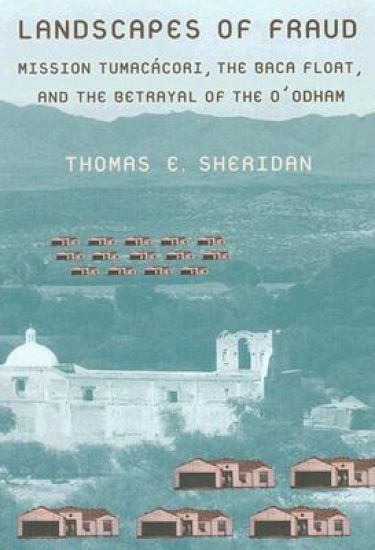
From the actions of Europeans in the seventeenth century to the real estate deals of the modern era, people making a living off the land in southern Arizona have been repeatedly robbed of their way of life. History has recorded more than three centuries of speculative failures that never amounted to much but left dispossessed people in their wake. This book seeks to excavate those failures, to examine the new social spaces the schemers struggled to create and the existing social spaces they destroyed. Landscapes of Fraud explores how the penetration of the evolving capitalist world-system created and destroyed communities in the Upper Santa Cruz Valley of Arizona from the late 1600s to the 1970s. Thomas Sheridan has melded history, anthropology, and critical geography to create a penetrating view of greed and power and their lasting effect on those left powerless. Sheridan first examines how Oodham culture was fragmented by the arrival of the Spanish, telling how autonomous communities moving across landscapes in seasonal rounds were reduced to a mission world of subordination. Sheridan then considers the fate of the Tumacacori grant and Baca Float No. 3, another land grant. He tells the unbroken story of land fraud from Manuel Maria Gandara's purchase of the , bandoned? Tumacacori grant at public auction in 1844 through the bankruptcy of the shady real estate developers who had fraudulently promoted housing projects at Rio Rico during the 1960s and ?70s. As the Upper Santa Cruz Valley underwent a wrenching transition from a landscape of community to a landscape of fraud, the betrayal of the Oodham became complete when land, that most elemental form of human space, was transformed from a communal resource into a commodity bought and sold for its future value. Today, Mission Tumacacori stands as a romantic icon of the past while the landscapes that supported it lay buried under speculative schemes that continue to haunt our history.
Contested Ground

Contested Ground

Donna J. Guy; Thomas E. Sheridan

University of Arizona Press
1998
nidottu
The Spanish empire in the Americas spanned two continents and a vast diversity of peoples and landscapes. Yet intriguing parallels characterized conquest, colonization, and indigenous resistance along its northern and southern frontiers, from the role played by Jesuit missions in the subjugation of native peoples to the emergence of livestock industries, with their attendant cowboys and gauchos and threats of Indian raids. In this book, nine historians, three anthropologists, and one sociologist compare and contrast these fringes of New Spain between 1500 and 1880, showing that in each region the frontier represented contested ground where different cultures and polities clashed in ways heretofore little understood. The contributors reveal similarities in Indian-white relations, military policy, economic development, and social structure; and they show differences in instances such as the emergence of a major urban center in the south and the activities of rival powers. The authors also show how ecological and historical differences between the northern and southern frontiers produced intellectual differences as well. In North America, the frontier came to be viewed as a land of opportunity and a crucible of democracy; in the south, it was considered a spawning ground of barbarism and despotism. By exploring issues of ethnicity and gender as well as the different facets of indigenous resistance, both violent and nonviolent, these essays point up both the vitality and the volatility of the frontier as a place where power was constantly being contested and negotiated.
Where the Dove Calls

Where the Dove Calls

Thomas E. Sheridan

University of Arizona Press
1996
nidottu
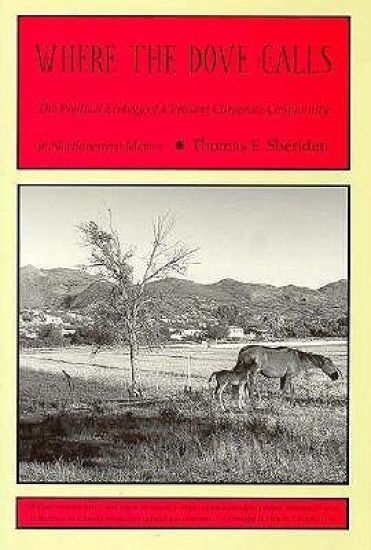
Thomas Sheridan's study of the municipio of Cucurpe, Sonora, offers new insight into the ability of peasants to respond to ecological and political change. In order to survive as small rancher-farmers, the Cucurpenos battle aridity and one another in a society characterized by sharp economic inequality and long-standing conflict over the distribution of land and water. Sheridan has written an ethnography of resource control, one that weds the approaches of political economy and cultural ecology in order to focus upon both the external linkages and internal adaptations that shape three peasant corporate communities. He examines the ecological and economic constraints which scarce and necessary resources place upon households in Cucurpe, and then investigates why many such households have formed corporate communities to insure their access to resources beyond their control. Finally, he identifies the class differences that exist within the corporate communities as well as between members of those organizations and the private ranchers who surround them. Where the Dove Calls (the meaning of "Cucurpe" in the language of the Opata Indians), an important contribution to peasant studies, reveals the household as the basic unit of Cucurpe society. By viewing Cucurpe's corporate communities as organizations of fiercely independent domestic units rather than as expressions of communal solidarity, Sheridan shows that peasants are among the exploiters as well as the exploited. Cucurpei??os struggle to maintain the autonomy of their households even as they join together to protect corporate grazing lands and irrigation water. Any attempt to weaken or destroy that independence is met with opposition that ranges from passive resistance to violence.
Los Tucsonenses

Los Tucsonenses

Thomas E. Sheridan

University of Arizona Press
1992
nidottu
Originally a presidio on the frontier of New Spain, Tucson was a Mexican community before the arrival of Anglo settlers. Unlike most cities in California and Texas, Tucson was not initially overwhelmed by Anglo immigrants, so that even until the early 1900s Mexicans made up a majority of the town's population. Indeed, it was through the efforts of Mexican businessmen and politicians that Tucson became a commercial center of the Southwest. Los Tucsonenses celebrates the efforts of these early entrepreneurs as it traces the Mexican community's gradual loss of economic and political power. Drawing on both statistical archives and pioneer reminiscences, Thomas Sheridan has written a history of Tucson's Mexican community that is both rigorous in its factual analysis and passionate in its portrayal of historic personages.