Kirjailija
Thomas G. Weiss
Kirjat ja teokset yhdessä paikassa: 35 kirjaa, julkaisuja vuosilta 1986–2023, suosituimpiin kuuluu Thinking about Global Governance. Vertaile teosten hintoja ja tarkista saatavuus suomalaisista kirjakaupoista.
Nimi esiintyy myös muodoissa: Thomas G Weiss
35 kirjaa
Kirjojen julkaisuvuodet: 1986–2023.
Seven decades after its establishment, the United Nations and its system of related organizations and programs are perpetually in crisis. While the twentieth-century’s world wars gave rise to ground-breaking efforts at international organization in 1919 and 1945, today’s UN is ill-equipped to deal with contemporary challenges to world order. Neither the end of the Cold War nor the aftermath of 9/11 has led to the “next generation” of multilateral institutions. But what exactly is wrong with the UN that makes it incapable of confronting contemporary global challenges and, more importantly, can we fix it? In this revised and updated third edition of his popular text, leading scholar of global governance Thomas G. Weiss takes a diagnose-and-cure approach to the world organization’s inherent difficulties. In the first half of the book, he considers: the problems of international leadership and decision making in a world of self-interested states; the diplomatic complications caused by the artificial divisions between the industrialized North and the global South; the structural problems of managing the UN’s many overlapping jurisdictions, agencies, and bodies; and the challenges of bureaucracy and leadership. The second half shows how to mitigate these maladies and points the way to a world in which the UN’s institutional ills might be “cured.” Weiss’s remedies are not based on pious hopes of a miracle cure for the UN, but rather on specific and encouraging examples that could be replicated. With considered optimism and in contrast to received wisdom, he contends that substantial change is both plausible and possible.

A singular development in the post-Cold War era is the use of military force to protect human beings. From Rwanda to Kosovo, Sierra Leone to East Timor, and Libya to Côte d? Ivoire, soldiers have rescued civilians in some of the world's most notorious war zones. But what about Syria? Why have we observed the Syrian slaughter and done nothing? Is humanitarian intervention in crisis? Is the so-called responsibility to protect dead or alive? In this fully revised and expanded third edition of his highly accessible and popular text, Thomas Weiss explores these compelling questions. Drawing on a wide range of case studies and providing a persuasive overview of the theory and practice of humanitarian intervention in the modern world, he examines its political, ethical, legal, strategic, economic, and operational dimensions to highlight key debates and controversies. Neither celebratory nor complacent, his analysis is an engaging exploration of the current quandaries and future challenges for robust international humanitarian action in the twenty-first century.
Problems posed by Syria s chemical weapons attacks, Egypt s ouster of an elected government, and myriad other global dilemmas beg the question of whether and how the world can be governed. The challenge is addressing what former UN Secretary-General Kofi Annan called Problems without Passports environmental, economic, humanitarian, and political crises that threaten stability, prosperity, and even human survival. Everything is globalized everything "except" politics, which remain imprisoned behind national borders. The world has changed, but our basic way of managing it has not. We pursue fitful, tactical, short-term, and local responses for actual or looming threats that require sustained, strategic, longer-run, and global actions. With clarity and passion, Thomas G. Weiss argues for a diversity of organizational arrangements some centralized, some decentralized and a plurality of problem-solving strategies some worldwide, some local. He proposes a three-pronged strategy: the expansion of the formidable amount of practical global governance that already exists, the harnessing of political and economic possibilities opened by the communications revolution, and the recommitment by states to a fundamental revamping of the United Nations."
Friends and foes of international cooperation puzzle about how to explain order, stability, and predictability in a world without a central authority. How is the world governed in the absence of a world government? This probing yet accessible book examines "global governance" or the sum of the informal and formal values, norms, procedures, and institutions that help states, intergovernmental organizations, civil society, and transnational corporations identify, understand, and address trans-boundary problems. The chasm between the magnitude of a growing number of global threats - climate change, proliferation of weapons of mass destruction, terrorism, financial instabilities, pandemics, to name a few - and the feeble contemporary political structures for international problem-solving provide compelling reasons to read this book. Fitful, tactical, and short-term local responses exist for a growing number of threats and challenges that require sustained, strategic, and longer-run global perspectives and action. Can the framework of global governance help us to better understand the reasons behind this fundamental disconnect as well as possible ways to attenuate its worst aspects? Thomas G. Weiss replies with a guardedly sanguine "yes".
With some 50 million people living under duress and threatened by wars and disasters in 2012, the demand for relief worldwide has reached unprecedented levels. Humanitarianism is now a multi-billion dollar enterprise, and aid agencies are obliged to respond to a range of economic forces in order to 'stay in business'. In his customarily hard-hitting analysis, Thomas G. Weiss offers penetrating insights into the complexities and challenges of the contemporary humanitarian marketplace. In addition to changing political and military conditions that generate demand for aid, private suppliers have changed too. Today’s political economy places aid agencies side-by-side with for-profit businesses, including private military and security companies, in a marketplace that also is linked to global trade networks in illicit arms, natural resources, and drugs. This witch’s brew is simmering in the cauldron of wars that are often protracted and always costly to civilians who are the very targets of violence. While belligerents put a price-tag on access to victims, aid agencies pursue branding in a competition for 'scarce' resources relative to the staggering needs. As marketization encroaches on traditional humanitarianism, it seems everything may have a priceÑfrom access and principles, to moral authority and lives.
One of the more prolific and influential analysts of multilateral approaches to global problem-solving over the last three decades is Thomas G. Weiss. Thinking about Global Governance, Why People and Ideas Matter, assembles key scholarly and policy writing. This collection organizes his most recent work addressing the core issues of the United Nations, global governance, and humanitarian action. The essays are placed in historical and intellectual context in a substantial new introduction, which contains a healthy dose of the idealism and ethical orientation that invariably characterize his best work. This volume gives the reader a comprehensive understanding of these key topics for a globalizing world and is an invaluable resource for students and scholars alike.
This book provides a succinct but sophisticated understanding of humanitarianism and insight into the on-going dilemmas and tensions that have accompanied it since its origins in the early nineteenth century. Combining theoretical and historical exposition with a broad range of contemporary case studies, the book: provides a brief survey of the history of humanitarianism, beginning with the anti-slavery movement in the early nineteenth century and continuing to today’s challenge of post-conflict reconstruction and saving failed states explains the evolution of humanitarianism. Not only has it evolved over the decades, but since the end of the Cold War, humanitarianism has exploded in scope, scale, and significance presents an overview of the contemporary humanitarian sector, including briefly who the key actors are, how they are funded and what they do with their money analyses the ethical dilemmas confronted by humanitarian organization, not only in the abstract but also, and most importantly, in real situations and when lives are at stake examines how humanitarianism poses fundamental ethical questions regarding the kind of world we want to live in, what kind of world is possible, and how we might get there. An accessible and engaging work by two of the leading scholars in the field, Humanitarianism Contested is essential reading for all those concerned with the future of human rights and international relations.
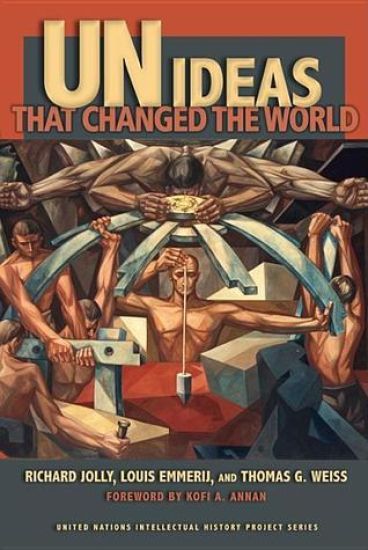
UN Ideas That Changed the World
Richard Jolly; Louis Emmerij; Thomas G. Weiss; Kofi A. Annan
Indiana University Press
2009
pokkari
Ideas and concepts have been a driving force in human progress, and they may be the most important legacy of the United Nations. UN ideas have set past, present, and future international agendas in many global economic and social arenas and have also led to initiatives and actions that have improved the quality of human life. This capstone volume draws upon findings of the other 14 books in the acclaimed United Nations Intellectual History Project Series. The authors not only assess the development and implementation of UN ideas regarding sustainable economic development and human security, but also apply lessons learned to suggest ways in which the United Nations can play a fuller role in confronting the challenges of human survival with dignity in the 21st century.
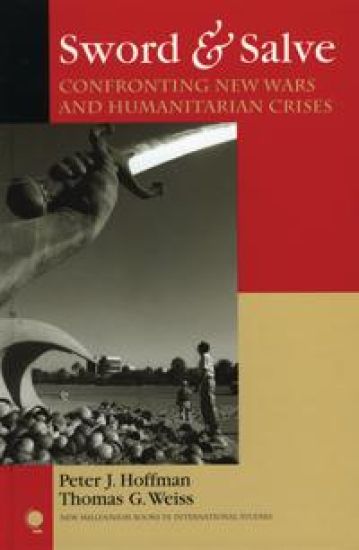
Arguing forcefully that changing times are a clarion call for new thinking, this book convincingly shows that if humanitarian organizations continue to operate as they have in the past, they will fail to help the very victims whom they try to save. Focusing especially on the emergence of 'new wars,' Hoffman and Weiss insist that humanitarian organizations must recognize that they live in a political world and that their actions and goals are invariably affected by military action. The brand of warfare that erupted in the 1990s-marked by civil or transnational armed conflicts featuring potent non-state actors, altered political economies, a high proportion of civilian casualties, and a globalized media-produced horrors that shocked consciences and led humanitarian agencies to question their unyielding stance of neutrality and impartiality. Indeed, in a departure from earlier norms and practices, some have reinvented their policies and tools and created 'new humanitarianisms.' This authoritative book traces the evolution of the international humanitarian system from its inception in the 1860s, parses the dynamics of war and emergency response from the 1980s through the current disasters in Afghanistan and Iraq, and provides a strategic roadmap for practitioners. By bringing historical perspective to bear, this volume provides an invaluable analytical framework for grasping the nature of humanitarian crises and how agencies can respond strategically rather than reactively to change. Students will find its blend of clearly presented theory and case studies a powerful tool for understanding the roles of state and non-state actors in international relations. By charting the tides of continuity and change, this book will prepare agencies to dodge both figurative and actual bullets that threaten humanitarian action at the outset of the millennium.
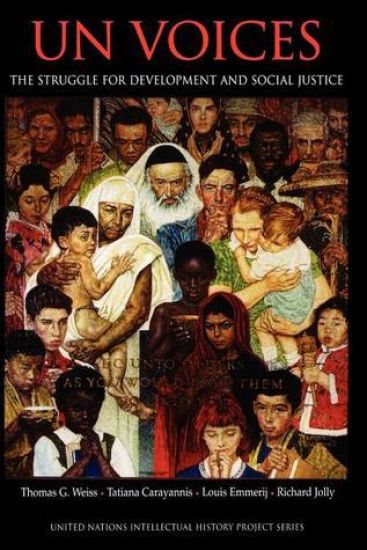
UN Voices
Thomas G. Weiss; Tatiana Carayannis; Louis Emmerij; Richard Jolly
Indiana University Press
2005
pokkari
"The authors have cajoled, intrigued, or reassured their 73 'voices' into telling a fascinating story of the UN and its institutions, which is also a story of 73 individual lives, of women and men . . . with their own complicated histories of emigration and education, family relationships and professional choices, hopes and successes." —from the Foreword by Emma Rothschild "Far from being a distant bureaucracy, the UN is composed of individuals who are reshaped by vital experiences. UN Voices gives international civil servants human faces and shows how ideas drive the grand experiment. It is a fascinating book." —Arthur Schlesinger, Jr. UN Voices presents the human and moving stories of an extraordinary group of individuals who contributed to the economic and social record of the UN's life and activities. Drawing from extensive interviews, the book presents in their own words the experiences of 73 individuals from around the globe who have spent much of their professional lives engaged in United Nations affairs. We hear from secretaries-general and presidents, ministers and professors, social workers and field workers, as well as diplomats and executive heads of UN agencies. Among those interviewed are noted figures such as Kofi Annan, Boutros Boutros-Ghali, Alister McIntyre, Conor Cruise O'Brien, Javier Pérez de Cuéllar, and Kurt Waldheim, as well as many less well known UN professional men and women who have made significant contributions to the international struggle for a better world. Their personal accounts also engage their contributions in dealing with such events and issues as the UN's founding, decolonization, the rise and fall of the Berlin Wall, human rights, the environment, and September 11, 2001.